


Rule of thumb: if your presale messaging would survive being copy-pasted onto a completely different kind of token, it isn't actually saying anything. Swap the chain name on an L1 roadmap for a memecoin's and nothing should still fit. The exception is early-stage social tokens, where identity and technology genuinely are the same pitch, and even there you can usually tell within the first week which half of the audience cares about the code and which half just likes the meme.
Most presale guides don't test for this because they're built around one funnel: countdown timer, KOL wall, FOMO copy, repeat. That funnel isn't wrong, it's incomplete, because it assumes every buyer is making the same kind of bet. A lot of crypto marketing teams reading this already sense the mismatch without having named it, and the pattern driving crypto presale marketing psychology comes down to one question: what does this specific buyer need to believe before they act?
Crypto Presale Marketing Psychology: the Numbers
An L1 buyer converts on roadmap specificity and named adoption proof, a memecoin buyer converts on cultural belonging paired with explicit risk language, and an RWA buyer converts on legal and custodial transparency. Running all three through the same countdown-and-KOL funnel burns the trust each one actually needs to act.
| Category | What the buyer is underwriting | What actually converts | What kills trust fastest |
| Layer-1 | A multi-year technical and ecosystem bet | Roadmap specificity, developer activity, named adoption | Unverifiable throughput claims |
| Memecoin | A cultural identity with known downside | Community voice, clear risk language | Hiding paid promotion |
| RWA | A legal claim on an off-chain asset | Issuer transparency, redemption terms, data provenance | Vague custody or legal structure |
Scope and channel mix scale from this table, not from a fixed budget. Start with the proof your category needs most, prove you can deliver it credibly in one channel, then widen the mix once that evidence is published and holding up under scrutiny.
Why One Presale Funnel Fails
A single funnel fails because it optimizes for the one thing all three buyer types share, wanting to act before the window closes, while ignoring what's actually different between them. What each one needs to believe before they act at all is not the same question twice.
An L1 buyer's decision horizon is long. They're asking whether the chain matters in three years, whether the developer ecosystem thickens or stalls. A countdown timer tells them nothing about any of that.
It can even read as a signal the project doesn't expect scrutiny to survive past launch week. A memecoin buyer's horizon is short, and that's fine, because they know the odds going in.
What they're underwriting is identity and community, not a five-year thesis, so urgency copy genuinely fits how they decide. The failure mode here isn't urgency, it's dishonesty about what's actually being sold.
An RWA buyer sits in between on time but carries the heaviest proof burden of the three. They're evaluating whether a legal entity will honor a claim on an asset they can't inspect directly, which is due diligence, not an impulse purchase. Messaging that treats it as one costs you the only buyers who were ever going to hold past the first dip.
Run all three through the same funnel and the result is predictable. The L1 buyer leaves because the page reads like a memecoin, the memecoin buyer gets bored by compliance language nobody asked for, and the RWA buyer walks because nothing on the page answers the question they came with.
Layer-1 Message Architecture
Layer-1 presale messaging answers a technical question before an emotional one, because the buyer you want is evaluating infrastructure, not vibes. Lead with the roadmap, the developer ecosystem, and named adoption evidence, and treat performance numbers as claims that need sourcing, not applause lines.
Start with the roadmap itself, specific about sequencing: mainnet dates, upgrade phases, which features ship before token generation and which come after. A vague roadmap reads as a placeholder to anyone who's watched a chain slip its own deadlines twice.
Developer ecosystem signals matter more here than almost anywhere else in crypto, because they're the leading indicator a technical buyer actually trusts. Grant programs, hackathons, live testnet activity, named integration partners, all of it does more work than a Discord member count.
Adoption evidence is the strongest card you can play, provided it's real and named. Circle's Arc testnet launched with more than 100 institutional participants, including BlackRock, Visa, Goldman Sachs, AWS, Coinbase and Kraken, named individually rather than described as "major institutions."
That's the bar a technical buyer measures you against. Not a claim of institutional interest, a list they can check themselves.
Performance claims need their conditions attached, every time. A throughput figure with no context, mainnet or testnet, real load or synthetic benchmark, gets picked apart in public, and the correction travels further than the original claim ever did.
Decentralization is worth addressing head-on. If validator distribution is currently concentrated, say so, and lay out the plan to change it; a technical audience respects an honest trajectory more than a polished claim that falls apart under five minutes of block-explorer scrutiny.
Trade-offs deserve the same honesty. Every L1 trades off somewhere between throughput, decentralization and cost, and naming yours as a deliberate engineering decision reads as competence, not confession.
Memecoin Message Architecture
Memecoin presale messaging works when it leads with culture and identity rather than impersonating a technology pitch, and it survives longer when it states the risk plainly instead of hoping nobody asks. The buyer already knows the odds; what they're deciding is whether this community is one worth joining.
Culture and identity come first because they're the actual product. The meme, the voice, the in-jokes, the sense of being early, that's what a memecoin buyer is purchasing. Messaging that smuggles in a utility narrative usually just confuses both audiences at once.
Explicit risk boundaries aren't a legal afterthought, they're what makes a community durable rather than disposable. Saying plainly that this is a high-risk, speculative asset costs nothing with a buyer who already understood that, and it's the difference between a community that sticks around after a drawdown and one that scatters.
Community rules are a trust signal in their own right. Published rules, no coordinated pump calls, no fake urgency, moderators who actually moderate, tell a prospective buyer the project isn't just extracting attention and moving on.
Transparent paid promotion is what separates a responsible memecoin campaign from a future enforcement case. The SEC fined Kim Kardashian $1.26 million for touting a crypto asset without disclosing a $250,000 payment behind the post, which is the going rate for treating disclosure as optional. If your crypto influencer marketing program doesn't have a disclosure standard written down before launch, fix that first.
None of this means memecoin marketing has to go soft to stay clean. It means the fun and the disclosure sit side by side, not in competition.
RWA Message Architecture
RWA presale messaging carries the heaviest proof burden of the three, because the buyer is evaluating whether a legal entity will honor a claim on an asset sitting off-chain, not a chain or a culture. Every piece of messaging earns the right to an emotional appeal only after it answers a legal and operational one.
Asset rights need to be stated in plain language before anything else: what, specifically, does the token entitle the holder to, and under what conditions does that entitlement change. Ambiguity here isn't a copywriting flaw, it's the single biggest risk factor an RWA buyer screens for.
Issuer and servicer roles matter because an RWA token usually involves more than one party. BlackRock's BUIDL fund is a useful reference point: a $5 million minimum investment, qualified-purchaser status required under U.S. securities law, and redemptions processed through dedicated infrastructure rather than informally.
That's the level of structural clarity worth matching, whatever your own minimum turns out to be. Legal structure disclosure is where most RWA messaging goes quiet, and where it needs to be loudest.
This is exactly where the guardrail matters: RWA and token-sale obligations vary materially by jurisdiction and by how the asset itself is structured. A general marketing guide cannot responsibly tell you what your structure needs to say, so that determination needs specialized legal review before it reaches a public-facing page, every time.
Redemption and transfer constraints deserve the same treatment as asset rights. Can the token be redeemed for the underlying asset, on what timeline, and are there transfer restrictions a secondary buyer should know about before assuming this trades like any other token?
Data provenance is becoming the differentiator in this category. BlackRock's BUIDL fund integrated Chronicle's asset proof layer in March 2026, giving real-time on-chain attestation of holdings sourced directly from custodian BNY Mellon, rather than a periodic PDF nobody can independently check. Ondo Global Markets launched with over 100 tokenized stocks and ETFs tracking names like Apple, NVIDIA and Tesla, each one standing or falling on the provenance of its underlying data feed.
For any EU-facing RWA offering, sequencing is a legal constraint, not a marketing preference. Under MiCA's marketing rules, communications must be published on the issuer's own website and can't go out before the crypto-asset white paper itself has been published. Build the content calendar around that order, not around a launch date somebody picked before checking.
Choose Channels by Information Need
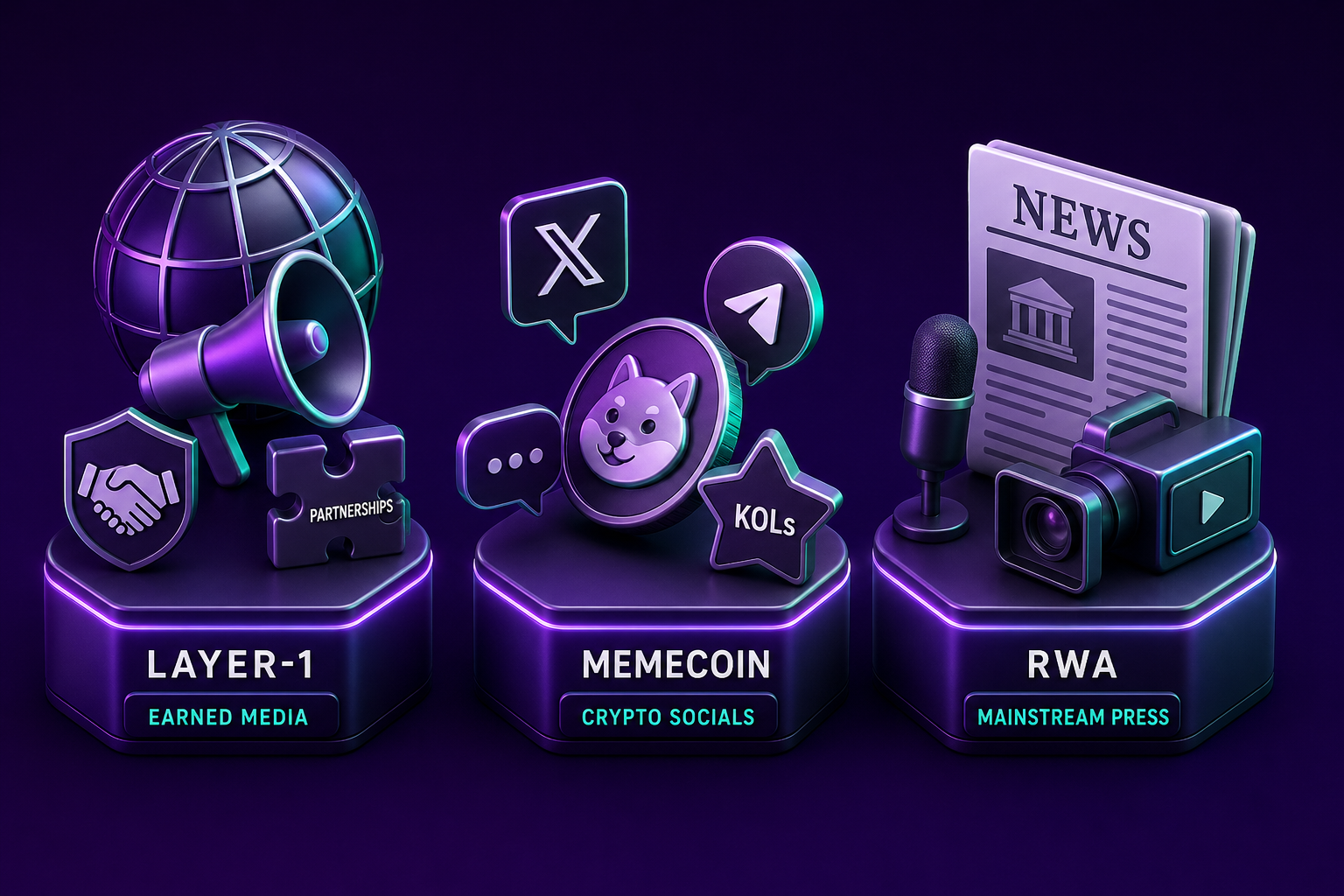
Channel choice should follow the question each audience is actually asking, not a generic media plan ported over from the last launch. Match the format to the proof burden, and most of the guesswork disappears.
- Layer-1: long-form technical documentation, developer-focused content and hackathon coverage, crypto PR placed with outlets a technical reader already trusts, and direct engagement in developer-native community formats.
- Memecoin: fast-moving crypto social media marketing on X and Telegram, community-led content, and influencer placements run through a disclosed, trackable program rather than informal DMs.
- RWA: detailed written disclosure hosted on-site, Web3-focused PR aimed at trade and institutional press, and direct outreach through professional channels where the audience already expects this level of documentation.
The common thread is that the channel should fit the question, not the other way round. Putting an L1's roadmap into a fifteen-second Telegram clip answers nothing, and an RWA custody disclosure belongs nowhere except a page the buyer can bookmark and return to.
Build the Category-specific Trust Hub
A trust hub works because it puts the evidence each buyer group needs in one place they can return to, rather than scattered across a pitch deck, a Discord pin, and a thread someone will eventually delete. Build it before launch, not in response to the first hard question in your Telegram.
For an L1, that hub holds the roadmap with real dates, developer documentation, audit reports, and named ecosystem partners, updated as things change rather than frozen at launch. For a memecoin, it holds the community rules, a plain-language risk statement, and a disclosed list of every paid promotion running alongside the campaign. For an RWA token, it holds the legal structure summary, redemption terms, custodian information, and a clear statement of what the project is not promising.
Limitations belong in the hub too, stated as limitations rather than buried in a disclaimer nobody reads. An L1 should say where its validator set is currently concentrated, a memecoin should say plainly it carries no claim on revenue or decisions, and an RWA project should say exactly what happens to a holder's claim if the issuer becomes insolvent. A source that states its own limits reads as evidence; one that only ever says yes reads as marketing the moment anyone checks it against reality.
Conclusion
None of this is a case for three separate agencies or three unrelated campaigns. It's a case for one crypto presale marketing team that understands the proof burden changes with the product, and builds the message architecture, channel mix and measurement around whichever one you're actually selling.
Don't use the same promise for three different products. Contact Coinpresso to build a category-specific presale message architecture and proof plan before you write a single line of launch copy.
Picture the copy-paste test from the opening again, now that you've seen what it's actually testing for. Run your current presale page through it: swap the token name and category for something else entirely, and see how much of the page still makes sense. If the answer is most of it, you haven't built a message architecture yet, you've built a template, and a template is exactly what the buyer doing real diligence will see straight through.
FAQs
How does Layer-1 presale messaging differ from memecoin marketing?
Layer-1 messaging leads with roadmap specificity, developer ecosystem evidence and named adoption proof, because the buyer is underwriting a multi-year technical bet. Memecoin messaging leads with culture and identity, backed by explicit risk disclosure, because the buyer already knows this is speculative and is deciding whether the community is worth joining.
What makes RWA token messaging higher risk?
The buyer is underwriting a legal claim on an asset they can't inspect directly, so ambiguity about issuer role, redemption terms or custodial structure is the single biggest trust risk in the category. Obligations vary materially by jurisdiction and asset design, which is why any RWA offering needs specialized legal review before the messaging goes public, not after.
Can memecoin marketing be responsible?
Yes, provided the fun and the disclosure run side by side rather than one hiding the other. Plain risk language, published community rules and disclosed paid promotion don't dampen a memecoin campaign; they're what the SEC's $1.26 million settlement over undisclosed touting shows is the actual cost of skipping them.
Which channels suit each token category?
Layer-1 campaigns suit long-form technical documentation, developer content and trade press; memecoins suit fast-moving social formats and disclosed influencer placements; RWA tokens suit detailed on-site disclosure and institutional-facing PR. Our case studies cover how that channel mix is built around a project's actual proof burden rather than a template.
How should a project choose buyer personas?
Start from what the buyer needs to believe before acting, not from a demographic profile. A technical thesis, a cultural identity, and a legal claim attract three different people, and building personas around the proof burden rather than age or income keeps the message architecture honest about who it's actually for.