

A crypto ambassador program involves incentivizing members of a project’s community to represent the project and spread awareness through various social media-focused activities. When planned and executed correctly, these programs can become one of the most effective forms of crypto marketing. However, they are not easy to get right, and when left to chance, they often end up doing more damage than good.
In 2026, the best ambassador programs leverage effective communication from the team, careful selection of ambassadors, and fair incentive systems to build campaigns that strengthen the project’s brand and profile within the crypto community.
This article will explain how successful Web3 projects structure and manage ambassador programs that actually convert. It will also explore real examples from major crypto ecosystems, showing how strong onboarding, KPI tracking, and reward systems help projects scale community growth without turning their ambassador programs into low-quality spam campaigns.
The Evolution of the Web3 Ambassador
Crypto ambassadors have come a long way from the early days of simply shilling tickers in Reddit threads or posting memes linked to a token on X. Today, the role of ambassadors covers several areas, including:
- Educators
Many ambassadors now focus on teaching users how protocols work through guides, videos, tutorials, and onboarding content. This is especially important for DeFi and Layer-1 ecosystems where products can be technically complex. - Community Leaders
Ambassadors often moderate Discord servers, answer questions, manage local communities, and help maintain positive engagement across social platforms. - Content Creators
High-quality ambassadors produce articles, graphics, YouTube videos, podcasts, and social media content that help expand awareness of the project. - Network Builders
Some ambassadors organize IRL events, host local meetups, attend conferences, and connect projects with regional crypto communities and developers.
There has also been a major shift away from anonymous “shilling” culture toward trusted and visible community figures. In earlier crypto cycles, projects often rewarded spam engagement and low-quality promotion. In 2026, trust is far more important. Projects now benefit more from respected ambassadors with genuine influence and credibility than from hundreds of low-quality accounts posting repetitive promotional content.
Solana is a strong example of this shift, with its ecosystem heavily supported by meetup organizers, hacker houses, and developer advocates around the world. TRON has also expanded through regional community leaders and localized ambassador programs that help onboard users into specific markets and languages.
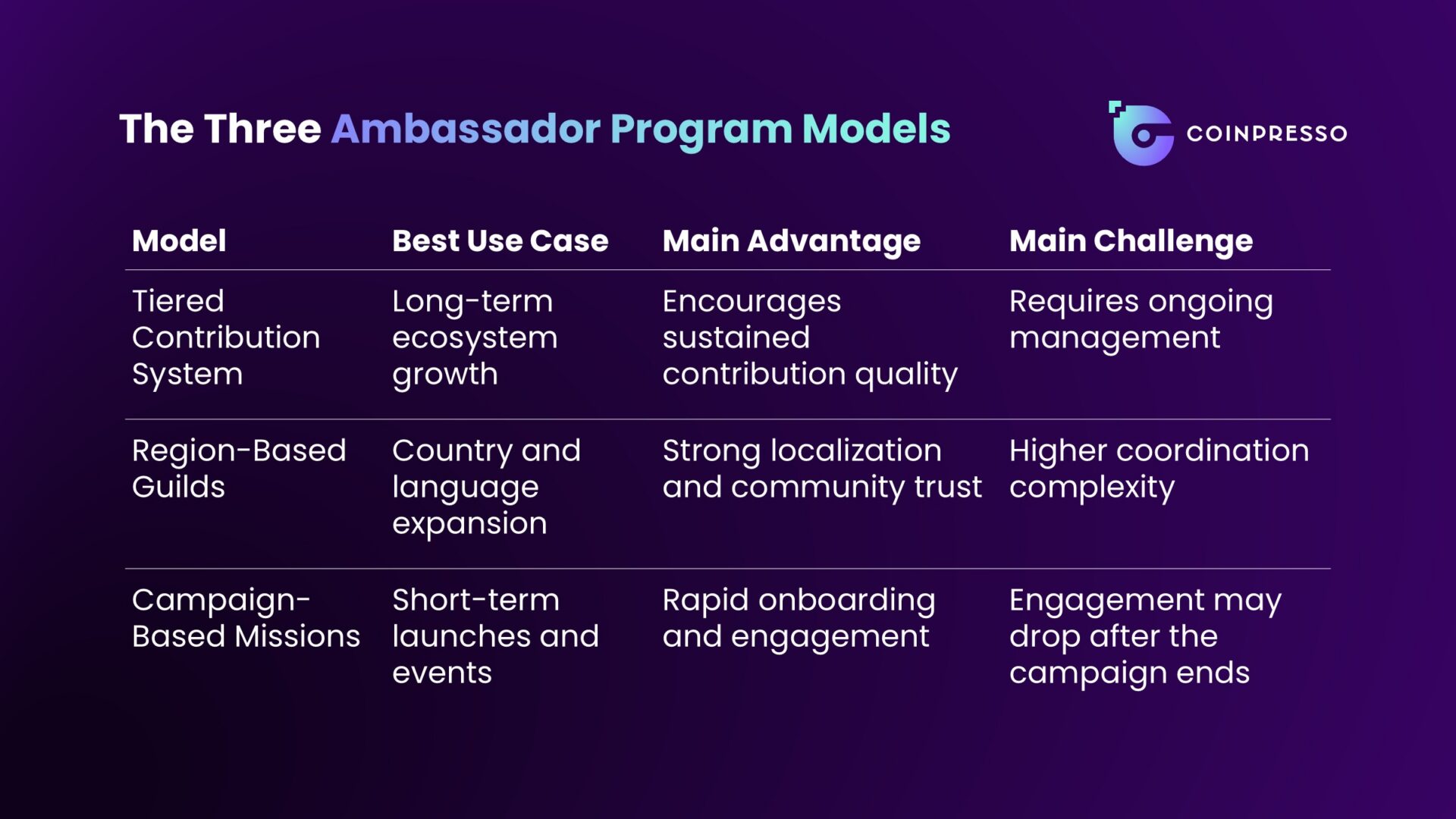
Three Scalable Ambassador Program Models
Model 1: The Tiered Contribution System
The gold standard of ambassador programs in Web3 ambassador strategy is the tiered system. This is especially effective for teams looking to pay incentives based on performance and quality while building their ambassador team quickly.
This structure usually works through progressive levels where ambassadors unlock more rewards and responsibilities over time.
- Best for projects needing content creation
Ambassadors can produce educational articles, videos, memes, and social media posts tied to specific KPIs. - Best for moderation and community support
Higher-tier ambassadors often help manage Discord or Telegram communities and onboard new users. - Best for testing and ecosystem participation
Projects launching testnets or new dApps can reward active users who consistently provide valuable feedback.
A strong example of this model is the Injective Ninja Program linked to Injective. The system rewards contributors for completing ecosystem tasks, educational campaigns, community participation, and content creation tied directly to the INJ ecosystem. Instead of rewarding low-quality spam activity, the structure encourages long-term ecosystem involvement and progression through the ranks.
For example, a DeFi protocol could structure ambassadors into Bronze, Silver, Gold, and Core levels. A Bronze ambassador may only complete social media tasks, while Gold members host community calls, create educational content, and support onboarding. This works well because it creates clear progression, filters out low-effort users, and helps identify long-term community leaders who can eventually become part of the project’s wider growth team.
Model 2: Region-Based Guilds
The region-based model may be best suited to projects looking to target a specific language or country. It can be very useful but arguably requires slightly more involvement, as ambassadors need to be vetted and their locations and linguistic skills assessed carefully.
This model is especially strong for expansion into LATAM, Southeast Asia, and European markets, where local language support and cultural understanding can significantly improve onboarding. A project trying to expand into Spanish-speaking countries, for example, will often benefit far more from local ambassadors creating native content and managing regional communities than from generic English-only marketing campaigns.
Region-based ambassador systems are also highly effective for local events and real-world networking. Major crypto conferences and meetups in places such as Singapore or Buenos Aires create opportunities for ambassadors to represent the project directly within important regional markets.
Ambassadors can host meetups, onboard users, distribute merchandise, create localized content, and strengthen relationships with local traders, developers, and influencers.
Model 3: Campaign-Based Missions
Ambassador programs do not always have to involve long-term commitments from both the team and the ambassadors. For short-term campaigns, it is possible to deploy ambassadors in order to drive short-term growth and engagement.
This model is best for projects needing rapid community activation around specific milestones or product launches.
Best for:
- Testnet launches
- Token generation events
- Product upgrades
- NFT launches
- Exchange listings
Campaign-based missions rely heavily on fast onboarding with very clear objectives and deadlines. Ambassadors need to understand exactly what the campaign requires, how success will be measured, and what rewards are available. This model works particularly well for testnets, where projects may need users to quickly complete wallet interactions, test protocol functions, report bugs, or provide product feedback before a mainnet launch.
Building the Foundation: Onboarding & Training
A simple onboarding PDF is not sufficient for a successful ambassador campaign. Everyone needs to be on the same page, and that means both the team and the ambassadors must understand clearly what the objectives are and how they plan to achieve them.
Many successful Web3 projects now build structured Ambassador Hubs using tools such as Notion. These hubs centralize onboarding materials, campaign updates, task tracking, moderation rules, and communication guidelines so ambassadors can easily access everything they need in one place.
Essential onboarding materials should include:
- Brand guidelines
- Tone of voice documentation
- Product explainers
- FAQ documents
- Social media rules
- Crisis escalation procedures
- Content creation standards
- Role definitions and expectations
- Reward structures and KPI explanations
These details matter. Ambassador onboarding should be handled carefully with input from all relevant team members, including marketing, community management, product, and leadership teams. A campaign will unravel quickly if the onboarding process has not covered all the bases and guaranteed that ambassadors understand both the product and the wider objectives of the campaign.
Setting KPIs and Tracking Success
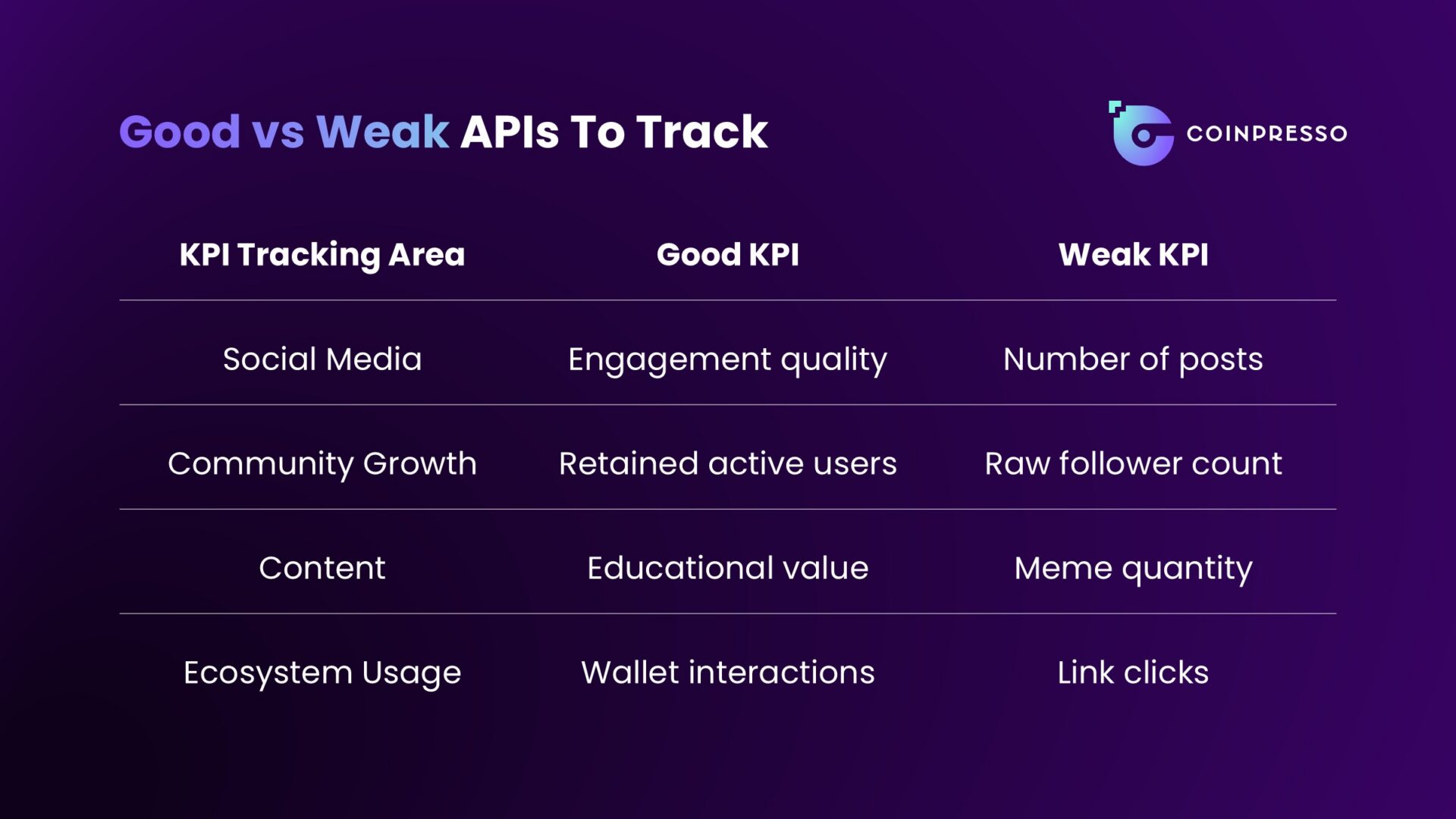
If you are measuring the number of times an ambassador posts on X or replies to Elon Musk’s tweets, then the campaign is going to struggle. Vanity metrics are not your ally in this battle for trust and growth.
Focus instead on measurable impact that contributes directly to ecosystem growth and community quality.
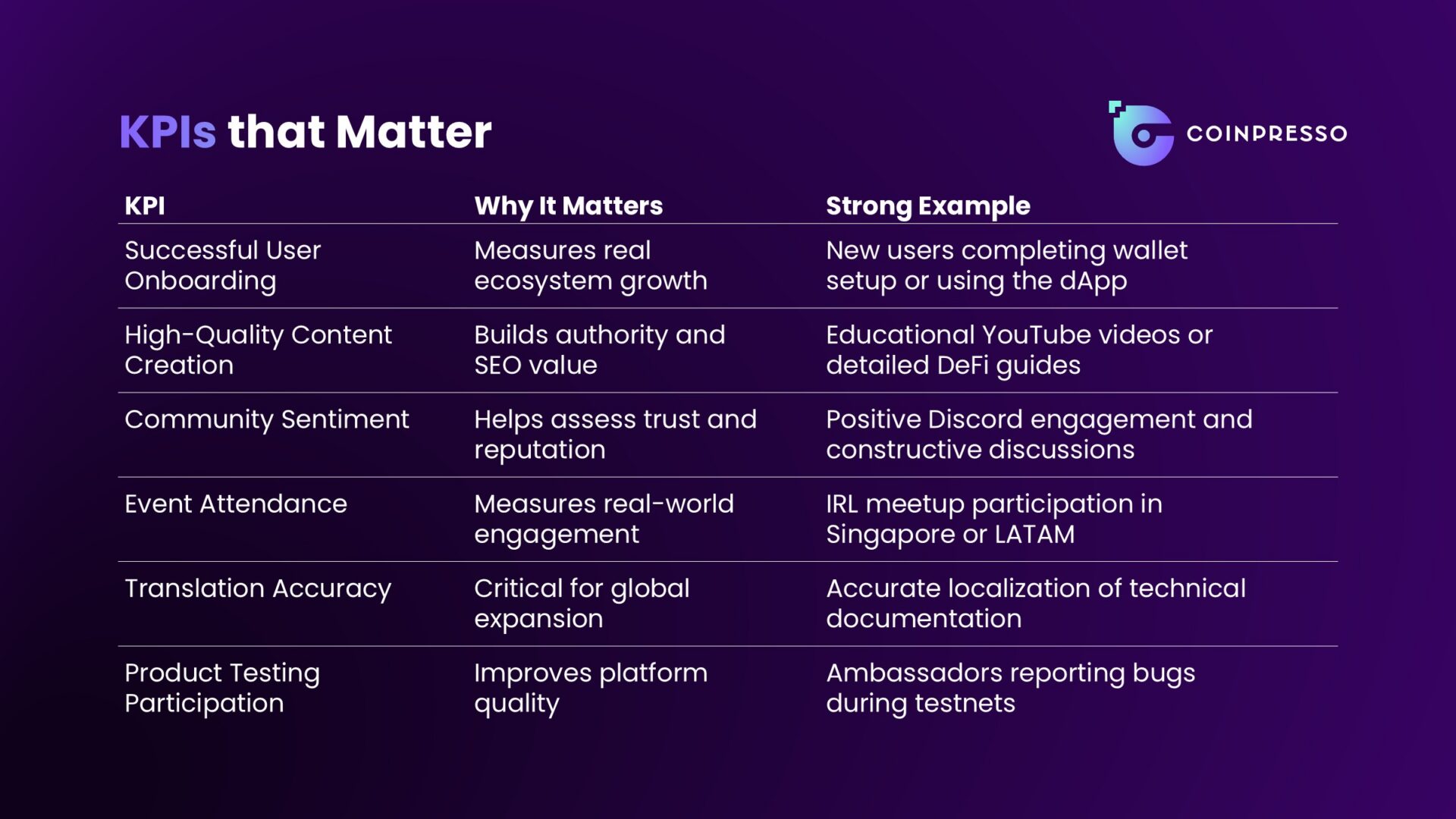
Useful tracking platforms include:
- Zealy for gamified task tracking and reward distribution
- Galxe for campaign management and credential-based community engagement
Poor KPI design often creates spam engagement and fake activity. If ambassadors are rewarded purely for post volume or impressions, they will naturally optimize for quantity over quality. This usually leads to repetitive comments, low-value content, and weak community trust rather than meaningful ecosystem growth.
Structuring Fair Rewards & Incentives
For a long time, it was possible to promise ambassadors an NFT or a portion of a project’s token allocation, but as the number of projects failing to gain traction has increased, this is no longer as feasible. Good ambassadors with a history of working hard and getting results now demand a clear and fair rewards system. Although this might make them slightly more expensive, it does improve the chances of high-quality output and generally improves returns.
Financial Rewards
Many projects now combine stablecoin payments with vested token rewards. Stablecoins provide immediate value and reliability, while token allocations help align ambassadors with the long-term success of the ecosystem. Performance bonuses tied to specific KPIs can also help improve contribution quality.
Access-Based Rewards
Some ambassadors are more motivated by access than direct payments. Early beta access, whitelist spots, governance participation, direct communication with the core team, and involvement in strategic discussions can all create stronger long-term engagement.
Status & Recognition
Recognition remains important in Web3 communities. Exclusive Discord roles, public acknowledgments, merchandise, event access, and ecosystem visibility can strengthen loyalty and encourage ambassadors to remain active within the project.
A good example is the Edel Finance ($EDEL) testnet campaign, which incentivizes users and ambassadors through rewards paid in on-chain stocks. This creates a clearer and more tangible value proposition compared to vague future token promises.
Final Thoughts on Web3 Ambassador Strategy
A successful Web3 ambassador strategy must be well planned and attract effective operators. This requires extremely careful planning from the crypto marketing team behind the project. The documents must clearly cover objectives, explain what sort of tone and content ambassadors should be using, and provide a clear rewards system that will encourage leading ambassadors to join the campaign and stick around for the long term.
Frequently Asked Questions
How much should I pay a crypto ambassador?
This depends heavily on the quality and experience of the ambassador. Smaller projects may start with rewards worth a few hundred dollars per month, while experienced ambassadors managing regional communities, hosting events, or creating high-quality media can command significantly more. Many projects now combine stablecoins with vested token rewards.
What is the best platform to manage a Web3 ambassador program?
There is no single best option, but many projects use:
- Zealy for task tracking
- Notion for onboarding hubs
- Discord for community management
The best setup usually combines several tools together.
How do I prevent ambassadors from just spamming social media?
The KPI structure is critical. If rewards are based purely on post quantity, ambassadors will naturally optimize for spam. Programs should instead reward measurable impact, such as onboarding users, producing educational content, hosting events, or improving community engagement quality.
Should I require ambassadors to KYC (Know Your Customer)?
This depends on the structure of the program, the type of rewards being distributed, and the regional laws or jurisdictions involved. Some projects may require verification for compliance or payment reasons, while others may not. It is generally best to consult legal and compliance experts before implementing mandatory KYC requirements for ambassadors.
How many ambassadors should a project start with?
Most projects are better starting small with a handful of high-quality ambassadors rather than trying to recruit hundreds immediately. A smaller group is easier to train, manage, and monitor while the onboarding systems and KPI tracking processes are still being refined.