

Fifteen million dollars is what the SEC alleges two outfits funnelled overseas, dressed up as "AI-powered trading platforms," in lawsuits filed against Cryptoaiml Ltd. and TSAI Pro Ltd. in September 2026. Nobody got rich off a chatbot in that story. They got robbed by people who knew exactly how much trust the phrase "AI-powered" buys you right now, and spent it.
That is the real stakes of this piece, not whether ChatGPT will one day slip and name a token. We get a version of this question from founders most weeks, usually right after a competitor's token gets a friendly mention in some AI answer and the Telegram group starts asking why theirs didn't. Will an AI model ever actually tell someone to buy a specific token, and if we invest in crypto generative engine optimization to influence that, how would we even know it worked? The honest answer needs more than a shrug, so this piece sets the scope before anything else: what these models are built to do with an investing question, and what they are flatly not.
The Short Answer: Sometimes, but Do Not Treat It as Advice
Sometimes, yes, a model will name a specific token when you ask it a crypto question. Naming is not recommending, and that distinction is doing nearly all the work in this article.
OpenAI's own Financial Services Terms state its outputs are informational only and do not constitute an offer, solicitation or recommendation to buy, sell or hold a financial product. Independent reporting has described a further tightening of how ChatGPT handles personalized financial guidance, though that account comes from a single secondary source and should be read as reported rather than settled. Anthropic and Perplexity hold a comparable line in their own published terms. None of that stops a model mentioning a token's name, summarizing a whitepaper, or comparing two protocols side by side — and a user skimming fast can mistake any of that for a green light.
This piece stays narrow on purpose. It carries no "best AI coins" list, no price targets, and nothing resembling a prompt trick to get around a model's guardrails. What it does instead is audit response behavior: what a model actually does with a crypto-investing question, category by category, logged and dated rather than remembered from one good chat. Understand what these systems do before you try to influence it.
Untangle “AI Tokens” From “AI for Crypto Research”
"AI crypto" means two different things, and most search results refuse to separate them. An AI token is a tradeable asset tied to an AI-themed project — a coin, in other words. AI for crypto research is software, usually a chatbot, used to analyze or organize information about any crypto asset at all, AI-themed or otherwise.
Both phrases get flattened to "AI crypto" in headlines, so both sit on the same results page and the engines guess which one a searcher actually means. They guess wrong in both directions often enough that it is worth stating plainly rather than assuming the reader already sorted it out.
A listicle of "top AI coins" answers the asset question and tells you nothing about model behavior. A generic "ChatGPT can't predict prices" warning answers the research-tool question with a shrug instead of evidence. This piece sits squarely in the second category: what happens, specifically and observably, when you ask an AI model about buying a crypto asset.
Our entity resolution work for token clients runs into a related confusion nearly every week — a model conflating a client's token with a copycat, a fork, or an unrelated project that happens to share a name. The same blur that separates "AI tokens" from "AI research tools" badly in search results shows up inside model answers about individual projects too.
The Six Common Crypto Question Types
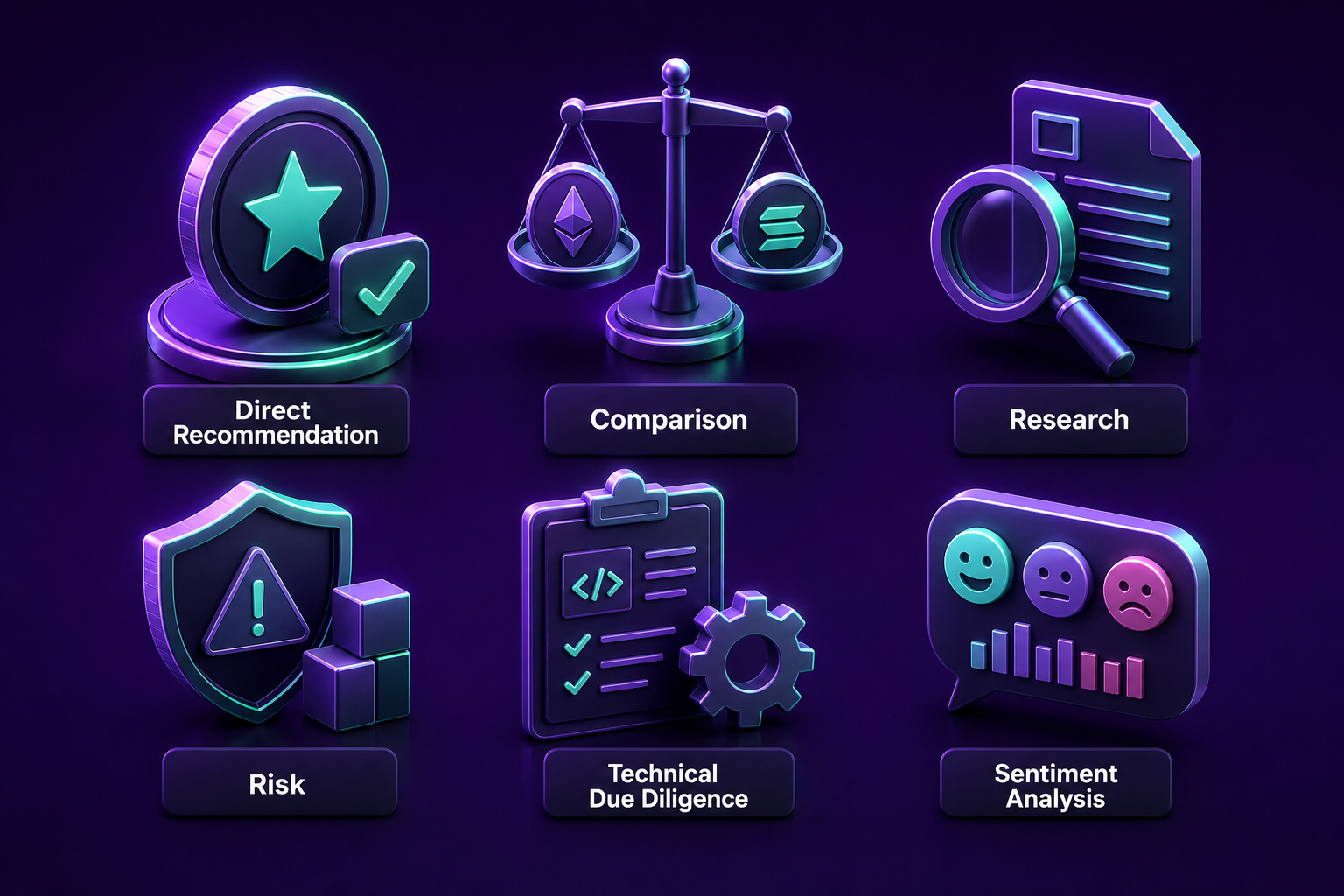
Not every crypto question gets the same treatment from a model, and lumping them together is where most existing commentary falls apart. Sort the questions people actually ask into six categories and a pattern appears fast, like six locks that all happen to need a different key.
- Direct recommendation — "What crypto should I buy right now?" The most guardrail-heavy category, most likely to trigger caveats or an outright refusal to name an asset.
- Comparison — "Is Ethereum or Solana a better long-term hold?" Models usually engage here, laying out criteria rather than declaring a winner.
- Research — "What does this project's tokenomics actually mean?" The most useful category: models are generally willing to explain mechanics in detail.
- Risk — "What could go wrong if I hold this token?" Tends to produce the most consistent, well-structured answers, since risk disclosure sits comfortably inside what these companies' own terms permit.
- Technical due diligence — "How is this protocol's governance structured?" Strong on explaining structure, weaker on confirming a specific claim about a specific project is still current.
- Sentiment analysis — "What is the market saying about this token this week?" Where models are most likely working from stale data or declining outright, since it needs live information most cannot reliably access.
Test all six, not only the "what should I buy" phrasing everyone else tests, and you see how a model's guardrails are actually structured. A model will often stonewall a direct recommendation, then two questions later happily dissect the same two assets under "comparison." That gap between categories is the finding, not a footnote. It is also the single biggest blind spot in every "I asked ChatGPT" article currently ranking for this term, because none of them test more than one category before writing up a verdict.
What a Controlled Model Observation Looks Like
A controlled observation means writing down what you did before you see what the model says, not reconstructing a tidy story afterward from a chat you remember going well. The ordering matters more than it sounds like it should.
Each log entry needs eight fields: the date, the exact model and version, whether the session used a search-enabled or offline mode, the unedited prompt text, any sources the model cited, a classification of the response type, caveats the model volunteered, and any factual errors spotted on review. Skip the date and you cannot tell whether a change in behavior reflects a policy update or ordinary variation between sessions. Skip the exact prompt and nobody can reproduce what you found, which is the biggest weakness in the genre currently dominating this search term.
One widely circulated example in that genre is now itself unreachable: a single chat session naming Stellar, Cardano, Chainlink, Tezos and Neo, run once, with no methodology attached. That rather proves the point about the whole genre better than citing it ever could.
Model behavior is not fixed, which is exactly why the date field matters. Anthropic's own usage policy update, effective September 2025, added human-in-the-loop requirements for high-risk consumer financial use cases of Claude specifically, a rule that did not exist a year earlier. One test run captures one moment against one policy version. Nothing more.
Here's an example of what a logged entry looks like in practice:
| Field | Example entry |
| Date | 2026-10-14 |
| Model / version | Claude, web interface |
| Mode | Search-enabled |
| Prompt | "Should I buy [Token X] right now?" |
| Sources cited | None |
| Response type | Refusal with educational redirect |
| Caveats volunteered | Volatility, no personalized advice, suggests independent research |
| Factual errors | None observed |
A single row proves nothing. A taxonomy of rows, run consistently across question types and models and over time, starts to look like evidence rather than anecdote.
The LLM Crypto Response Map
We call the finished version of that taxonomy the LLM Crypto Response Map, a classification system for what a model actually does with a crypto question, independent of which token gets named. A handful of response behaviors recur often enough to earn their own row rather than a paragraph of description.
| Response category | What to measure |
| Educational explanation | Does it explain the concept accurately and cite current sources where relevant? |
| Comparison | Does it name decision criteria, risks, eligibility and differences rather than pick a winner without context? |
| Risk framing | Does it identify volatility, custody risk, fraud risk or regulatory uncertainty where appropriate? |
| Direct recommendation / refusal | Does it avoid or caveat personalized, prescriptive or predictive language? |
| Unsupported assertion | Does a claim go unsupported, stale, misattributed or conflated with another token entirely? |
| Citation behavior | Does it name a source at all, and is that source current? |
Mapping output against these categories tells you something a single transcript never will: where a model is confident, where it hedges, and where it is simply guessing and dressing the guess up in a nice suit. A model that cites sources reliably on research questions but goes quiet on sentiment questions is telling you exactly where its real-time limits sit, and that is worth more than ten transcripts of someone asking it to pick a winner.
This is observational content, built to understand response patterns. It is not an investment-recommendation engine, and it is not a method for finding the phrasing that bypasses a model's safety language. If your team is trying to game this map rather than understand it, you have missed what it is for.
Where Models Help—and Where They Fail
Models earn their keep at exactly two things here: summarizing dense material fast, and generating the list of questions a serious researcher should be asking next. Both are real, unglamorous value. Neither is a substitute for doing the actual work.
Hand a model a whitepaper and ask it to flag the token distribution mechanics, and it usually does that competently. Ask it what questions you should put to a project's team before committing capital, and it often produces a sharper list than a rushed human would on a first pass.
Ledger's own educational content lands on the same framing, describing LLMs as a research copilot rather than an oracle. It is a sensible way to think about where the genuine value sits.
Where models fail is just as consistent, and worth stating plainly instead of hedging around. They cannot reliably forecast numbers: price, volume, anything time-sensitive and probabilistic. CryptoNews makes this point well in its own coverage, noting that ChatGPT can't place trades directly and often lacks real-time price data.
They also cannot assess your personal financial circumstances, because they do not know them and are not built to ask. A generic risk disclosure is not a suitability assessment, however well it reads.
That gap between what a model says and what is actually true for your situation is where a joint investor alert from the SEC, NASAA and FINRA earns its place in this piece. It warns that bad actors are exploiting AI's popularity to lure investors into scams, including unregistered platforms claiming an AI edge they cannot substantiate. A chatbot summarizing a whitepaper accurately and a platform guaranteeing returns through "proprietary AI" are not the same category of thing. Conflating them is exactly how people get hurt.
A Safer Research Workflow for Users
Start with primary sources, not the summary of them. A model's description of a project's tokenomics is a second-hand account of a document you can read yourself in twenty minutes.
Check disclosures and contract addresses directly against the project's own channels and a block explorer, rather than trusting a model's recollection of either. Models can conflate one project with a similarly named one, and a contract address is the one detail with no room for approximation.
- Read the project's own documentation before asking a model anything about it
- Verify the contract address independently, against the project's own channels
- Use the model only to generate a due-diligence question list
- Cross-check anything it cites against the source it actually names
- Treat risk-framing answers as a checklist to verify yourself, not a finished assessment
That final question, whether to commit money, sits with you, your own risk tolerance, and ideally a professional adviser if the sum involved warrants one. Perplexity's own enterprise terms are explicit on this, instructing users not to rely on outputs for investment or financial advice of any kind and to verify accuracy against the sources cited.
None of this is distrust for its own sake. It is treating an LLM as what Ledger calls a research copilot and nothing more — excellent at organizing a question, poor at bearing the weight of a decision it was never built to carry.
What Token Teams Should Learn From This
If you run a token project, the lesson is not "find a way to get recommended." It is "make sure the model has accurate, dated material to work with when it describes you," which is a completely different and far more durable goal.
Technical documentation, risk disclosures, tokenomics breakdowns and governance structures should all be written clearly enough that a model summarizing them gets the summary right. That is a content and clarity problem, and it is one we solve for clients through crypto content built specifically to be parsed accurately, not just skimmed once by a human.
What does not work, and what we will not build for a client, is manufacturing the appearance of safety or consensus. Seeding fake endorsements, dressing marketing copy up as a safety disclosure, or engineering the exact phrasing that nudges a model toward a favorable mention — all of it is a fast way to get your project cited as a cautionary tale rather than a trustworthy one. A model citing your own site back to a user is only as valuable as what actually holds up on that site when someone checks.
The honest framing is a documentation problem with an audit layer on top, not a persuasion problem. That is closer to what our crypto SEO and GEO work actually does for clients than anything resembling advice-generation, and it is the only version of "getting AI on your side" that survives the next policy update.
Conclusion
Go back to that fifteen million dollars. It did not vanish because a chatbot recommended a token. It vanished because people were persuaded an AI system could guarantee an outcome no honest one ever claims to, and nobody checked that claim against a primary source before the money moved.
That is the whole argument in one line. AI models can describe a token accurately, compare two projects fairly, and flag the risks worth thinking about, and that is genuinely useful. What they cannot do, and what no credible provider claims they do, is tell you what to buy. The work worth doing, for a researcher asking the question and for a token team hoping to be described well, is making sure the accurate version of the story is the one a model has to work with. If AI answers are confusing your project with speculation, your best response is better evidence, not louder hype — ask Coinpresso for an AI-search content accuracy audit.
FAQs
Can ChatGPT predict which crypto will rise?
No reliable consumer-facing LLM should be treated as a price-prediction tool. It can help structure research but cannot validate a forecast or replace due diligence, which is why our case studies focus on accurate description rather than promised outcomes.
Why might an AI name a token when asked what to buy?
The model may be summarizing available information or responding to wording in the prompt. That appearance is not a recommendation, endorsement, or suitability assessment, whatever it reads like in the moment.
Can AI help research a crypto project?
It can help formulate questions, summarize supplied material, and compare disclosed information side by side. Users should still verify claims against primary sources and consider professional advice for personal decisions.
What is the difference between an AI token and AI used in crypto research?
An AI token is an asset associated with an AI-related project. AI research tools are software used to analyze or organize information about any crypto asset, regardless of theme.
How should a token team optimize for this type of query?
Focus on accurate, dated, technical and risk documentation, never on manufacturing endorsements or presenting AI output as financial advice. Contact Coinpresso if you want a second set of eyes on how your project is currently being described.