

Most founders treat "TikTok banned crypto ads" as a settled fact and move on, either writing the whole platform off or quietly running ads through a creator's personal account and hoping nobody notices. Both reactions are wrong, and they are wrong for the same reason: TikTok doesn't have one crypto policy, it has three, and they point in different directions depending on whether you're buying an ad, briefing a creator, or just posting.
A lot of crypto marketing teams reading this already know that a licensed exchange can apply for paid placement, while a token sale almost never can. Run your crypto Google Ads or TikTok eligibility checks against the same questions, because the gates are structural, not creative. Organic education content about either is usually fine, right up until it strays into a promise about returns, at which point it stops being a platform problem and becomes a legal one. This piece separates those three surfaces properly, tells you where your offer actually sits, and builds out what a compliant TikTok program looks like once you've stopped asking the wrong question.
Separate Paid, Creator, and Organic Activity
TikTok does not apply one crypto rule across the app. It runs three separate policy regimes stacked on top of each other like a three-lock door, and conflating them is the single most common reason crypto teams either over-restrict themselves or get flagged for something they didn't realize was covered.
Paid ads sit under TikTok's financial services advertising policy, which names cryptocurrencies, exchanges, trading platforms and NFTs directly. It sets eligibility bars most crypto offers cannot clear without a licensing review and a direct application through a TikTok Sales Representative.
Branded content is different again. Anything a creator posts in exchange for payment or product, disclosed through TikTok's own tool, falls under a separate Branded Content Policy that bars prohibited-industry promotion and bans false or misleading claims, regardless of whether a paid-ad campaign is even running.
Plain organic posting, the stuff nobody pays for, sits under Community Guidelines. That's the lightest-touch of the three, but it is not a free pass — it is still subject to local financial-promotion law the moment a claim strays toward an investment outcome, which the next section covers in full.
The practical consequence: your paid-ads rejection tells you nothing about whether a creator can post about you, and a creator's green light tells you nothing about whether your own organic account can say the same thing. Each surface gets evaluated on its own terms, which means your channel strategy has to be built three times, not once.
Classify the Crypto Offer
Before you touch TikTok's policy pages, work out what you're actually selling, because the eligibility bar moves enormously depending on the answer. A licensed exchange, a non-custodial wallet, a token sale, pure education content and a software product are five different cases with five different outcomes.
Exchanges and custodial wallets sit at the top of the difficulty curve for paid media. TikTok's own financial services policy permits these ads only where the advertiser holds the relevant license, applies directly through a TikTok sales representative rather than the self-serve ad platform, and restricts delivery to audiences aged 18 and over. That's a real path, but it is slow, gated, and not available through standard campaign setup.
Token sales sit in a worse spot, not because TikTok has banned them outright in writing, but because no documented licensing pathway exists for presale or token-sale promotion anywhere in TikTok's current policy. The absence of a route is the policy. In practice, that means most token launches should plan around paid ineligibility rather than gamble a media budget on finding an exception nobody else has found.
NFTs occupy a narrower middle ground. Ads are permitted provided they never frame the NFT as an investment vehicle or imply guaranteed returns, a distinction that sinks a lot of NFT ad creative before it's even submitted.
Pure educational content — explaining how blockchains work, what a wallet does, how staking functions mechanically — tends to clear review more easily across all three surfaces because it isn't selling a financial outcome. Software and infrastructure products that don't custody funds or sell a token sit closer to a standard SaaS ad than a financial product, which is often the most underused distinction in this whole conversation. Know which of these five buckets you're actually in before you build a media plan around an assumption.
Check Paid-ad Eligibility First
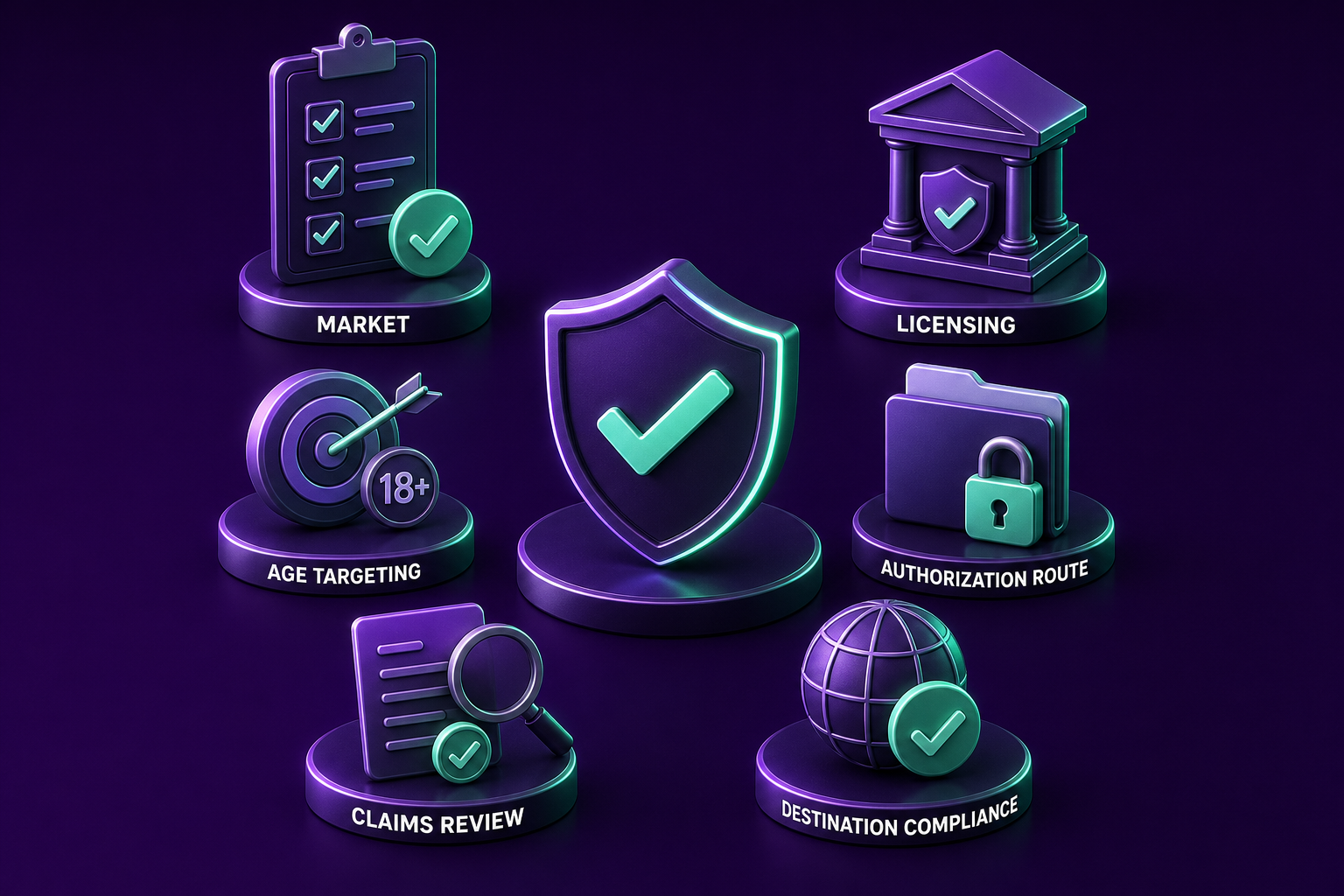
Run this eligibility check before you write a single piece of ad creative, because the gating questions are structural, not creative, and no amount of good scripting fixes a disqualified account type. This is the order TikTok actually reviews in.
- Market — financial services ad rules vary by country, and crypto advertising is restricted or unavailable entirely in a meaningful share of markets TikTok operates in
- Licensing — exchange and wallet advertisers need a verifiable license in the markets they're targeting before TikTok will even route the application to a sales representative
- Age targeting — financial services ads, where permitted, are restricted to users 18 and over as a baseline, non-negotiable floor
- Authorization route — crypto financial services ads are not available through TikTok's self-serve platform; they require direct application and sales-rep sign-off
- Claims review — any implication of guaranteed, fixed or assured returns disqualifies creative outright, for exchanges and NFTs alike
- Destination compliance — the landing page an ad sends traffic to gets reviewed too, and a page making claims the ad itself avoided can still sink approval
If your offer fails any one of these, the honest move is to stop optimizing the ad account and start building the channel that's actually open to you. Review your crypto PPC options against this checklist before committing media budget anywhere, because the same gating questions apply whether you're planning TikTok, Meta or Google spend.
Build Compliant Content When Paid Is Unavailable
When paid is closed, the instinct is to treat organic as a consolation prize. It isn't — it's a different channel with its own ceiling, and the content that performs on it looks nothing like repurposed ad creative.
Brand and product education travels well because it doesn't ask for anything. Think explainers on what your protocol does, how a transaction actually settles, what problem the token mechanically solves. None of that triggers the same review scrutiny as a return promise, because there isn't one to make.
Developer-facing content works for the same reason. A walkthrough of an SDK or a testnet integration is technical, verifiable, and has no financial claim attached to strip out.
Safety and scam-awareness content is the most underused format in crypto's organic playbook, and it does double duty. It builds trust with an audience that has been burned before, and it demonstrates the account is operating in good faith rather than skirting the edge of what's allowed.
Community-facing formats round out a program that gives an audience real reasons to stick around without ever needing an ad account at all: AMAs, build updates, behind-the-scenes development content. For teams structuring this across TikTok, Shorts and Reels together, a crypto short-form video strategy built around these formats outperforms one built around a single platform's quirks.
Never Call Organic a Loophole
This is the part some corners of the clipping and creator economy keep getting wrong, and it's worth saying plainly: organic content is not a backdoor around TikTok's ad rules. Treating it that way is how a project ends up in genuine regulatory trouble rather than just a rejected ad.
Branded content rules apply to creator posts whether or not a formal ad campaign exists alongside them, which means a disclosed partnership promoting a prohibited offer is a policy violation regardless of spend. Community Guidelines apply to every account regardless of whether a post is paid, meaning fraud and deception protections don't switch off just because nobody bought reach.
Underneath both of those sits something bigger than platform policy: financial promotion law applies to the claim being made, not the medium carrying it. The UK's Financial Conduct Authority is explicit that its rules apply to firms marketing cryptoassets to UK consumers regardless of the technology or platform used, and that includes ordinary social posts with no ad spend behind them. Its finalised guidance confirms those rules are platform-agnostic, applying equally to a paid campaign and an unpaid post from an unauthorized "finfluencer."
The scale of the problem is not theoretical. A compliance analysis of high-traffic crypto promotion posts found that 89% breached FCA financial promotion guidelines, with 43% of the TikTok posts in that sample missing a risk warning entirely.
Unauthorized promotion of a regulated financial product by someone without FCA approval can constitute a criminal offense carrying up to two years' imprisonment, an unlimited fine, or both. That is not a platform risk you manage with a better caption. It's a legal exposure that organic distribution does nothing to remove, and any vendor telling you otherwise is selling you a liability dressed up as a growth hack.
Measure Safe Channel Outcomes
Without ad spend and the attribution that comes bundled with it, you need a different scorecard, and vanity view counts are the wrong one to reach for. Measure what the channel can actually tell you, which is engagement quality, not reach volume.
| Metric | What it tells you | Why it matters without paid attribution |
| Content completion rate | Whether the explainer or education format is actually landing | Views alone don't show comprehension; watch-through does |
| Site engagement from TikTok referral | Whether interest converts to a real visit, not just a scroll-past | Tells you the content is pulling, not just performing |
| Audience learning signals | Comment quality, repeat questions answered, misconception correction | Shows whether education content is closing knowledge gaps |
| Consented first-party actions | Newsletter signups, waitlist joins, Discord applications | The only conversion event you fully own and can measure cleanly |
*What a safe-channel scorecard tracks when there's no ad account doing the measuring for you.*
None of these promise revenue or token outcomes, and any program built on this channel should be judged against engagement and audience-building goals, not acquisition targets borrowed from a paid campaign. Measurement infrastructure built for a paid funnel doesn't map cleanly onto organic, so design the dashboard for what the channel is actually for before the first post goes live.
Conclusion
The honest version of this story is unglamorous: most crypto offers can't buy TikTok ads, some can under tight conditions, and organic content is a real channel with real rules of its own rather than an escape hatch from either. Here's how that breaks down by offer type and surface, so you can see where you actually sit.
| Offer type | Paid ads | Branded/creator content | Organic posting |
| Licensed exchange / custodial wallet | Possible, via sales-rep application, licensing proof, 18+ targeting | Allowed if disclosed and claims-compliant | Allowed, subject to Community Guidelines and local promotion law |
| Token sale | Not realistically available | High risk, rarely clears review | Allowed for factual updates, not return claims |
| NFT | Allowed if no investment framing or return guarantee | Allowed under the same claims restriction | Allowed, same claims restriction applies |
| Pure education / infrastructure software | Generally available, standard review | Generally available | Generally available |
*The TikTok channel-fit matrix: match your offer type to its row before you brief a single ad or creator.*
Pick your row, and you've got your real channel mix for the next quarter instead of a guess built on a headline about a ban.
Here's the thing you can check tonight, on your own account: pull up your last ten TikTok posts, organic or paid, and ask whether a single one implies a guaranteed or fixed return. If the answer is yes even once, that's not a creative problem, it's the exact exposure this piece has been describing. Coinpresso builds TikTok programs around verified eligibility and compliant crypto content from the start, so founders find that exposure before a launch, not after one.
Build a TikTok plan around verified eligibility and real audience value, not a policy workaround. Contact Coinpresso to assess your paid, creator, and organic channel options.
FAQs
Are crypto ads allowed on TikTok?
Only in narrow cases. Licensed exchanges and custodial wallets can apply through a TikTok Sales Representative and clear a licensing review, but most crypto offers, including the majority of token-related projects, cannot clear eligibility at all.
Are token-sale ads allowed?
No documented licensing pathway exists for token sales or presales in TikTok's current financial services policy, which in practice functions as a block. Budget for organic and creator channels instead of waiting on a paid-ad application that has nowhere to land.
Can creators promote crypto brands?
Sometimes, through disclosed branded content, but the same claims restrictions apply as to paid ads, and financial-promotion law still governs what the creator can say regardless of disclosure. See our crypto influencer marketing page for how disclosure and claims review fit together in practice.
Does organic content avoid TikTok rules?
No. Community Guidelines apply to every account whether or not a post is paid, and jurisdictional financial-promotion law, like the FCA's, applies regardless of the platform or spend behind a post.
What content is safer when paid promotion is unavailable?
Product education, developer walkthroughs, scam-awareness content and community formats such as AMAs carry the lowest risk because none of them make a financial claim that needs to be verified or walked back. Our case studies show how projects have built organic-first programs around exactly this kind of content.