

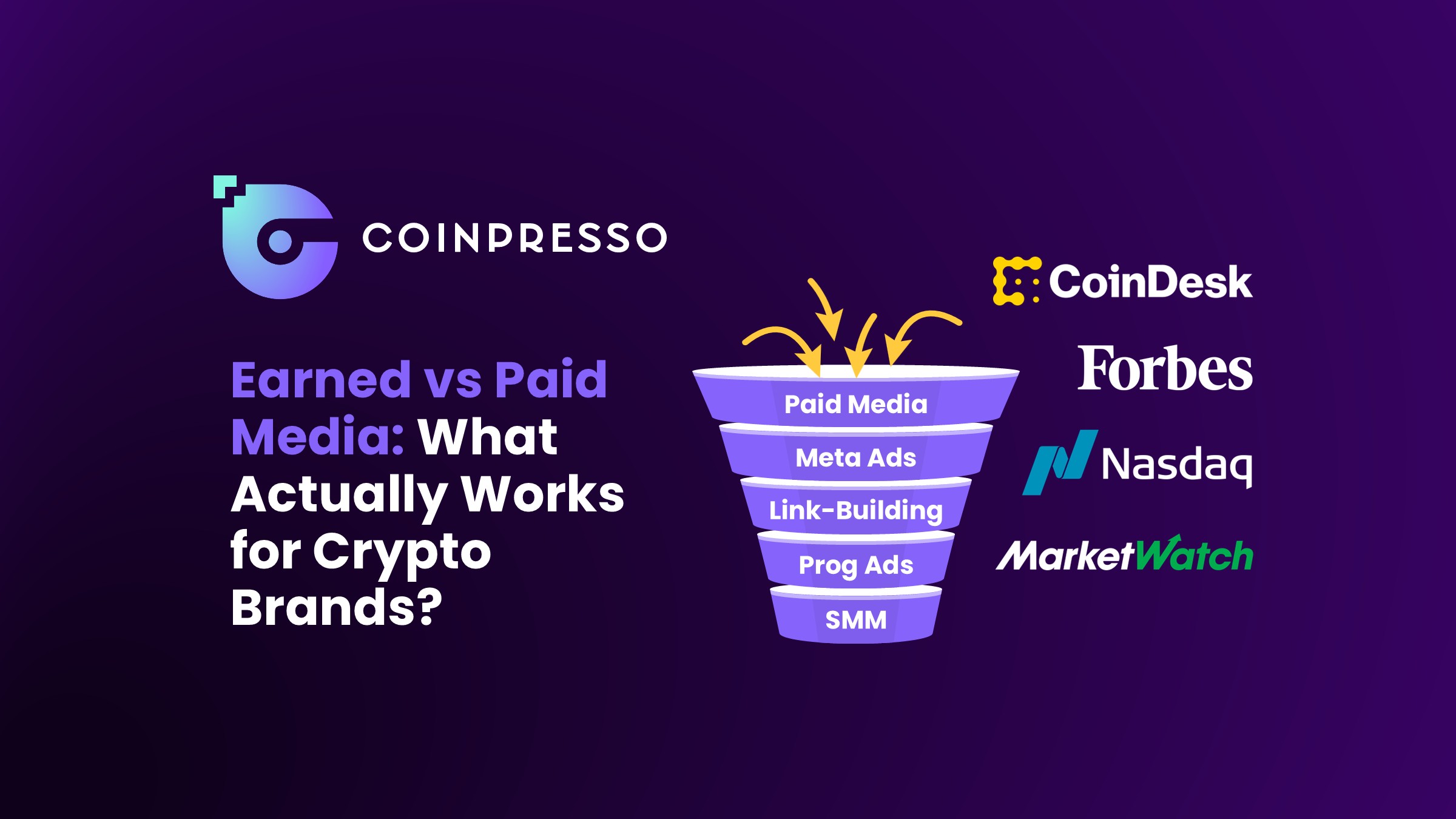
Earned vs paid media crypto marketing is a hot topic for Web3 teams. For projects that have recently launched and have limited budgets, it is often impossible to dedicate enough resources to follow through with both earned and paid media campaigns, so they are forced to make a choice. In some instances, the entire budget is shifted toward trying to earn a single article on a respected outlet, while others decide to fire off dozens of paid articles on lower-authority sites.
Generally, earned media is seen as more valuable. In terms of crypto brand building, an earned article on a leading outlet like CoinDesk or Forbes can be a game-changer. At the same time, these publications are difficult to secure, and relying solely on a handful of earned media publications will likely mean that the crypto brand is not visible much of the time.
Therefore, the best crypto press release distribution strategy will often find a balance between earned and paid media and rely on data-driven decision-making to shift the focus along the way, allowing the team to build authority through major publications while also amplifying traction through crypto advertising strategy, crypto SEO, social media marketing, and paid articles.
The Unique Challenges of Crypto Marketing
Trust and restrictions are two of the biggest barriers in the crypto marketing field in 2026. The trust of the community has been battered by presales that never launched, pump.fun rug pulls, DeFi exploits, and high-profile exchange hacks.
Advertising Restrictions and Crypto Advertising Strategy
Crypto ads are complicated. A solid Meta ads campaign or well-managed programmatic ads strategy can yield healthy results, but due to restrictions and limitations, it can only really be executed by expert teams.
Google Ads has become increasingly strict regarding crypto advertising compliance. In 2026, many crypto advertisers are required to complete certification processes tied to local regulations and licensing requirements before campaigns can even go live. This means even legitimate crypto projects can face delays, disapprovals, or sudden campaign removals if campaigns are not structured correctly.
Meta restrictions on crypto campaigns have also tightened considerably. Crypto advertisers increasingly require authorization, verification, and in some cases, regulatory documentation before ads are approved.
As a result, a crypto advertising strategy can lead to some ads being rejected unexpectedly, accounts can face restrictions, and scaling campaigns globally becomes significantly harder without specialist knowledge.
Ultimately, ads can be removed, spend wasted, and valuable time lost on campaigns that infringe platform-specific regulations and advertising rules.
The Trust Problem
Trust is now the most valuable currency in the crypto market. Its scarcity becomes apparent if you spend a few hours on crypto social media. New projects are often flagged as scams for little to no reason, partly due to the surge in pump-and-dump projects created on launchpads like pump.fun and due to high-profile failures like the recent Aave exploit.
In this environment, ads are not particularly effective at building trust. Everyone knows they are paid for, and they are often associated with presales rather than established projects. As a result, simply running ads is often not enough to build credibility in 2026.
Trust and The Case for Earned Media
Earned media is a powerful trust signal. Random projects launched on pump.fun do not get mentioned by leading financial and crypto outlets, and the community is well aware of this. It shows that a team is serious and that the token or DeFi protocol could potentially become a major player in the industry.
Stronger trust signals are one of the main reasons earned media remains so powerful. A good example is MegaETH, which generated significant attention through coverage from respected crypto publications, including CoinDesk. Appearing in trusted outlets immediately improves how a project is perceived by traders, investors, and the wider market.
Earned media also provides long-term SEO value. Unlike paid ads that disappear once spending stops, earned media placements can continue generating traffic, backlinks, and authority for months or even years. For this reason, earned media should be integrated into a broader crypto SEO strategy focused on building topical authority and long-term search visibility.
Beyond direct trust with the community, earned media also improves E-E-A-T signals. Media mentions and backlinks help strengthen the Experience, Expertise, Authoritativeness, and Trustworthiness of a crypto project, which can improve rankings across crypto search terms.
Adding to the trust-building element of earned media is the syndication effect. A single article can quickly spread across dozens of crypto sites through syndication. The result is improved visibility along with better authority for the site due to its contribution to crypto link building.
The Case for Paid Media
Paid media still has a place in a crypto marketing campaign. However, it is best used alongside earned media as it allows the brand to keep its profile visible in the market even when earned media is moving slowly.
However, it is important that the paid media is of high quality. Articles should be written by expert crypto copywriting teams, and the content must then be amplified across social media channels by crypto community management teams who understand the target audience.
Paid media articles can also be combined with link-building strategies to support broader SEO campaigns while simultaneously gaining exposure across major outlets. Well-placed sponsored content can help strengthen a site's authority while also driving referral traffic and brand awareness.
Paid media is also increasingly linked to Parasite SEO strategies. This involves publishing optimized articles on high-authority domains in order to rank for competitive search terms. For example, a new Layer-2 project may publish paid articles targeting keywords such as “best Layer-2 tokens in 2026” or “fastest Layer-2 cryptos.” Because the content is hosted on powerful domains with existing authority, it often has a stronger chance of ranking quickly in Google search results.
Crypto ads should only really be deployed by expert teams that understand platform restrictions, regional compliance rules, and crypto-specific advertising limitations. Poorly managed campaigns can quickly lead to rejected ads, account restrictions, and wasted spend.
More importantly, ads should generally accompany earned media rather than replace it. Running ads linked to respected media coverage, founder interviews, or third-party articles creates significantly stronger trust signals than simply blasting out generic banner ads or token promotions across social media and ad networks.
The Amplification Strategy
So, the answer to earned vs paid media in crypto is a bit of both. However, the question of exactly how these two forms of crypto marketing work together is what really needs to be answered before a team dives into marketing.
Earned media is primarily used to build trust, while paid promotions such as programmatic ads, paid articles, and crypto influencer marketing tools are then used to amplify its impact. Instead of relying on ads alone, projects can use paid media to push trusted third-party coverage in front of a much larger audience.
For this example, we will look at a newly launched DeFi protocol where users can lend stablecoins at high rates.
- The project launches and secures an earned article on CoinDesk discussing the protocol and its lending model.
- The article is then shared organically across X, Discord, Telegram, and Reddit communities.
- The team launches paid programmatic ads and social promotions, directing users toward the earned article rather than directly to the protocol.
- Crypto influencers discuss the media coverage and explain the protocol to their audiences.
- Users who engage with the article are retargeted later through paid campaigns promoting tutorials, onboarding guides, and staking opportunities.
This strategy works because it reduces skepticism toward ads through high-trust earned media. Instead of users seeing a random ad for an unknown DeFi protocol, they first encounter coverage from respected media outlets. This improves the value of every dollar spent on paid promotion because users already have some level of trust before interacting with the ads.
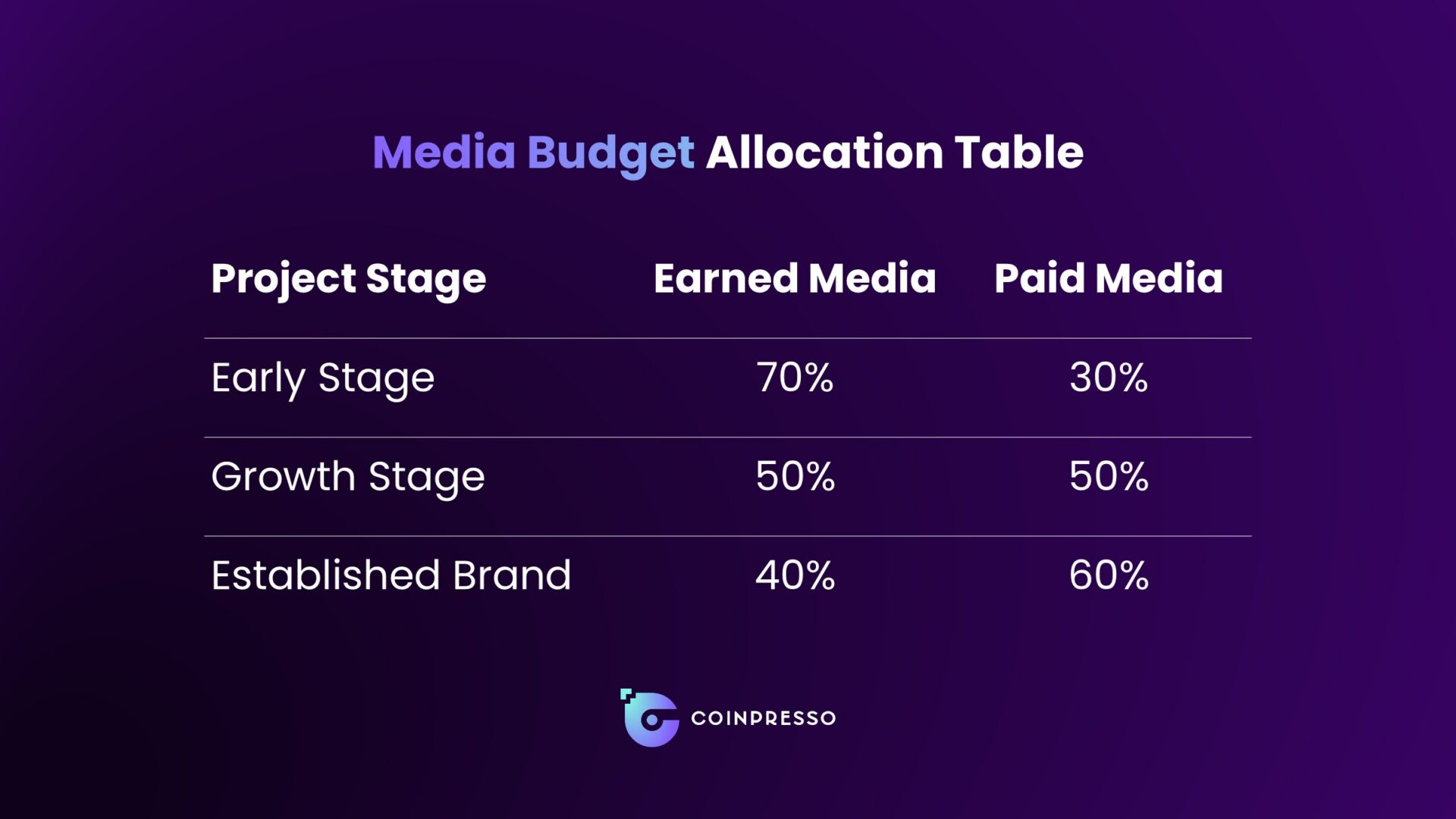
In terms of budget allocation, strategies will vary across projects. The best move is to get a consultation from a crypto marketing agency like Coinpresso. However, the table below shows a rough estimate of how budgets are usually planned across the three major growth stages.
Measuring Success Across Both Channels
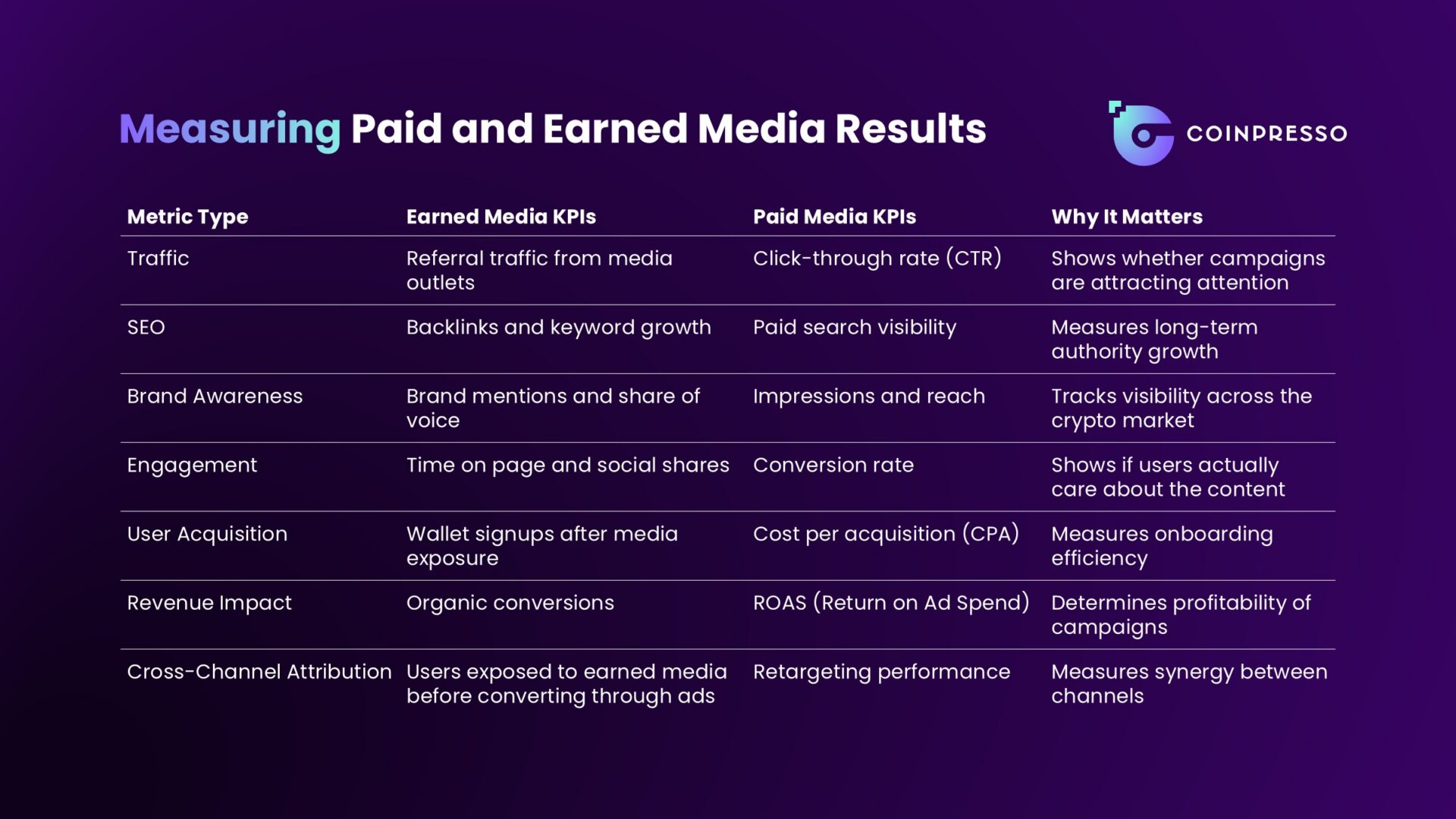
Measuring the success of earned and paid media campaigns requires effective data gathering and analysis. Without actionable reports, teams cannot make careful adjustments to improve campaign performance over time.
A strong example is programmatic advertising, which can be difficult to manage but offers extremely valuable data if the team has the expertise to collate it and organize it into useful reports that guide future marketing decisions.
Final Thoughts on Earned vs Paid Media Crypto
There is no clear winner in the earned vs paid media crypto marketing debate. The most successful marketing teams leverage both simultaneously to amplify the trust created by earned media. This amplification relies on social media, ads, and paid article placements working together.
When done correctly, a well-organized campaign can maximize the value of earned media, turning articles into more than one-off success stories and instead using them to build crypto brands into market leaders. Ultimately, earned media alone is not enough, while paid media alone will not build trust, so both must be combined to maximize the impact of marketing budgets.
FAQs
Why are my crypto ads being rejected on Google and Meta?
Most rejections happen due to financial compliance issues, restricted jurisdictions, unrealistic claims, or missing advertiser verification and certification requirements.
What is a realistic Customer Acquisition Cost (CAC) for a crypto project?
CAC varies massively depending on the niche. A crypto casino or exchange will often face much higher acquisition costs than a smaller NFT or community-focused project because competition for users is far more aggressive.
How long does it take to see results from earned media?
Earned media is generally a longer-term strategy. Some traffic and visibility can arrive immediately after publication, but the SEO, trust, and backlink value often build over several months.
Can I use paid media to promote my own press releases?
Yes. In fact, this is often one of the smartest uses of paid media. Amplifying earned articles or PR placements through ads and social campaigns usually performs better than directly promoting a token or product.
What percentage of my budget should go to earned vs paid media?
There is no fixed rule. Early-stage projects often lean more heavily toward earned media to establish trust, while larger brands with stronger authority can scale more aggressively through paid campaigns.
Is influencer marketing considered paid media in crypto?
Yes. Paid influencer promotions, sponsored X posts, Telegram campaigns, and YouTube integrations are all forms of paid media and should be tracked carefully for ROI.
Does earned media help with crypto SEO?
Absolutely. Earned media can generate backlinks, improve E-E-A-T signals, increase branded search traffic, and strengthen topical authority across competitive crypto keywords.