


Generative Engine Optimization is a necessity, not a luxury, for crypto projects.
A bold statement, however with the major increase of AI Search use and the rapidly-evolving search landscape, combined with a crypto market that is more saturated than ever with more projects vying for the same investor mindshare—LLM visibility has become a “needs must” for web3 projects instead of a “nice to have”.
AI engines now act as the ultimate trust arbiters, and your Web3 brand needs to get them to buy-in to your project in the form of citations and mentions, in order to cut through the smoke and allow you to access your project's ideal end users.
Over the course of this GEO for Web3 projects guide, we will dive into the proprietary “Crypto GEO Trust Framework” that connects on-chain data verification, regulatory compliance signals, and community sentiment/brand mentions into a unified Crypto GEO strategy for 2026.
Let’s dive in!
The $80B SEO Market Crack
For over a decade, crypto search engine optimization revolved around one objective: ranking first on Google.
In 2026, that objective is no longer enough. Search behaviour has fundamentally changed.
Investors, developers, journalists, institutions, and retail users are increasingly asking questions directly inside AI platforms rather than opening dozens of browser tabs. Whether someone is researching a Layer-2 protocol, comparing DeFi lending platforms, evaluating a token launch, or investigating regulatory risk, their first interaction is often with an AI model—not a search engine. Goodbye Google, hello ChatGPT, Gemini et al.
This shift has created what many marketers still underestimate: the separation of visibility from rankings.
A project can dominate Google for high-value keywords while remaining almost invisible to large language models. On the flipside, a protocol with relatively modest organic traffic may become the primary recommendation generated by ChatGPT, Gemini, Claude, Perplexity, or future enterprise AI systems simply because it demonstrates stronger authority, consistency, and machine-readable trust signals.
For crypto companies, the implications are even larger.
Unlike traditional SaaS companies, crypto projects distribute information across dozens of disconnected environments:
- Documentation
- GitHub repositories
- Governance forums
- GitBook
- Medium publications
- Discord announcements
- X threads (particularly prominent with the Grok LLM and how crypto projects are mentioned/cited)
- DeFi analytics platforms
- Block explorers
- Community discussions
Traditional SEO was designed for websites. Generative Engine Optimization (GEO) is designed for knowledge ecosystems.
The projects that understand this distinction earliest won't just generate more traffic. They'll become the default answers and subject matter experts to questions that investors are asking.
Why Crypto Is Entering a New Visibility Economy
Over previous crypto marketing cycles, visibility among web3 natives could be purchased through crypto PPC or KOLs, earned through backlinks, or built through years of crypto content production. AI changes the equation drastically.
Large language models don't reward whoever spends the most. They reward whichever project has the best trustflow, is consistently referenced, and semantically complete. This creates an entirely new competitive advantage for projects that move first within their respective niches in Web3.
Instead of competing for Position 1, Organic Clicks, better CTR, or featured snippets—projects are beginning to compete for:
- AI citations
- Recommendation frequency
- Knowledge graph prominence
- Entity confidence
- Model recall
This transition mirrors the early days of SEO in the mid-2000s, if you’ve been in the search game that long you’ll understand this reference. If you haven’t, you’re probably not old enough!
Anyhow, most Web3 businesses probably won't react until they experience declining organic visibility or discover that competitors are becoming the recommended solution inside AI conversations.
By then, the gap may already be difficult to close. This is your warning signal to start taking Web3 GEO & LLM optimization seriously for your crypto project.
How LLMs Evaluate Web3 Projects vs. Web2 Projects
Large language models don't "rank" websites as has been the norm of the last two decades. They synthesise evidence. Every answer generated is effectively a probability calculation built from thousands of independent trust signals collected across the public internet.
That means optimization moves beyond keywords.
Instead, AI evaluates & poses questions such as:
- Is this protocol consistently referenced?
- Does independent evidence support its claims? (High quality, topically-relevant backlinks still remain key here as they always have been in SEO.)
- Are technical documents aligned with marketing?
- Is leadership visible?
- Is the information current?
- Does the project demonstrate regulatory awareness in the geos it operates in?
- Is the ecosystem coherent?
At the same time, the fundamentals of GEO ultimately represent excellent SEO. A backlink and piece of relevant content from Forbes Crypto will do your AI visibility wonders, just as it would do your rankings wonders back in 2015.
While a lot of the rubbish, grey-hat SEO techniques of yester-year have largely been wiped out & made redundant by AI Search, the best SEO specialists & the most trusted crypto brands are ultimately the ones reaping the biggest rewards from GEO.
Reference Rates Replace Click-Through Rates
Search engines measured engagement. LLMs measure consumer and market confidence.
If fifty independent sources consistently reference one protocol when discussing liquid staking, AI becomes increasingly confident that protocol belongs in future responses. The quantity of backlinks matters less than the quality and consistency of references. That distinction is absolutely critical.
Many crypto SEO campaigns historically focused on building thousands of directory links via PBNs (private blog networks) or guest posts. AI systems are considerably better at recognising manufactured or paid/sponsored “authority”.
Instead, they favour repeated independent, organic mentions across:
- Renowned industry publications & your crypto earned media profile
- Academic research
- Developer documentation
- Regulatory sources
- Technical analyses
- Community consensus
- Verified datasets
Reference density has become significantly more valuable than backlink density. Quality over quantity etc.
Why AI Often Favours More Regulated Projects
Crypto exists within an environment where misinformation, scams, rugpulls, exploits, and exaggerated marketing remain common. LLMs attempt to reduce the probability of recommending harmful information.
Thus, projects that clearly demonstrate stronger compliance signals frequently receive higher confidence scores.
Transparent leadership, public legal entities, published audits, licensing disclosures, risk documentation and similar compliance-related docs are still the ultimate currency when it comes to increasing trust and the likelihood of being cited by AIs.
This doesn't mean decentralised projects cannot perform exceptionally well. It means uncertainty reduces confidence. Every missing trust signal creates another reason for an AI model to hesitate before recommending your project.
The Crypto GEO Trust Framework: GEO For Web3 Projects
At Coinpresso, we’ve found that Web3 projects performing well in AI environments typically align across three interconnected trust layers. We had a similar concept for crypto SEO; the three pillars of SEO.
However the three Web3 GEO trust layers ultimately take this concept to a new level. The quality bar is much higher, and sub-standard content marketing tactics will no longer pass the AIO (AI Overview) smell test.
Layer One: Technical Authority
Can the model understand exactly what your protocol does? Is your content well structured both on and off-page with clear silo-ing?
This includes:
- Whitepapers
- GitBook documentation
- GitHub repositories
- API documentation
- SDK references
- Smart contract verification
- Technical architecture diagrams
- Roadmaps
Many crypto projects produce excellent technical documentation. Very few optimise it for AI extraction.
Optimizing any fragmented Web3 architecture (unifying GitHub repos, GitBook docs etc) is the starting point for your crypto GEO strategy in 2026 & beyond as these docs form the entrypoint for AI crawlers into your project ecosystem.
Making them easily crawlable, parsable, and digestible greatly benefits both AIs and users respectively.
For example:
- Documentation should reference the primary domain.
- GitHub should clearly identify the official protocol.
- Whitepapers should reference governance documentation.
- Blog articles should reinforce technical terminology.
- Founder interviews should align with published documentation.
- Token pages should consistently reference official resources.
Consistency dramatically increases machine confidence. Every disconnected property should strengthen—not dilute—the project's identity.
Layer Two: Compliance & Transparency
Models increasingly evaluate organisational legitimacy. This isn’t something that a crypto marketing agency or similar entity can support you with, and falls more within your legal teams remit, senior leadership, or your blockchain developers in conjunction with third party blockchain auditing firms.
Signals include:
- Audit reports (Hacken, Certik etc)
- Regulatory disclosures that are easily parsable by AIs
- Legal documentation
- Terms of service & privacy policies
- Treasury transparency
- Token allocations & general token economy
- Team verification
These aren't simply legal necessities. They're confidence signals for both investors and LLMs.
Layer Three: Market Validation & AI Search Optimization for Blockchain
Finally, AI attempts to understand whether the market itself believes your project matters and ultimately evaluates the efficacy of your crypto marketing efforts across the entire funnel.
These are the components that a Web3 GEO agency can support your project with in order to help improve AI visibility:
- Industry citations
- Conference appearances
- Podcast mentions
- Developer adoption
- GitHub activity
- Media coverage
- Community sentiment
- Academic references
Trust emerges where all three layers overlap.
Projects missing one of these pillars often appear fragmented, even if their technology is exceptional. In a market landscape where 50,000 token launches a day is not uncommon, having a “full-funnel” approach to your Web3 marketing is arguably more important than ever.
Crypto GEO Strategy 2026: Structuring Your Content for AI Extraction
Content written purely for humans increasingly underperforms inside AI systems. That doesn't mean you should start writing robotic articles.
It means making expertise easier to extract. E-E-A-T (Expertise, Experience, Authoritativeness, Trustworthiness) still remains the overarching ideology when it comes to how your content is cited and utilized by LLMs.
The strongest Web3 GEO content generally combines narrative depth with highly structured information architecture.
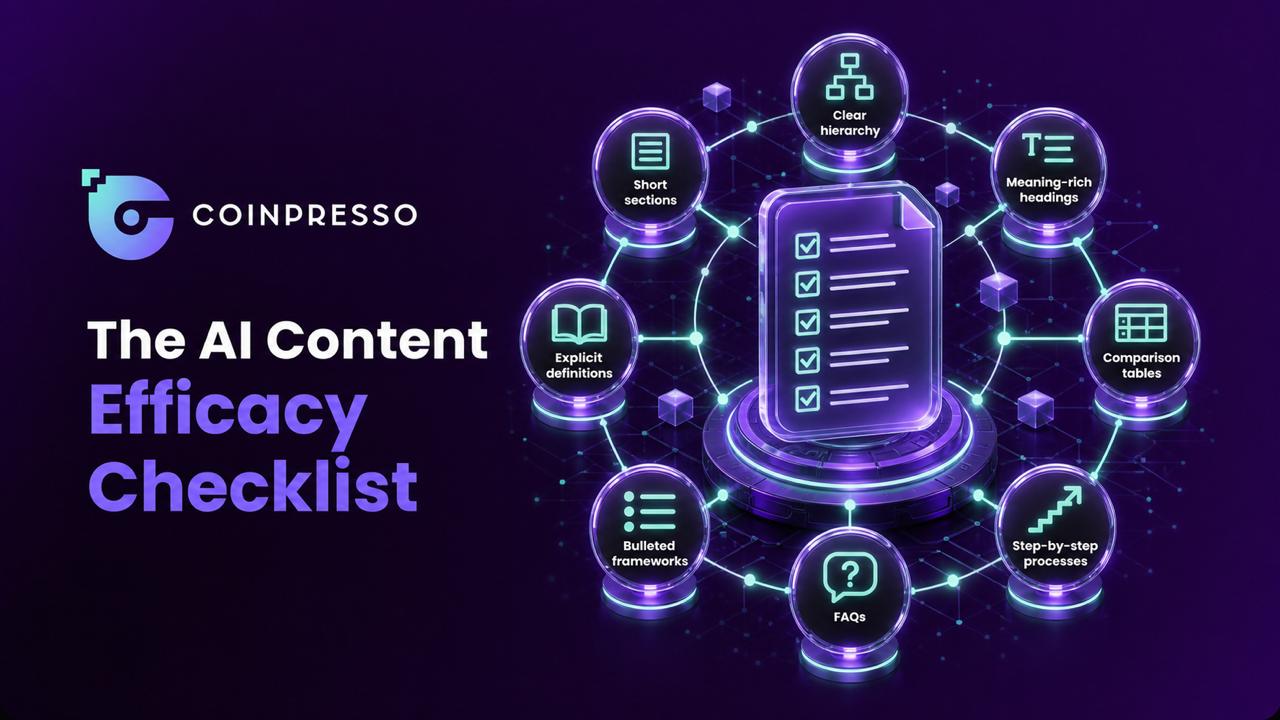
Effective characteristics include:
- Clear hierarchy
- Short explanatory sections
- Meaning-rich headings
- Explicit definitions
- Comparison tables
- Bulleted frameworks
- Frequently asked questions (FAQs)
- Step-by-step processes
AI models favour dense semantic information over unnecessary filler. Instead of repeating keywords, reinforce concepts, explain relationships, define terminology, connect ideas, and ultimately provide context.
This improves extraction while simultaneously improving readability for human audiences.
The Power of Summary Sections
One of the simplest but most effective Web3 GEO techniques involves strategically placed summaries. Each major section should conclude with explicit takeaways.
For example:
In Summary
- AI prioritises confidence rather than rankings.
- Consistent references increase recommendation probability.
- Technical clarity improves knowledge extraction.
- Trust signals compound across multiple sources.
This reinforces understanding for readers while simultaneously creating highly extractable information blocks for AI systems.
The Role of On-Chain Data in GEO
Perhaps the greatest competitive advantage available exclusively to crypto projects is verifiable data. Unlike traditional businesses, blockchain companies can demonstrate objective evidence of adoption on-chain.
AI is starting to become evermore cognisant of blockchain-specific metrics that demonstrate user adoption and social proofing. Instead of relying solely on marketing claims, models can reference measurable protocol performance.
- Total Value Locked (TVL)
- Daily Active Wallets
- Transaction volume
- Validator count
- Treasury reserves
- Revenue generated
- Fees distributed
- Token holder growth
- Governance participation
However, many projects bury these metrics inside dashboards that are difficult for language models to interpret. The solution is straightforward. Surface important on-chain metrics within crawlable, structured content.
Instead of writing:
"Our ecosystem continues to grow rapidly."
Publish:
- Current TVL
- 30-day growth
- Daily users
- Monthly transactions
- Active developers and other ecosystem confidence signals
- Governance participation
- Protocol revenue
Objective evidence strengthens AI confidence far more effectively than promotional language ever can or will.
Measuring Success: GEO for Web3
Traditional Web3 SEO relied on vanity metrics such as rankings, sessions, bounce rate, CTR, and Domain Authority (DA) etc. GEO for Web3 introduces an entirely new measurement framework, and you should be changing your perspective on how you view and measure your performance versus the search engine days of old.
Share of Model Voice
One emerging metric is Share of Model Voice. As Web3 marketers, instead of asking:
"How often do we rank?"
A more poignant & relevant start to your hypothesis is:
"How often do AI models recommend us compared to like-for-like blockchain competitors?"
This measures visibility where future on-chain buying decisions increasingly begin.
Citation Frequency
How frequently does your project appear within AI-generated answers?
Across:
- Product comparisons
- Industry explanations
- Investment research
- Technical discussions
- Educational prompts
Higher citation frequency generally indicates stronger machine trust. There is no secret sauce here other than proven expertise and “skin in the game” within your niche of Web3 or DeFi.
At Coinpresso, we provide projects with their own Web3 for GEO AI Agent that reports on AI visibility on a weekly basis, while providing recommendations in real-time in line with performance and competitor analysis.
Entity Strength
Can AI consistently distinguish your protocol from competitors?
Entity ambiguity remains one of the largest hidden GEO challenges in crypto. Projects with generic names frequently lose visibility because AI struggles to identify which entity users intend. Building stronger entity recognition through consistent branding and contextual references becomes increasingly important over time.
Knowledge Coverage
Does AI understand every major aspect of your project?
Many protocols rank well for one feature while remaining invisible for five others. Comprehensive knowledge coverage creates far greater recommendation potential than isolated content clusters.
Demonstrate you are a subject matter expert to both AIs and your ideal end users through your knowledge banks and project docs, in addition to off-page coverage from industry-renowned and relevant publications & crypto media.
30-Day GEO Action Plan for Crypto Marketers

Generative Engine Optimization in Web3 isn't something that your project can “flick the switch” on and see instantaneous results. It is the cumulative result of improving every trust signal that AI systems rely upon, and showing up with consistency—every single day—whether you’re creating content, conducting outreach, or implementing schema markup—GEO for Web3 brands is a continuous grind.
If you're beginning today, prioritise the following roadmap as an initial starting point:
Week One — Audit
- Map every public digital property.
- Identify inconsistent messaging.
- Review documentation.
- Check entity consistency.
- Evaluate structured data.
- Audit AI responses for branded searches.
Week Two — Consolidate
- Connect fragmented knowledge sources.
- Improve internal linking.
- Standardise terminology.
- Update outdated documentation.
- Add clear ownership signals.
Week Three — Optimise
- Rewrite high-value content using semantic structures.
- Introduce summary sections.
- Surface on-chain metrics.
- Improve technical documentation.
- Expand educational content.
Week Four — Amplify
- Earn references from respected crypto publications.
- Publish expert commentary.
- Increase founder visibility.
- Encourage developer contributions.
- Monitor AI citation frequency across major models.
The Future of Crypto Visibility Belongs to Trust
SEO isn't disappearing.
It's evolving. The barrier to entry has heightened significantly.
Only excellent, high-quality SEO principles will stand the test of time during the new era of AI search in crypto.
Traditional search will continue to generate significant traffic, particularly for transactional queries, but AI-assisted discovery is rapidly becoming the first touchpoint for high-intent crypto research. The projects that win in 2026 will be those that recognise visibility is no longer earned solely through rankings, but through becoming the most trustworthy, consistently referenced source within an AI's understanding of the crypto ecosystem.
Generative Engine Optimization isn't about gaming language models. It's about making your expertise impossible to ignore.
For crypto projects, that means aligning technical documentation, on-chain transparency, compliance signals, educational content, and third-party validation into a single, coherent knowledge graph that both humans and machines can confidently understand.
The protocols investing in GEO today aren't simply preparing for the future of search—they're shaping it.
If your project is still measuring success exclusively through rankings and organic traffic, you're likely overlooking the fastest-growing discovery channel in Web3 and a direct access point to retail investors.
The question is no longer whether AI will influence how crypto projects are discovered. The question is whether your protocol will be one of the projects AI chooses to recommend.
If you’ve read this Generative Engine Optimization for Crypto Projects guide and realized the gravity and importance of GEO (understandable)—and need a Web3 GEO Agency to support your AI visibility journey, contact Coinpresso today for a free mini GEO audit and no-obligation proposal.
Frequently Asked Questions: FAQs on Web3 GEO
What is Generative Engine Optimization (GEO) for Crypto Projects?
GEO for crypto projects is the practice of optimizing your blockchain project's content and technical infrastructure to appear in AI-generated answers from ChatGPT, Perplexity, Claude, and Google AI Overviews. Unlike traditional SEO which focuses on ranking in search results, GEO focuses on being cited directly within AI responses when users ask questions about your category.
How is Crypto GEO Different From Traditional Crypto SEO?
Traditional crypto SEO optimizes for keyword rankings and click-through rates on Google. GEO optimizes for "reference rates" — how often your brand is cited in AI-generated answers. The key differences include: content must be dense with meaning rather than keywords, formatting must be easily extractable by LLMs, and trust signals (audits, compliance) carry more weight than backlinks.
Why Are Some Crypto Projects Invisible to AI Search?
Most crypto projects are invisible because their content is fragmented across multiple platforms (main site, GitBook, GitHub, Medium), uses promotional language that AI engines filter out, and lacks the structured data and trust signals that LLMs require before citing a source in financial queries.
How Long Does It Take To See Results From Crypto GEO?
Initial improvements in AI visibility can appear within 4-8 weeks after implementing technical fixes (llms.txt, schema markup, content restructuring). Building sustained citation authority typically requires 3-6 months of consistent optimization, content publication, and third-party validation building. A Web3 GEO Agency can support your project marketing team with these deliverables.