

Here's the mistake, in order: a milestone slips, the team goes quiet for a week deciding how to phrase it, then posts a single reassurance message with no date attached. Three weeks later that message gets screenshotted back at them as proof they lied. Nobody set out to deceive anyone, but silence followed by vague comfort is exactly what a community reads as deception. By the time the team notices, the damage isn't the delay anymore — it's the credibility of everything they say next.
This piece is about fixing that sequence, not the delay itself. Delays happen to good projects and bad ones alike; what separates the two is whether the next update is a mood or a document, and whether a member can check your claims against something other than your tone of voice. That's the operational side of crypto community management, and it's the part most roadmap-recovery advice skips in favor of telling you to "be transparent," as if transparency were a font choice rather than a set of verifiable facts. A fair amount of crypto marketing still treats that word as the whole job rather than the starting line.
One honesty note before any of this: Coinpresso has not run its own before/after trust-recovery campaign at the scale described below, and we're not going to dress up someone else's numbers as ours. The sequences that follow are reconstructed from public timelines, project statements and press coverage, not from our own dashboards. Treat them as a structure to copy, not a benchmark to hit — your own Telegram, Discord and X data are the only numbers that tell you whether your recovery is actually working.
Name the Broken Promise Precisely
Start with the sentence you'd least like to repeat: what you said, when you said it, and who built plans around it. Vague acknowledgment reads as evasion to anyone who can scroll back and find the actual date you promised. "We know things have been slower than expected" tells a community nothing it didn't already suspect, and it insults everyone who kept the receipts.
Shibarium is the clearest public case of what happens when this step gets skipped. The mainnet was teased from mid-2021 and expected through 2022, and the target kept sliding right through the following year's trading windows. By June 2023, a Shiba Inu content marketing specialist told followers directly on Twitter that the launch would not land that month, with no new date offered for the following two or three. The project eventually went live on August 16, 2023, onboarding 21 million wallets during its testing phase before mainnet day arrived.
Naming the promise precisely means stating three things in plain language: the original commitment, the date it was supposed to land, and the groups who made decisions on the strength of it, whether that's holders, builders integrating against your API, or partners who scheduled their own announcements around yours. Skip any of the three and the acknowledgment reads as PR dressed up as candor.
Separate Facts, Assumptions, and Decisions
A delay announcement usually collapses three different kinds of statement into one paragraph, and that's exactly what makes it sound evasive even when it's honest. Facts are what you can verify today. Assumptions are what you believe but haven't confirmed. Decisions are what you've chosen to do about both, and conflating the three is how a team ends up guessing out loud in public.
Keep them visibly separate. Here's an example of how that split should look in an update:
| Category | What it is | Example |
| Fact | Verified, checkable today | "The bridge contract failed a load test at 40,000 concurrent transactions." |
| Assumption | Believed but not yet confirmed | "We think the relayer queue is the bottleneck, pending a full audit." |
| Decision | What the team is doing in response | "We are pausing the public launch date and re-testing at three times projected load." |
When Shibarium's mainnet buckled hours after its August 16, 2023 launch under traffic it hadn't load-tested for, the response worked because it didn't pretend the cause was fully understood before it was. The team pulled the network into private mode, fixed the throughput problem, and relaunched on August 25, 2023, surpassing 50,000 wallets within days and processing 420,000 transactions in the first 24 hours back online.
That's a team saying "here's what broke, here's what we're doing, here's what we still don't know," rather than inventing a root cause in public and quietly walking it back later. The instinct to assign blame, internally or publicly, is the one to resist hardest here. A community doesn't need a villain. It needs to know what's actually true right now, and a decent appetite for "we're not sure yet" said plainly.
Publish a Recovery Contract
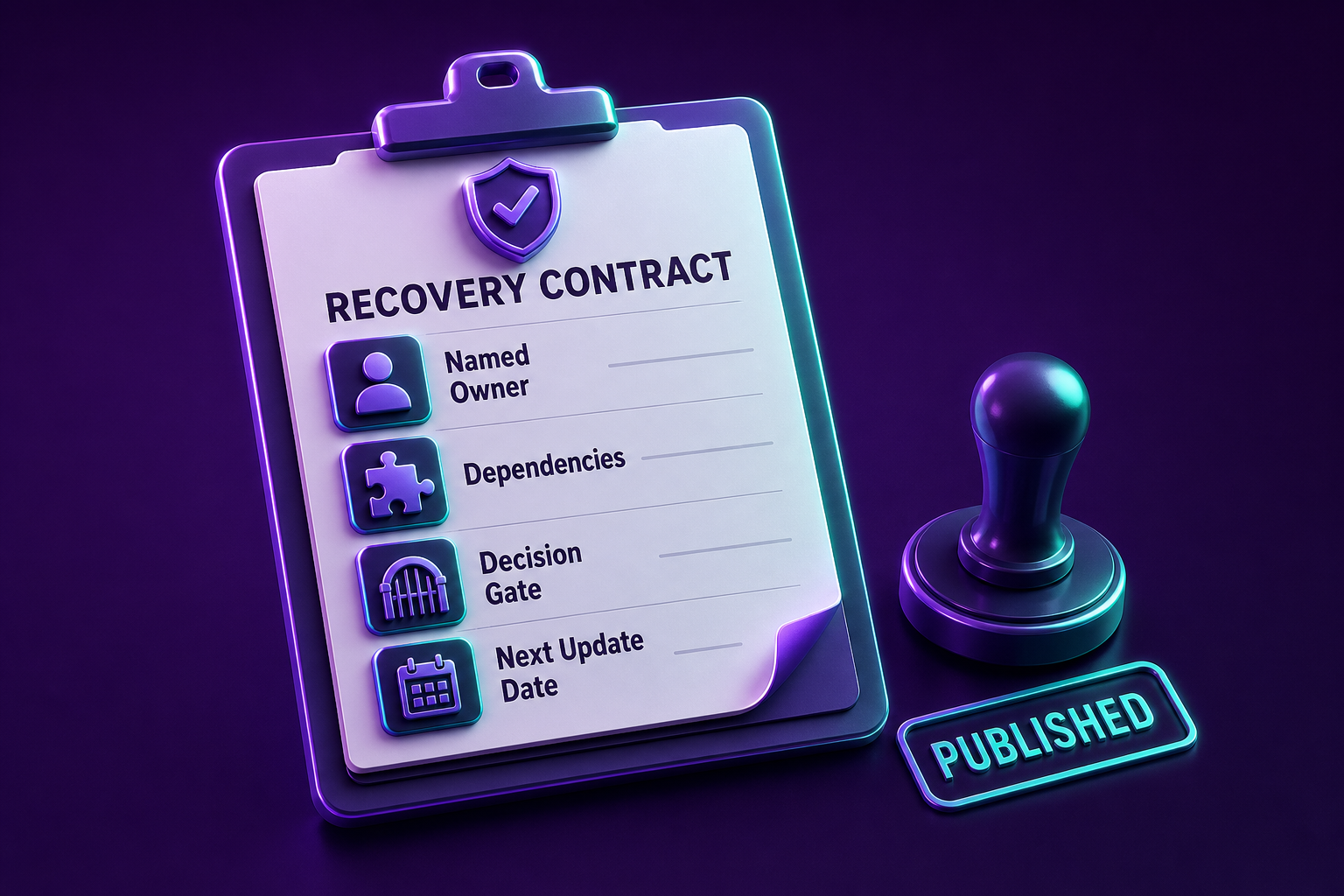
A recovery contract replaces the roadmap graphic with a document a member can hold you to. It states the revised scope, who owns each piece of it, what it depends on, the point at which a decision gets made, and the date of the next update — whether or not that update has good news in it.
| Element | What it covers |
| Revised scope | What's shipping, cut down to what's actually achievable, not what was originally promised |
| Named owner | A person or team accountable for each piece, not "the team" as an abstraction |
| Dependencies | What has to happen first, including things outside your control |
| Decision gate | The point you'll know whether the revised date holds, and what happens if it doesn't |
| Next update date | Fixed, public and calendared regardless of outcome |
The contrast case here is Cetus Protocol, which lost $223 million to an exploit on May 22, 2025. Within the following weeks, validators representing 90.9% of total stake voted on-chain to move roughly $162 million in frozen funds into a multisig wallet earmarked for return to users. That decision was something the whole community could verify independently, on a block explorer, rather than take on trust from a blog post.
The relaunch that followed set out pool recovery rates of 85% to 99% depending on the damage to each pool, alongside a token allocation of 15% of CETUS supply, 5% of it claimable immediately and the rest unlocked monthly over a year. None of that is reassurance copy. It's a contract with numbers in it, and numbers are the one thing a community can't argue has a bad tone.
Show Operational Proof
Proof is anything a member can check without asking you first: release notes with commit references, a public demo, test results, a governance vote they can see on-chain, a changelog with a timestamp. The test is simple — can the claim be verified by someone who has no reason to trust you and every reason to doubt you?
This is where most delay communications fail quietly. They publish sentiment ("we're confident this fixes it") where they should publish artifacts. If your update reads like a press release, you're already losing the room. Cetus clears this bar because its community vote and compensation structure were both things a holder could inspect directly rather than take on faith from a founder's tweet.
Shibarium's relaunch cleared it too. The team didn't just announce the network was fixed; it published wallet counts and transaction volumes that demonstrated the fix had actually held under real load, not a controlled test environment.
Match the proof to the product. A DeFi protocol has on-chain transactions and audit reports. A game studio has a playable build. A Layer 2 has a public testnet and a block explorer. If your only evidence is a founder's tweet saying progress is good, that's not proof — it's the same reassurance that got you into this position in the first place, just with better punctuation.
Create Two-way Accountability
A recovery cadence that only pushes information outward isn't accountability, it's a newsletter with extra steps. The structure needs a way for members to ask, and a way for the team to show which questions got answered, which are still open, and where the team got something wrong the first time.
In practice that means a standing, visible log: questions collected from Discord, Telegram and X, grouped by theme rather than answered one at a time in the noise of a general channel, with a note against each theme saying whether it's answered, pending, or genuinely unknown. "We don't know yet," repeated honestly for four updates running, is worth more than a confident guess that gets quietly corrected later.
Shibarium's September 2025 bridge exploit is the cautionary half of this, and it belongs to a different category of failure entirely from the roadmap delay above. This was a security incident, not a missed date, but the communication pattern rhymes uncomfortably well. After validator keys were compromised and roughly $2.4 million was drained, with 10 of 12 validators affected, the project's lead developer went quiet for several days while speculation about his own involvement filled the gap he'd left.
During that silence, the bridge sat completely blocked with no reopening schedule communicated, and trust eroded with each quiet day rather than each bad update. When the developer finally addressed the community directly, he described a "war room" assembled with developers and leadership to restore funds and tighten security. The statement landed better than it would have on day one, but it still cost days of goodwill that silence had already spent on nothing.
A crypto Discord marketing operation exists precisely to close that gap before it opens, by making sure nothing asked twice goes unanswered in public.
Measure Trust Recovery Over Time
Trust recovery isn't one post landing well. It's a pattern across several updates, and the metrics that show it have nothing to do with token price, however tempting that chart is to screenshot. Track the themes repeating in your support queue, and whether the same question keeps surfacing week over week despite an answer already sitting in the channel.
Track whether members mention the project unprompted in a neutral or positive way outside your own channels, where sentiment is harder to perform than inside them. Track moderator response time to flagged questions, and whether milestones you set in the recovery contract actually land on the dates you gave rather than slipping quietly a second time.
There's no industry benchmark worth quoting for any of these, because nobody has published one with real crypto-community data behind it, and anyone offering you a specific percentage is selling confidence rather than measurement. What matters is your own trend line: is the repeat-question rate falling, is participation quality improving even if raw volume is flat, are you hitting your own decision gates on schedule, three updates running. A project tracking its own community management KPIs against its own baseline will know if the cadence is working months before price tells it anything, and price was never answering this question to begin with.
Conclusion
Fix the sequence first. Name the gap precisely, separate fact from assumption, publish the recovery contract with named owners and real dates, then let proof carry the weight instead of tone. Leave the root-cause speculation and the blame-finding alone entirely — neither one rebuilds anything, and both give a community something new to argue about instead of something to verify.
Here's a minimal template for the first missed-milestone post itself:
- What we said: the original commitment and its date, quoted exactly
- What's true today: verified facts only, no hedging language
- What we assumed and got wrong: named plainly, no blame attached
- What we're doing: the revised scope, the owner, the dependency, the decision gate
- Next update: a fixed date, regardless of what it contains
A new roadmap is not enough. Members need evidence that delivery itself has changed, not a better-designed version of the same promise. Ask Coinpresso to build a transparent recovery communications cadence that gives your team the operating model, moderation workflow and update rhythm to run this without guessing at the next step.
FAQs
Should a project apologize for a roadmap delay?
Acknowledge the specific gap rather than perform remorse. "We missed the date we gave you on March 3" does more for crypto roadmap trust recovery than any amount of apology language, because it names something a member can check against the original announcement. The limitation: an apology with no attached facts, owner, or next date reads as the same evasion it's trying to fix, so treat it as a sentence inside the update, not the update itself.
What should a revised roadmap include?
A revised scope cut to what's actually achievable, a named owner for each piece, the dependencies it's waiting on, a decision gate, and a fixed next-update date regardless of outcome. Leave out specific new dates you can't yet stand behind; a second broken date does more damage than an honest "we don't know yet." See our case studies for how that kind of operating structure gets built around a real update cadence.
How much technical detail should be shared?
Share enough that someone technical could verify the claim, such as what a load test actually measured or what a contract audit actually covered, without turning the update into an internal postmortem. The limit is anything that exposes an unpatched vulnerability or invites a new attack before a fix ships; security disclosure timing should sit with your engineering and legal owners, not a community manager working alone.
Can a project regain trust after multiple missed milestones?
Yes, but each additional miss raises the evidence bar and shortens the patience window, so the recovery contract has to get more specific, not more reassuring, each time. There's no fixed number of misses after which recovery becomes impossible, and no reliable way to measure that threshold in advance, so the only honest move is treating every update as the one that has to hold.
Which metrics indicate recovering community trust?
A falling repeat-question rate, unprompted positive mentions outside your own channels, steady or improving moderator response times, and milestones landing on the dates stated in your own recovery contract. None of these have a published industry benchmark worth quoting, so measure your own trend against your own baseline rather than someone else's case study; contact Coinpresso if you want help setting that baseline up properly.