

A pinned message that says "admins will never DM you first" has never stopped a single scam. It feels like a policy, but it's a warning nobody reads at the moment they need it, because the member getting DM'd right now by someone wearing your logo isn't scrolling back through pinned posts — they're mid-conversation with what looks exactly like the help they asked for an hour ago.
The fix isn't a bigger warning. It's a design choice: make the real support path so visible, so consistently branded and so boringly official that the fake one looks exactly as cheap as it is. A lot of crypto marketing teams treat this as a one-off announcement rather than a permanent fixture of their crypto community management setup, and that gap is what this piece closes, section by section, starting with why the scam works at all.
Why Fake-admin DMs Work
Fake-admin DMs work because they exploit three things at once: urgency, borrowed authority, and a support system most projects never finish building. The scammer isn't inventing a lie so much as answering a question your own community left wide open.
Urgency does the heavy lifting. A member with a stuck transaction, a failed claim, or a wallet error is already anxious, and anxious people skip the verification step they'd normally catch. The DM lands at the exact moment the member wants a fast answer more than a correct one.
Authority mimicry closes the deal. The scammer copies your admin's display name and profile photo, and Telegram's own interface does nothing to stop this, because usernames and display names aren't unique the way a verified badge is. Telegram's FAQ confirms the mechanics that make this possible at all: someone can message you directly if you share a group with them, which every member of an active community does with every admin by default.
The third ingredient is the one most teams never admit: confusion about where official support actually lives. If a community has no single, consistently promoted support channel, it has a vacuum, and scammers fill vacuums the way water finds the crack in a wall — quietly, and faster than anyone notices.
Scale this up and the pattern stops looking like a niche crypto problem. Reported imposter scam losses across the US hit $3.5 billion in 2025, part of roughly $16 billion in total reported fraud losses, the highest figure the FTC has ever recorded. That number covers every platform and every impersonation type, not Telegram admin impersonation specifically — no agency publishes a figure that granular — but it tells you the underlying tactic, a stranger with borrowed authority reaching you directly, is working at scale against people paying far more attention to their money than a member mid-claim usually is.
Crypto compounds it further. The FBI's Internet Crime Complaint Center found cryptocurrency investment fraud was the single largest category of reported financial loss to Americans in 2025, at $7.2 billion. That figure spans investment fraud broadly, not admin impersonation on Telegram as its own line item, and the honest position is that nobody currently isolates that number. What both figures confirm is the shape of the attack: a stranger opens contact claiming authority, and the conversation moves to a messaging app from there.
Publish Non-negotiable Contact Rules
A contact-rules policy is one paragraph, pinned permanently, stating exactly who can DM a member, through which channel, and what your team will never ask for. Without it published somewhere a member can check in ten seconds, "verify independently" is advice with no reference point to verify against.
Write the rule as a short, absolute list rather than a soft suggestion:
- Official team members never initiate a direct message to request wallet connections, seed phrases, private keys, or remote access
- Support is only ever provided through one named channel, linked in the group description and pinned message, never through a personal DM
- No staff member will ever ask you to move a conversation to a different app or a "private verification" chat
- Giveaways, airdrops, or "limited time" claims requiring a DM first are never legitimate, regardless of who appears to be sending them
The absolute framing matters more than it sounds like it should. A rule that says admins "rarely" DM first leaves a crack for a member to assume this is one of the rare exceptions, and that crack is exactly what a scammer needs to get through.
Say it as "never," not "rarely," and the crack closes. It costs nothing but a pinned message and the discipline to actually follow the rule internally, and it turns crypto community security from a vague instinct into a published standard the group can hold you to.
Create an Official Support Path
An official support path is one pinned link, one consistent username across every platform, and one help page a member can check without asking anyone. If the path to real help requires asking "is this really you?" in the group, doubt has already had ten seconds to work in a scammer's favor.
Start with consistency. Your support handle should be identical, or near enough, across Telegram, Discord and X, and it should never change without an announcement explaining why. A member who's seen the same handle for six months will notice a slightly altered one faster than any warning message could ever teach them to.
Pin the real links where nobody has to scroll for them: the group description, the pinned post, and ideally a dedicated help page on your own domain listing current, verified contact channels. Add in-group reporting instructions into that same pinned message. A simple "if you've received a DM claiming to be from our team, forward it to [channel] immediately" does more good sitting in plain sight than any after-the-fact warning post.
Worth being precise here, because it gets misunderstood constantly: Telegram's own verification system confirms official channels, groups and bots, not individual admin accounts. A blue checkmark on your project's main channel tells a member something real. It tells them nothing about whether the account DMing them is one of your actual team members, which is exactly why the pinned support path has to carry weight no badge can. Teams running crypto Telegram marketing at volume tend to learn this the expensive way, after the first wave of claim-related impersonation attempts, not before it.
Triage a Suspected Impersonation
The first ten minutes after a member reports a fake-admin DM decide whether this stays a contained incident or turns into group-wide panic. Protect the member first, preserve the evidence second, and only then decide whether the wider community needs to hear about it.
Protecting the member means acknowledging the report immediately, confirming in plain language that the DM did not come from your team, and checking whether the member has already shared anything sensitive. If they have, the priority is damage limitation for that person, not investigating the scammer's account.
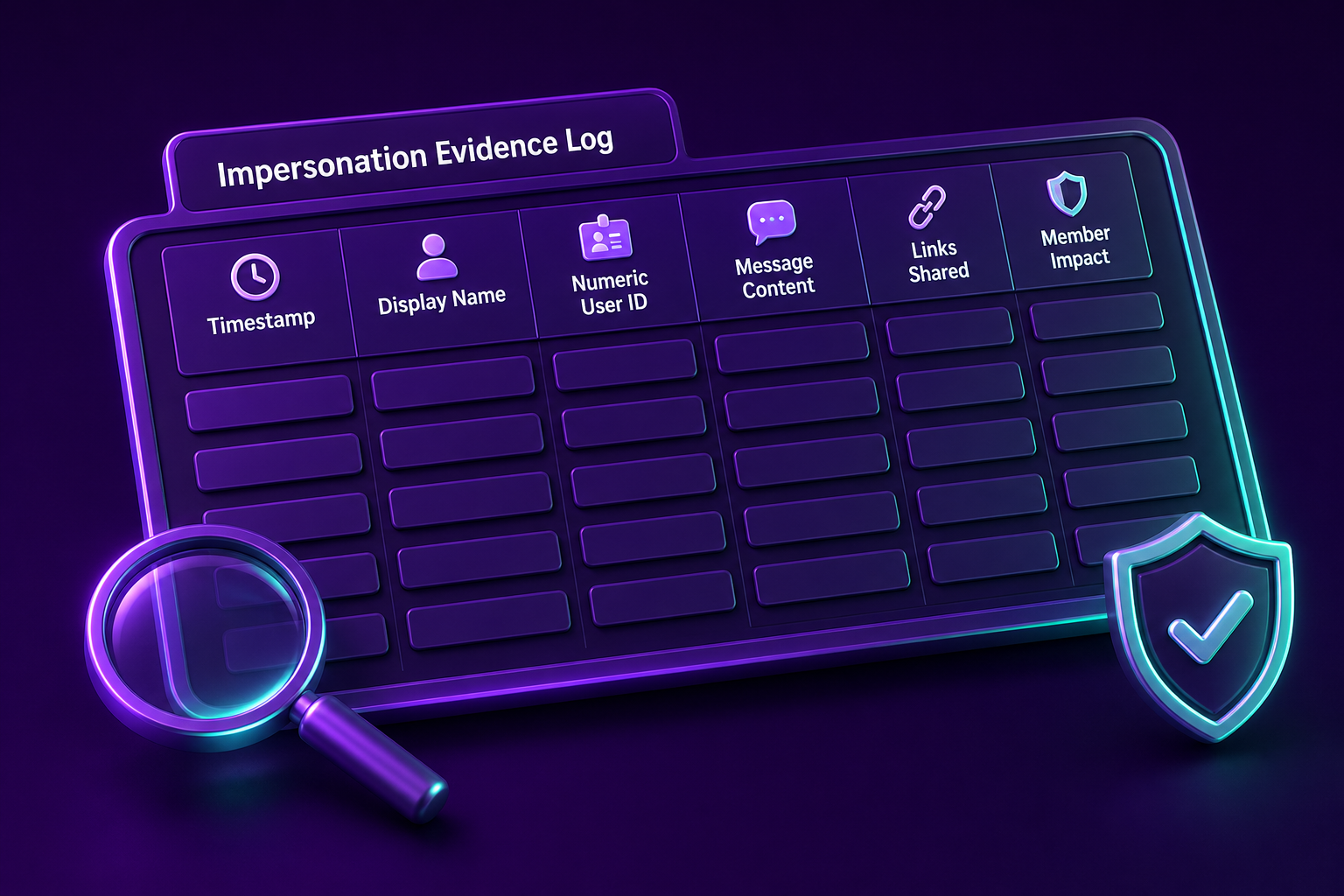
Evidence collection has to happen before the account disappears, which experienced impersonators tend to do very soon after being blocked or reported. A moderator should screenshot the full thread including the sender's username and profile, record the exact timestamp, and capture the sender's user ID if visible — display names and usernames can be changed, but the underlying account ID generally cannot.
Here's an example of what that evidence log should capture, nothing more elaborate than this:
| Field | What to record |
| Reporting member | Username and how they were contacted |
| Scammer display name | As shown at time of report |
| Scammer username/ID | Captured before block, if visible |
| Screenshots | Full thread, including first message |
| Timestamp | Exact time of first contact |
| Action taken | Blocked, reported to Telegram, group notified |
Once evidence is captured, block and report the account through Telegram's own reporting tools. Only escalate to a group-wide alert if the same scammer appears to be targeting multiple members, or the pattern suggests a coordinated run rather than one isolated attempt.
Communicate Without Amplifying the Scam
A scam alert states facts, not the bait. Tell the group what happened, what to do, and what your team will never ask for, without reposting the scammer's message, their username, or any link they sent.
Reposting a malicious link, even as a warning, risks members clicking it anyway out of curiosity or confusion about which link is the dangerous one. Describe the pattern instead: "a fake admin account is DMing members asking them to connect a wallet to claim a reward" tells members everything they need without handing the scammer free distribution.
The hardest discipline here is resisting any promise of recovery. If a member has already lost funds, the honest answer is that recovery is rare and never guaranteed, and a community post implying otherwise sets up a second disappointment stacked directly on the first.
State what you're doing — reporting the account, alerting the group, reviewing how the contact happened — and stop there. Our crypto guide to Discord, Telegram and X community marketing covers where this kind of incident response sits against day-to-day moderation, and it's worth reading before you're writing this message under pressure for the first time, not during.
Harden the Team Account Model
Your team's own accounts are the raw material a scammer needs, so account hardening is prevention, not response. Two-factor authentication, restricted admin permissions, and a routine audit of who holds which role are the three things that actually reduce how often impersonation becomes possible in the first place.
Every account with admin or moderator rights should have two-factor authentication enabled without exception. A single compromised account can message every member who shares that group, which is exactly the access Telegram's FAQ confirms is all a contact needs.
Permissions should be restricted to what each role genuinely requires. Not every moderator needs the ability to add new admins, and not every community manager needs access to the official announcement channel.
Run a role audit on a fixed schedule, not "whenever someone remembers." Check who currently holds admin rights, whether they're still active, and whether any dormant account still carries privileges nobody revoked after someone left the team. An old admin account nobody's watching is functionally the same as a fresh fake one, except it comes pre-loaded with legitimacy a scammer would otherwise have to build from nothing.
Conclusion
None of this works as a document somebody reads once. It works as a standing operating model: published contact rules, one verified support path, a triage process your moderators have actually rehearsed, and a hardened account structure nobody has to think about because it's simply how the team operates.
Here's the shortest version, as a checklist to run the next time a fake admin shows up in your reports channel:
- Confirm the DM did not come from your actual team
- Protect the member — stop further sharing, don't panic them
- Screenshot the full thread, username, and account ID before blocking
- Block and report the account through Telegram's tools
- Post a factual, link-free alert to the group if the pattern looks coordinated
- Never promise fund recovery
- Log the incident for your own role-and-access review
Scam prevention works when official routes are unmistakable and reports are handled quickly. Contact Coinpresso to build a Telegram zero-trust DM protocol.
Check tonight whether your own pinned message actually names a single verified contact channel, or whether it just warns members what to avoid. If it's the second one, you have a policy with no address behind it, and that's the exact gap this piece was written to close.
FAQs
Do real Telegram admins DM users first?
Legitimate admins and official support almost never open a direct message first; they respond to tickets or messages a member sent into an official channel. Telegram's own FAQ confirms anyone sharing a group with you can message you directly, which is exactly the access a scammer needs and exactly why a published, absolute contact rule matters more than trusting the exception.
What should a user do after receiving a fake-admin DM?
Stop replying, don't click anything sent, and report the message through the group's official channel listed in its pinned post or crypto community management help page. Block the sender afterward, not before, since blocking first can prevent you from screenshotting the full thread for evidence.
What evidence should be saved before a scammer deletes a chat?
Screenshot the entire conversation including the sender's username, display name, and profile photo, note the exact timestamp, and capture the account ID if it's visible, since display names can be changed but the ID generally cannot. Impersonators tend to delete accounts quickly once reported, so this has to happen before you block, not after.
Should a project post every scam report publicly?
No. Isolated, one-off reports are usually better handled privately with the affected member, while a public, factual alert is reserved for patterns that look coordinated or are hitting multiple people at once. Public posts should state what happened without repeating the scammer's username or any link, since republishing the bait gives it more reach, not less.
Can a community promise fund recovery?
No, and a project that implies otherwise is setting a member up for a second loss on top of the first. The honest line is that recovery is rare and never guaranteed, and the team's job is reporting the account, supporting the member, and reviewing how the contact happened — see our case studies for how structured incident response plays out in practice.