


A crypto press release distribution campaign can provide a massive boost to a project. Well-written articles by expert crypto copywriting teams, which are distributed to well-positioned outlets, have long been one of the most useful marketing tools in crypto marketing. However, in 2026, simply firing off a bunch of articles is not enough. Performance has to be proven through data, and that data must in turn be used to optimize crypto PR campaigns.
In the past, teams generally relied on vanity metrics to report the achievements of PR campaigns. Measuring variables like impressions and clicks usually dominated these reports. An article with a lot of impressions was often treated as the main objective of the process.
However, impressions do not really reveal much about PR ROI. Even if they demonstrate the reach of an article, they tell the team almost nothing about its ROI because they do not directly demonstrate how the article contributed to the project’s bottom line.
To measure PR ROI, the team has to understand who clicked on the article, how many people followed through and used the project or bought the token, the demographics of the average user, where they are located, and several other valuable data points.
This article will provide a practical framework to measure crypto PR ROI and offer insights into how the top PR teams in crypto maximize the ROI of their campaigns by collating reports that provide genuine insights into campaign performance.
Why Traditional PR Metrics Are Broken
Traditional crypto PR ROI metrics reveal very little about the true impact of PR campaigns. Although they might provide some insight into the reach of articles, there are a few reasons they do not really help teams understand the true ROI.
Vanity Metrics vs Real Metrics
Vanity metrics, as the name implies, provide a relatively cosmetic insight into PR performance. Metrics such as impressions, views, or estimated reach may look impressive in reports but often reveal very little about whether the campaign actually generated users, revenue, trust, or long-term growth for the crypto project.
Common Misleading PR Claims
The crypto PR industry is full of agencies making big promises. They often claim to be able to reach millions of readers in a short space of time. There are two issues with these claims. Firstly, the readership often simply does not exist, and target figures are manipulated to appear larger than they really are. Secondly, even if the targets are hit in terms of impressions, this is often achieved through syndication with little to no referral traffic, while the impressions themselves generate very little actual ROI.
Why Crypto Requires Better Measurement
Crypto-specific PR campaigns require more accountability from both the project side and the wider industry. Many crypto startups run on tight marketing budgets, and they cannot afford to spend money on campaigns that cannot prove ROI. The crypto community surrounding a project is generally very aware of the marketing process. If they see that articles are being published on low-quality sites and syndicated randomly across the web without improvements in token price action, they will vote with their wallets. Therefore, PR in crypto must demonstrate measurable impact.
Attribution as the Solution
Attribution is the answer to the issues facing traditional metrics for crypto PR. It connects PR activity to crypto SEO, traffic, acquisitions, and ultimately shows real ROI rather than just vanity metrics.
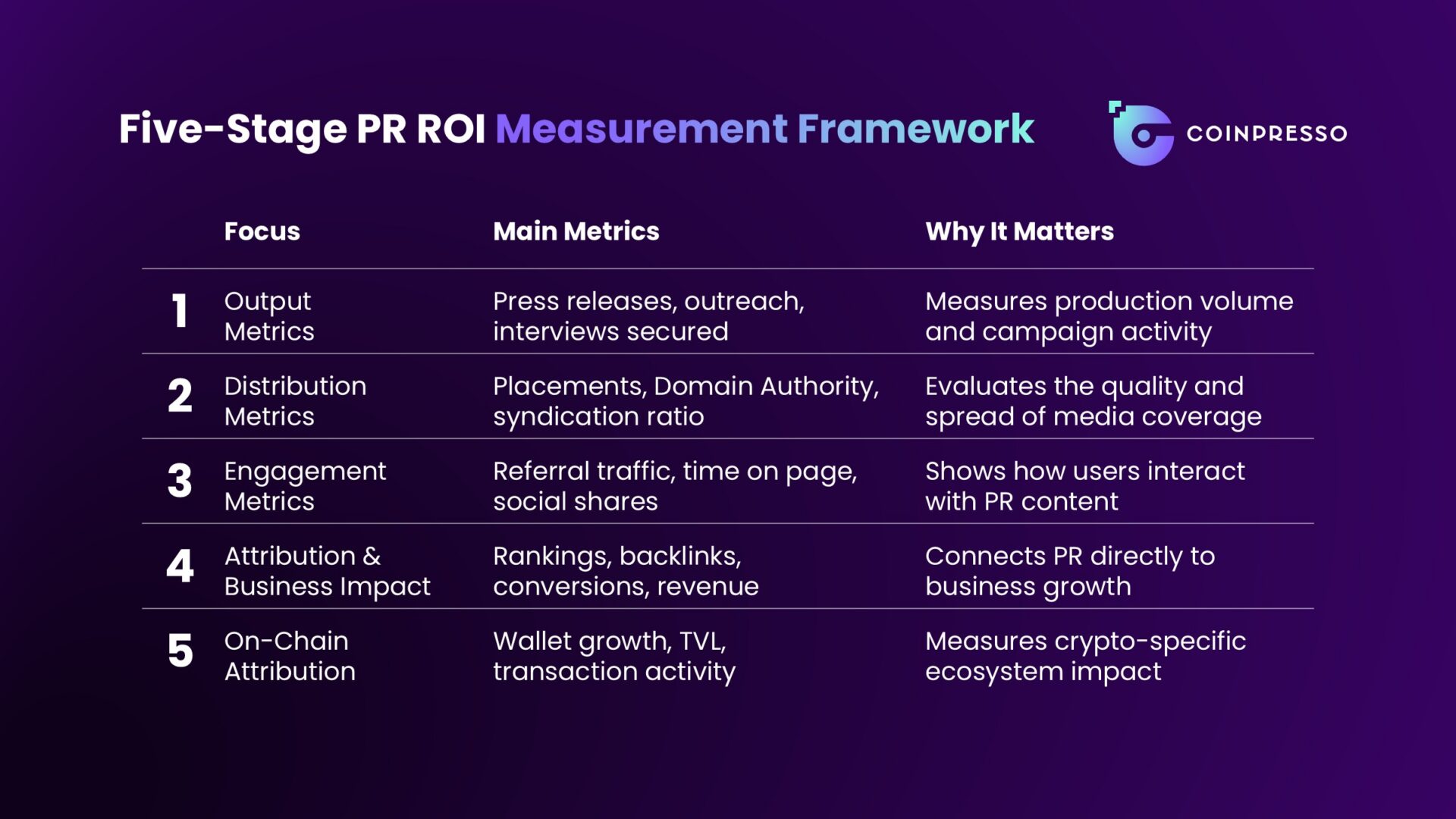
The Five-Stage PR ROI Measurement Framework
To effectively measure crypto PR ROI, a five-step process is generally used, which provides real actionable insights into performance and allows the marketing team to make adjustments for future campaigns.
Calculating Cost Per Link (CPL) and Link Lifetime Value (LTV)
Cost Per Link (CPL) is a cornerstone element of crypto PR. It measures the average cost required to secure a high-quality backlink through a PR campaign and is generally calculated by dividing total PR spend by the number of valuable backlinks earned.
Understanding Link Lifetime Value (LTV) is equally important. A strong backlink from a high-authority crypto publication can continue generating SEO value, referral traffic, and keyword ranking improvements for years after the article is published. For example, a backlink from CoinDesk or Cointelegraph can strengthen the authority of a DeFi project long after the initial campaign has ended.
For example, if a DeFi lending platform spends $8,000 on a PR campaign that earns backlinks from CoinDesk, Cointelegraph, and several syndicated publications, the CPL can then be benchmarked against campaign goals such as keyword ranking improvements, referral traffic, or user acquisition. A slightly higher CPL is often acceptable if the backlinks come from extremely authoritative domains with strong long-term SEO value.
| Metric | Formula | Example |
| Cost Per Link (CPL) | Total PR Spend ÷ High-Quality Links Earned | $8,000 ÷ 10 links = $800 CPL |
| Link Lifetime Value (LTV) | Long-Term SEO + Traffic Value | CoinDesk backlink generating traffic for 2+ years |
| Campaign ROI | Revenue Generated ÷ Campaign Cost | $20,000 generated from $8,000 campaign |
Tracking Referral Traffic and User Acquisition
UTM tracking is a must-have when it comes to crypto PR ROI in 2026. It is the gold standard of analysis because it allows the team to correctly track PR traffic using Google Analytics. Without proper UTM structures, it becomes extremely difficult to understand which articles, publications, or campaigns are actually driving traffic and conversions. This makes campaign optimization far less effective.
Campaign-level attribution through UTM parameters allows teams to track the exact source of traffic. For example, a URL linked inside a CoinDesk article may contain UTM tags identifying the source, campaign, and medium. This allows the marketing team to see precisely how many users arrived through that specific article and what actions they took afterward.
This process also allows teams to identify which publications drive qualified traffic and, crucially, understand the difference between traffic volume and conversion quality. A smaller article on a niche DeFi publication may generate fewer clicks than a major media outlet but produce significantly more wallet signups or token purchases.
Measuring PR-Driven Users
- Wallet signups after media exposure
- Exchange registrations
- DeFi protocol interactions
- Token purchases
- Newsletter signups
- Community joins through Discord or Telegram
Ultimately, effective referral tracking transforms crypto PR from a vague branding exercise into a measurable acquisition strategy backed by actionable data.
Dashboard To Measure PR Success in 2026
The best way measure PR success in 2026 is to keep track of a campaign is through a PR measurement dashboard. For most teams, building these dashboards is not an option, which is why leading crypto startups rely on support from external cryptocurrency PR teams who provide custom dashboards for their clients.
| Dashboard Metric | What It Tracks | Why It Matters |
| Referral Traffic | Users arriving from PR articles | Measures traffic quality |
| Backlinks Earned | New links from media placements | Tracks SEO authority growth |
| Keyword Rankings | Search performance improvements | Measures SEO impact |
| Brand Mentions | Mentions across crypto media and social media | Tracks visibility |
| Conversion Rate | Wallet signups, registrations, purchases | Measures campaign effectiveness |
| Geographic Data | User location and demographics | Helps optimize targeting |
| On-Chain Activity | Wallet growth, TVL, transactions | Tracks crypto-specific engagement |
Using this type of dashboard, PR teams provide clients with regular reports, offering clear insights into campaign ROI and suggesting adjustments based on performance data. This allows the marketing strategy to evolve over time and clealy measure PR success in 2026.
On-Chain Attribution for Crypto Projects
To measure PR ROI in crypto, it is not enough to rely on standard Web2 metrics. Crypto PR metrics are mostly found on-chain. As blockchains are public, this data is available and plays a huge role in how marketing teams measure PR success in 2026.
Connecting PR campaigns to on-chain activity is now a major part of crypto analytics. Following major media coverage, teams can often identify spikes in wallet creation, trading activity, staking participation, or increased usage of a DeFi protocol. This gives much clearer insight into whether PR campaigns are actually influencing user behavior rather than simply generating impressions.
Several useful on-chain analytics platforms are commonly used by crypto PR and marketing teams:
- Dune Analytics for custom dashboards and blockchain data queries
- Nansen for wallet behavior and smart money tracking
- Glassnode for market and blockchain activity analytics
A good example is a token launch PR campaign for a new DeFi project. Following coverage on major crypto publications, the team may observe increases in wallet creation, higher transaction volume, growth in Total Value Locked (TVL), and increased token trading activity. While token price movement alone is not enough to prove PR success, combining these on-chain metrics with referral and acquisition data provides a far more accurate understanding of campaign ROI.
Final Thoughts on Measuring Crypto PR Metrics in 2026
The best way to measure crypto PR metrics in 2026 is by going beyond the reliance on vanity metrics and gathering valuable data ranging from engagement metrics and attribution impact to on-chain data. The data should then be presented in clear reports that demonstrate the crypto PR ROI and make it possible for marketing teams to make adjustments in order to improve the value of every article that gets published.
FAQs
What is a healthy Cost Per Link (CPL) for a crypto project?
There is no universal benchmark because CPL depends heavily on the authority of the publication. A backlink from a major crypto outlet will naturally cost more than links from smaller niche sites but often provides significantly greater long-term SEO value.
How do I know if a backlink is actually helping my rankings?
The clearest indicators are keyword ranking improvements, increased organic traffic, and stronger domain authority over time. Good backlinks generally improve visibility across related crypto search terms.
Can I measure PR ROI if my project is still in stealth or testnet?
Yes. Even without revenue data, teams can still measure referral traffic, wallet creation, community growth, newsletter signups, social engagement, and on-chain activity linked to PR campaigns.
How do I attribute token price movements to PR campaigns?
This is difficult because token prices are influenced by many variables, including market sentiment, Bitcoin volatility, liquidity, and broader macro conditions. PR should therefore be analyzed alongside metrics such as wallet growth, trading volume, referral traffic, and user onboarding rather than price alone.
What tools do I need to measure crypto PR ROI?
Most teams use a combination of:
- Google Analytics
- Ahrefs
- Semrush
- Dune Analytics
Together, these tools help track traffic, backlinks, rankings, and on-chain activity.