

Every GEO vendor deck now carries the same slide: a bar chart showing how often brands get mentioned when someone asks an AI model about a category. Marketers nod at it, screenshot it, and drop it into the next board update as if it were settled science. Almost nobody in that room asks where the questions on the left-hand axis actually came from, or whether a single one resembles something a real buyer typed at midnight while deciding whether to trust you with their money.
That gap matters more in crypto than almost anywhere else, because getting a fact wrong here isn't embarrassing, it's expensive for someone. A lot of crypto marketing teams reading this have never built a prompt panel properly. They've bought a vendor's chart and mistaken it for research. This piece builds one from scratch, and it leans on Web3 generative engine optimization throughout, because a prompt panel with no GEO strategy behind it is a spreadsheet nobody ever acts on. If your crypto PR team is still reporting impressions while this conversation happens around them, that's worth fixing first too.
Why Crypto Prompt Research Is Not Keyword Research
There is no keyword tool for ChatGPT prompts, and there won't be one in the shape your SEO team is used to. A Google Keyword Planner export hands you a search term, a volume, a tidy trend line. ChatGPT and Gemini hand you a conversation that mutates the moment you look away.
When someone asks ChatGPT "is [exchange] safe to use," the model doesn't match that string against an index and fling back ten blue links. OpenAI's own documentation describes a process in which the request gets rewritten into one or more search queries before an answer appears. Google's grounding documentation describes the same trick for Gemini: the model reads the prompt and automatically fires off one or multiple search queries if it decides it needs to. One question from your buyer can fork into three queries behind the curtain, and you never see any of them.
Then there's the follow-up, where most volume charts fall apart completely. A buyer researching a wallet rarely stops at one question. They ask about safety, then fees, then whether it supports a specific chain, and the model drags context across all three like a thread. A prompt list treating each question as an isolated event is measuring a snapshot of a conversation, not the conversation.
Here's the honest starting position for anyone building a crypto GEO prompt panel: there is no universal, publicly available volume figure for how many people ask ChatGPT "best DeFi protocol for staking" in a given month. Anyone selling you otherwise is quoting a vendor's internal number dressed up as an industry one. What you can build instead is a representative panel, sourced from where real questions already live, tested on a schedule, scored consistently. That's a far less photogenic headline than a volume chart, and a far more useful tool.
Where Real Crypto Questions Come From
The prompts worth testing are sitting in your own support inbox, not in a keyword tool somebody's trying to sell you. Support tickets, sales calls and site search logs all contain the exact phrasing a confused or skeptical buyer used, unedited and unprompted by a marketer's idea of what they should be asking.
Pull from these sources before you write a single test prompt yourself:
- Support tickets and live chat. A ticket reading "can I withdraw to a hardware wallet from here" is a near-verbatim AI prompt, already written for you.
- Sales call recordings and discovery notes. The objection a prospect says out loud on a call is usually the objection a quieter buyer types into an AI model instead of risking with a salesperson.
- Site search on your own domain. Whatever visitors type before giving up and leaving is a strong proxy for what they'll later ask an AI model, since it's the same unmet need on a different surface.
- Reddit, Discord, Telegram, and YouTube comments. Unprompted buyer language nobody wrote for a marketer's benefit, which makes it worth lifting straight into your panel.
- Google Search Console's queries report. Phrases with high impressions but weak click-through are frequently the same questions now getting swallowed by an AI overview instead of a click.
- Competitor FAQ pages. Their support team has already done the grinding work of surfacing the hard questions; you're copying their homework, legally.
None of these sources alone gives you a complete prompt set. Combined, they tell you what a real person asks, in their own words, at each stage of deciding whether to trust your project with anything.
The Seven-Cluster Crypto Prompt Taxonomy
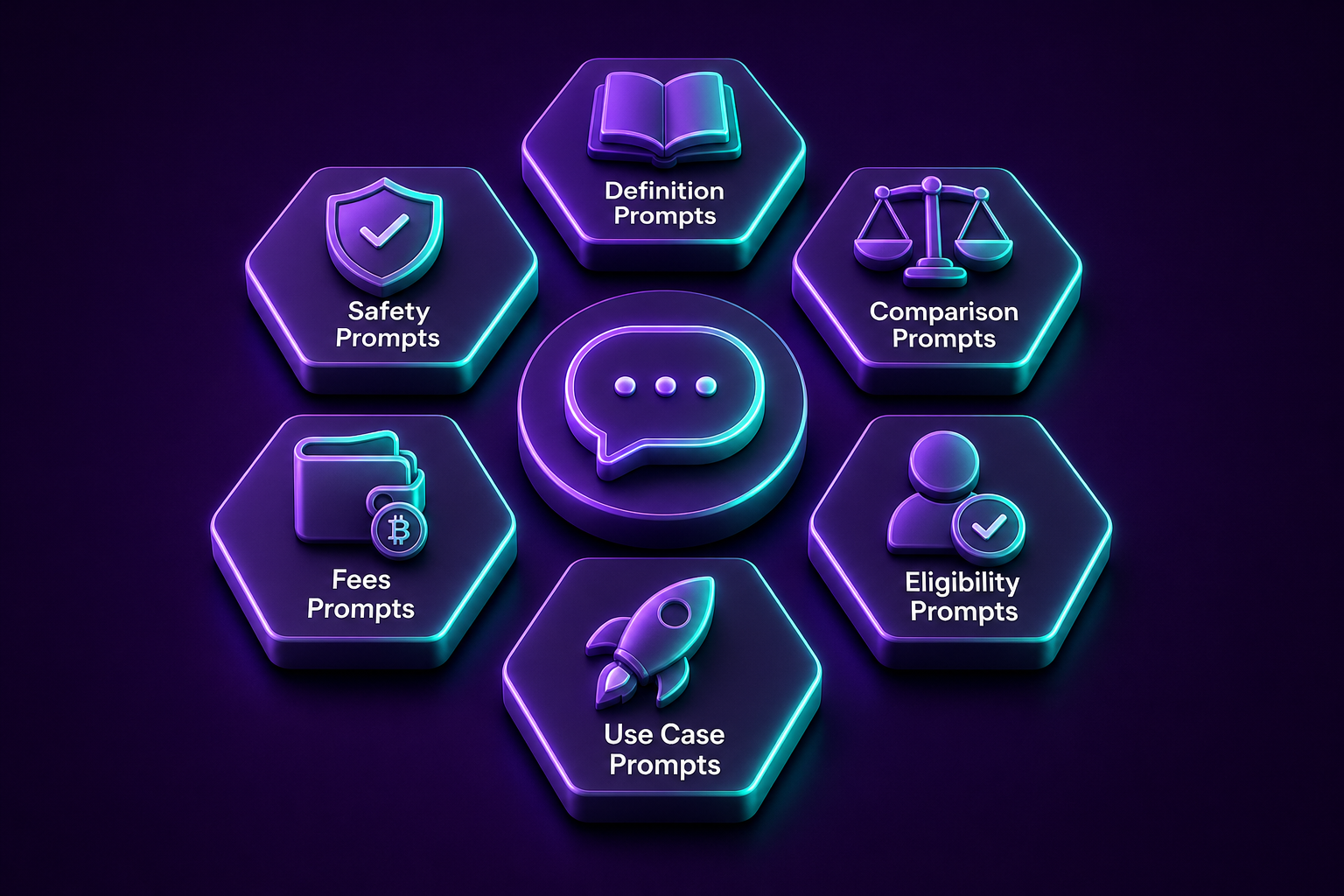
Sort every prompt you collect into one of seven clusters. A brand can be dominant in one and a ghost in another, and a single aggregate score papers over that completely.
Definition prompts ask what a thing is. "What is a liquid staking token" or "what does a Layer 2 actually do" are broad, usually unbranded, and often the first handshake a newcomer has with your category. Losing visibility here is a top-of-funnel problem, and it compounds quietly for months before anyone notices.
Safety prompts are where trust actually gets decided, not where it gets claimed. "What evidence should I check before using a [category]" or "is [project] legitimate" sit in this cluster. They're the prompts most likely to surface third-party commentary over your own marketing copy, whether you like it or not.
Comparison prompts follow the pattern "[Project A] vs [Project B] for [specific use case]." These are high-intent and competitively brutal, because the model has to pick a framing, and whichever framing it picks tends to calcify across the rest of the conversation.
Fees prompts ask "what is the total cost of using [category] for [transaction]." Crypto fee structures are a genuine mess of gas costs, withdrawal fees and spread, and a model that gets this wrong isn't making a small error; it's repeating bad math at scale to everyone who asks.
Eligibility prompts cover "which [category] can residents of [jurisdiction] use." This is one of the highest-stakes clusters in the whole category, because a wrong answer can point someone toward a product they're not actually permitted to touch.
Use case prompts ask "which [category] supports [network, standard, or integration]," the technical-fit question a builder or power user needs answered before they spend an afternoon evaluating something properly.
Investment research prompts, the seventh cluster, catch the skeptical end of the funnel in the act of being skeptical. "What are the main risks or limitations of [project/category]" and "what are credible alternatives to [incumbent] for [persona]" both belong here. They are the prompts most likely to hand your spot to a competitor if your own crypto content never addresses the question head-on.
Here's the full pattern set, usable as a starting panel for any category:
| Cluster | Representative prompt pattern |
| Safety | "What evidence should I check before using a [category]?" |
| Comparison | "[Project A] vs [Project B] for [specific use case]" |
| Eligibility | "Which [category] can residents of [jurisdiction] use?" |
| Fees | "What is the total cost of using [category] for [transaction]?" |
| Technical fit | "Which [category] supports [network, standard, or integration]?" |
| Risk/limitations | "What are the main risks or limitations of [project/category]?" |
| Alternatives | "What are credible alternatives to [incumbent] for [persona]?" |
Prompts by Project Category
The seven clusters above are a skeleton. Every project category dresses it differently, because the thing a buyer is genuinely nervous about shifts with the product in front of them.
Exchanges get hammered on safety and eligibility above all else: "is [exchange] regulated in [country]," "what happened during [exchange]'s last outage," "does [exchange] support fiat withdrawal to [country]." A wrong answer on jurisdiction here isn't a brand inconvenience. It's a compliance problem wearing a marketing costume.
Wallets skew toward technical fit and fees: "does [wallet] support [chain]," "what are the gas fees for [wallet] on [network]," "is [wallet] non-custodial." Custody is the single word that reframes almost every wallet prompt, because the answer determines who is left holding the bag if something breaks.
DeFi protocols live or die on risk and comparison prompts: "what is the smart contract risk for [protocol]," "[protocol A] vs [protocol B] for yield," "has [protocol] been audited and by whom." These prompts are most likely to pull a third-party audit report into the answer instead of your own copy, so the audit itself becomes part of your AI visibility whether you planned for that or not.
Infrastructure providers, oracles, bridges, RPC providers, get technical-fit and use-case prompts almost exclusively: "which oracle supports [chain] for [use case]," "what is the uptime history of [bridge]." This audience asks narrow, precise questions, and a vague answer reads as a red flag rather than as flexibility.
Gaming and metaverse projects sit closer to definition and comparison prompts, because the category itself is still being explained to newcomers: "what is play-to-earn," "[game A] vs [game B] for new players." Use-case prompts only follow once someone has decided the category is worth the time.
Stablecoins concentrate almost entirely on safety and fees: "what backs [stablecoin]," "has [stablecoin] ever depegged," "what is the redemption fee for [stablecoin]." Depeg history is the one question that decides, in a single answer, whether a model recommends a stablecoin or quietly files it under caution forever.
Tokenized assets, RWAs chief among them, lean hardest on eligibility and investment-research prompts. The buyer question is rarely "does this work" and almost always "am I legally able to hold this, and what happens if the underlying asset defaults." Those two questions alone account for a disproportionate share of the serious research this category gets.
Build a starter panel per category using the seven-cluster table as the frame, then weight it toward whichever two or three clusters carry the real anxiety for that product. A gaming project spending its panel budget on fee prompts is testing the wrong fear entirely.
Add Geography, Persona, and Risk Modifiers
A single prompt pattern is never one prompt. It's a template that multiplies the moment you add who's asking, from where, and how cautious they already are.
Take "best exchange for beginners." Add a country and the honest answer changes completely, because licensing, fiat on-ramps, and which exchanges even operate there differ by jurisdiction. Add an experience level and the answer should shift again: "best exchange" for someone who has never touched crypto isn't the same recommendation as "best exchange" for someone already running a hardware wallet and comparing maker-taker fee schedules for sport.
Asset type is its own modifier, and a sneaky one. "Best wallet" means something different depending on whether the person is asking about Bitcoin, a specific EVM chain, or a basket of NFTs. Custody preference is just as decisive: a buyer who explicitly says "non-custodial only" is really asking a safety question in a technical-fit disguise.
Compliance need is the modifier that gets skipped most often, and it's the one that bites hardest. "Which exchange can a US resident use" and "which exchange can a UK resident use" aren't two flavours of the same prompt. They're two different prompts with two different correct answers, and a brand accurately represented in one and absent from the other has a real gap, not a rounding error to shrug off.
Practically, test every cluster in your taxonomy with at least two or three modifier combinations rather than once in the abstract. "What is the total cost of using [DeFi protocol] for [transaction]" run with no modifier, then again with "as a beginner in the UK" and "as an institutional desk," will frequently surface three different answers from the same model. That spread, not any single answer, is the signal you're actually hunting for.
Build a Representative Test Panel
A panel built entirely from branded prompts tells you how accurately you're described. One built entirely from unbranded prompts tells you whether you show up at all. Build only one of those and you're flying with half the instruments dark.
Balance the panel across a few axes rather than piling prompts into whichever cluster is easiest to write on a Tuesday afternoon:
- Head terms — broad, high-competition prompts like "best crypto wallet," where dozens of brands are plausible answers
- Mid-tail — "best non-custodial wallet for DeFi users," narrower and genuinely more winnable
- Long-tail — "best wallet for staking on [specific chain] with hardware support," where a correct, specific answer is actually achievable
- Branded — prompts naming your project directly, testing factual accuracy and reputation rather than discovery
- Unbranded — prompts naming only the category, testing whether you get discovered at all
- Positive-framed — "best [category] for [use case]"
- Skeptical-framed — "is [category/project] safe" or "what are the risks of [category]"
- Comparison-framed — prompts naming you against a named competitor
Branded prompts should never be an afterthought bolted onto the end of an unbranded list, however tempting that is when you're short on time. They reveal whether a model gets a basic fact about you wrong, misattributes a feature, or surfaces something you fixed eighteen months ago, problems no amount of unbranded visibility work will ever touch.
A workable starting panel runs 25 to 40 prompts per project for a single category, covering all seven clusters with at least one head, one mid-tail and one long-tail variant each, split roughly evenly between branded and unbranded. Multi-category projects need a panel per category rather than one shared list cobbled together, because the clusters that matter shift hard with the product, exactly as the previous section showed.
Run and Score the Panel
Running the panel once tells you almost nothing, because model answers drift between runs even for an identical prompt fired twice in a row. The value sits in the log, kept consistently, not in any single glorious screenshot.
Log every run with the same fields, every time, so the data is actually comparable across months instead of a pile of anecdotes.
| Field | What to capture |
| Model | ChatGPT, Gemini, Claude, Perplexity, Grok |
| Date | Run date, for trend tracking over time |
| Mode | Default chat, search-enabled mode, or a specific agent/app |
| Exact prompt | Verbatim wording, including any modifier |
| Mentioned | Yes/no — does your brand appear at all |
| Cited | Yes/no — is a source link attached to your mention |
| Recommended | Yes/no — are you the answer, or one of several listed |
| Sentiment | Positive, neutral, negative, or mixed |
| Accuracy | Correct, partially correct, or wrong, against your own canonical facts |
| Competitors named | Which other projects appeared in the same answer |
Run the full panel on a fixed schedule rather than whenever someone remembers to, because the comparison only holds if the gap between runs stays consistent. A monthly run on priority clusters, with safety, comparison and eligibility earning that frequency, and the full panel re-run quarterly, is a reasonable baseline for most teams without a dedicated analyst.
Score consistently and you get something closer to a coverage map than a vanity screenshot: which clusters you dominate, which you're a ghost in, and which you appear in but get described like a stranger wrote your biography. That last category is often the most fixable and the most ignored, because a "mentioned but wrong" result still shows up as a mention on anyone too lazy to check accuracy separately.
An E-E-A-T for crypto websites problem and a GEO coverage problem usually share one root cause: the canonical facts about your project aren't published anywhere a model, or a human researcher for that matter, can find them cleanly. Academic work backs this up at scale. A study analyzing 1,909 query-LLM pairs across six models and 30 brands found mention-rate disparities as wide as 88.9% against 58.3% between model groups, which means the gap you're scoring isn't a fluke of one unlucky run. It's structural, and it's exactly what a scoring log is built to catch.
Turn Coverage Gaps Into a Content Roadmap
A coverage gap is a diagnosis, not a complaint to vent about on Telegram. Every row in your scoring log where you're absent, miscited, or flatly wrong against your own facts maps to a specific fix, and the fix is rarely "write more content" in the lazy, generic sense.
A prompt where you're simply absent, no mention at all, usually means there's no page answering that exact question in language a model would ever retrieve. The fix is a new page or section built around that precise question, not a reshuffle of copy you already have sitting idle.
A prompt where you're mentioned but described inaccurately points somewhere narrower. Your own documentation is unclear, contradictory, or silent on the specific point the model fumbled. Fixing your canonical source, a docs page, an FAQ, a terms page, matters more here than publishing anything new.
A prompt where a competitor gets recommended and you don't, despite a comparable offering, usually signals a third-party validation gap rather than a content gap. Models lean on independent sources for comparison and risk questions precisely because brand-owned claims are the least trustworthy evidence category available to them. An audit, a review, or coverage from an independent outlet closes that gap faster than another self-published blog post, which is a bitter pill if you've spent the quarter writing exactly that.
A prompt where the underlying issue is product-level, a feature genuinely doesn't exist yet, isn't a content problem at all. Flag it to product and move on; no amount of polishing a sentence fixes a missing feature.
Prioritize by funnel stage and risk level before raw volume. A single wrong answer on an eligibility prompt is worth fixing ahead of ten missing mentions on a head-term definition prompt, because the downside of the first is someone doing something they're not legally permitted to do.
Conclusion
Rebuild the taxonomy quarterly and re-run priority clusters monthly; that's the cadence that catches drift before it hardens into a pattern a user actually acts on. Treat this panel as the raw input to a larger metric, not as the finished product you report upward.
Once you're logging mentions, citations and sentiment consistently across models, you're already most of the way to tracking share of model voice for your category over time, the number that actually tells a board whether any of this is paying off.
Start with the safety and eligibility clusters if you only have time for one thing this quarter. Those are the prompts where a wrong or absent answer does real damage, not merely a missed impression nobody was counting. Leave investment-research and definition prompts for the second pass; they matter, but they are rarely where a buyer gets burned by bad information first.
Do you know which AI questions decide whether your crypto brand is discovered? Contact Coinpresso for a category prompt map and visibility baseline.
FAQs
Can we see exact ChatGPT search volume for crypto prompts?
No, there is no public, keyword-style volume tool for ChatGPT prompts the way there is for Google search terms. Build your estimate instead from first-party signals, support tickets, site search, Search Console, and community channels, and disclose that sourcing method rather than presenting a guess as a hard number.
How many prompts should a crypto GEO audit include?
There's no universal count; coverage should match category complexity and the number of real decision paths a buyer walks through. A single-product exchange might need 25 to 40 prompts across the seven clusters, while a multi-chain DeFi protocol with several user types needs a panel per category, not one shared list.
Should branded prompts be included?
Yes, always, alongside unbranded ones rather than instead of them. Branded prompts reveal factual accuracy and reputation issues, where unbranded prompts reveal whether you get discovered at all, and a panel built from only one half is flying blind on the other.
How often should the list be refreshed?
Run priority clusters, safety, comparison and eligibility, monthly, and re-run the full panel quarterly. Move faster than that after a product launch, a regulatory shift, or a competitor's rebrand, since any of those can change an answer overnight.
What should a team do when a prompt produces a wrong answer?
Trace where the model likely pulled the claim from, fix the canonical source behind it, whether that's your docs, your FAQ, or a terms page, and retest across several runs rather than tweaking the prompt until it happens to come out right. Our case studies show this correction work is usually cheaper and faster than chasing a new piece of content from scratch.