


A wire release and a CoinDesk feature both arrive in your inbox looking like "coverage." One cost you a card payment and a template. The other cost you weeks of pitching, a journalist's judgment call, and the uncomfortable possibility that they say no. CoinDesk's own advertising policy spells out exactly why those two things can never be graded on the same scale: its editorial desk does not sell articles or accept pitches in exchange for payment, and keeps its partnerships team walled off from anything carrying a byline.
That one sentence quietly ends a debate half the crypto PR industry still has with a straight face, about whether a wire blast and an earned feature are the same product at different price points. They are not, and the confusion in crypto earned media vs wire distribution costs founders real budget every quarter. A lot of crypto marketing teams buy fifty syndicated placements because the invoice looks like progress, then wonder why nobody outside their own Telegram noticed. This piece sets out what an owned announcement, a wire, a sponsored placement and an independently reported feature are each built to do, and how to stop buying the wrong tool for the job sitting in front of you.
Four Distribution Models
Four distinct things get lumped together under "PR," and treating them as one is where budgets go to die. Each has a different owner, a different relationship with its audience, and a different ceiling on what it can achieve.
An owned announcement is anything published on channels you control outright: your blog, your docs, your X account, your mailing list. Nobody edits it, nobody checks it against a second source, and nobody but you decides when it goes live. It is a notary stamp, not a character reference. It proves something happened and says nothing about whether anyone outside your own community should care.
A wire release is an owned announcement wearing a bigger coat. You still write every word and nobody edits it, but a paid network pushes it out across hundreds of partner sites simultaneously. The outlets carrying it are paid or contracted to do so, not persuaded by news value, which is the detail most pitches to founders conveniently skip.
Sponsored or native content sits one rung up the ladder. You pay a specific outlet to publish something under its own template, sometimes its own byline, but the commercial arrangement has to be flagged under FTC guidelines on native advertising. The outlet's name is attached, and so is a "sponsored" label, because the law says it must be.
Independently reported coverage is the only one of the four where a journalist decided, on their own judgment, that your story earned a slot in front of their readers. Nobody paid for the piece to exist. That is why it is the hardest of the four to get, and the only one that functions as proof rather than self-description.
What Each Model Can and Cannot Do
Each model trades control for credibility at a different exchange rate, and no amount of spend moves a release from one column to another. Here is the comparison worth pinning above your desk before the next budget meeting.
| Model | Who controls the message | Editorial independence | Disclosure required | Typical lifespan | How you measure it |
| Owned announcement | You, entirely | None, it's yours | No | Indefinite, low discovery | Site traffic, click-through |
| Wire release | You, entirely | None | No, but link attribution matters | Days visible, then buried | Syndication count, referral clicks |
| Sponsored/native content | Shared, outlet applies house style | Limited, outlet keeps some tone control | Yes, must be labeled | Weeks to months | Pageviews, disclosed referral traffic |
| Independently reported coverage | Journalist, almost entirely | Full | Not applicable, it isn't paid for | Years, often indexed and cited long after | Mentions, backlinks, inbound inquiries |
Reach and control sit at opposite ends of that table. A wire buys reach with nobody's judgment attached to it. Independent coverage buys judgment at the cost of surrendering the final wording entirely.
Lifespan is the column founders underrate most. A wire-distributed release gets buried under the next day's news cycle on every site that carried it. A feature that runs in a trusted outlet keeps surfacing in search results, and increasingly in AI-generated answers, for as long as that outlet keeps its archive indexed.
Why Independent Reporting Is Different
Independent coverage is hard to get, full stop. A journalist has to find your story worth their time against everything else competing for that slot the same week, and most pitches simply lose.
A reporter working a story typically checks your claims against a second source before running with them. A block explorer, an audit, a founder interview, another outlet's prior coverage. CoinDesk's ethics policy describes this as independence maintained through a dedicated committee that separates the newsroom from the business side entirely.
That friction is a feature, not a bug. It is the exact mechanism that makes a reader trust the result more than they trust your own announcement.
The trade-off is losing message control the moment a journalist takes your pitch. They may lead with an angle you would never have chosen, quote a critic alongside you, or simply pass and move on. No agency, however deep its contact book, can promise the outcome of someone else's editorial judgment. Any pitch that claims otherwise is selling a result that does not exist.
This is also why independent coverage is the only model of the four that works as genuine third-party validation. A wire release says: we said this about ourselves, and we paid to have it repeated widely. A feature says someone with nothing to gain checked this and decided it was worth telling their readers.
When a Wire Is Useful
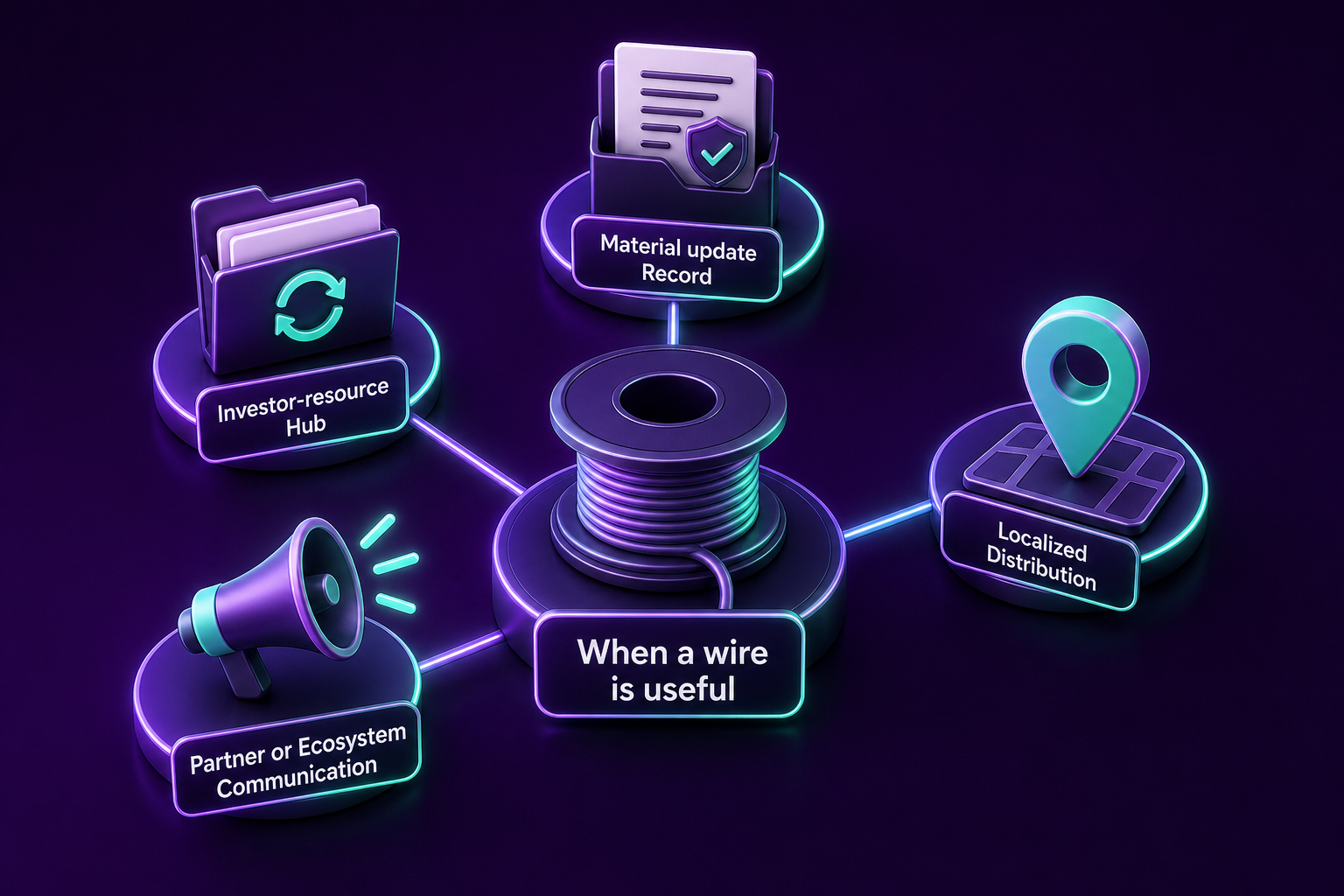
A wire release earns its cost when the job is record-keeping or reach, not persuasion. It is the right tool in at least four recurring situations.
- Material update record. A mainnet launch, a token generation event, a leadership change. You need a timestamped, widely distributed public record that the announcement happened, fast.
- Investor-resource hub. Some wires feed directly into financial data terminals and investor-relations aggregators that institutional readers already monitor, a channel earned coverage does not automatically reach.
- Localized distribution. Regional crypto press across Korea, Japan or Southeast Asia is a market where a wire network holds placement relationships your own team simply does not.
- Partner or ecosystem communication. A joint announcement with an exchange or protocol partner needs a neutral, simultaneous public record rather than a persuasive narrative.
None of those four jobs is "convince a skeptical reader this project is credible." A wire can document an event at scale, but it was never built to earn trust. Expecting it to do a journalist's job is where most disappointment with wire spend actually starts.
There is a second, quieter reason wires disappoint founders chasing search rankings specifically. Google's spam policy names press releases distributed on other sites carrying optimized anchor text as link spam unless those links carry a nofollow or sponsored attribute. A wire blast was never meant to move your rankings. For years it quietly did anyway, until the policy caught up with the practice.
The Credibility and Disclosure Test
Sponsored coverage can be a legitimate part of a crypto PR strategy, but only when the paid relationship is disclosed in plain sight, not buried in a footer link nobody scrolls to. The FTC does not treat crypto as a special case here.
FTC guidance makes clear that disclosure rules apply across platforms, from a sponsored article to a paid social post, and that labels like "sponsored" or "#ad" need to be obvious rather than technically present somewhere on the page.
Readers decide how much weight to give a piece of content partly on who paid for it. A hidden sponsorship does not just risk a regulatory letter. It quietly poisons the trust the content was supposed to build in the first place.
Run a simple test on anything your team is about to publish. If a reader found out after the fact that you paid for it, would they feel misled? If the honest answer is yes, the disclosure is not doing its job, however compliant the small print claims to be.
The Decision Matrix
Matching the message to the channel is the entire discipline, and most bad spending decisions in crypto PR come from skipping this one step. Here is how to read it.
| Your objective | Best-fit channel | Evidence you need ready | Risk if mismatched |
| Timestamp a material event | Wire release or owned announcement | Verified facts, dates, on-chain proof | Low, but low payoff too |
| Reach a regional or institutional audience | Wire with relevant network relationships | Localized messaging, compliance review | Medium, wasted spend if network doesn't fit audience |
| Build third-party credibility | Independently reported coverage | Audit results, usage data, a story worth telling | High effort, no guaranteed outcome |
| Explain a product or thesis in depth | Sponsored/native content, clearly labeled | A genuinely informative angle, not a disguised ad | Reputational, if disclosure is weak |
Evidence readiness is the column founders skip, and it decides whether a journalist even opens your second email. A reporter asked to cover a claim with no audit, no usage numbers and no verifiable detail has no story, however newsworthy the headline sounds in your pitch.
Risk here rarely means legal risk. It means wasted effort and credibility spent on the wrong channel. A wire blast bought to do a journalist's job does not fail quietly. It can read as a tell to anyone checking your coverage history afterward, the marketing equivalent of shouting your own praises in an empty room and calling it a reputation.
Conclusion
A crypto PR mix that works treats these four channels as different tools for different jobs, not four price points on the same menu. Run the matrix above before a release goes out, not after the invoice lands on your desk.
Here is the gap worth naming plainly: Coinpresso has not published its own placement-cost-to-referral-traffic comparison showing what a single earned feature returned against fifty syndicated wire hits, and nobody honest in this industry has published that number either. Ask any PR partner, Coinpresso included, how they would measure success against the objective you have actually named, before you commit spend to a wire or a feature pitch. Our case studies show the kind of evidence that question should produce.
Fix the objective first, before you fix the channel. Choose each tool for the job it actually does, not the job the invoice implies it does. Contact Coinpresso to build a crypto PR mix around evidence, audience, and outcomes.
FAQs
Is wire distribution the same as earned media?
No. A wire release is paid syndication you write yourself with nobody's editorial judgment attached, while earned media is independently reported coverage a journalist chose to publish unpaid. Treating crypto earned media vs wire distribution as interchangeable is exactly how budgets end up spent on the wrong objective.
Can a PR agency guarantee a CoinDesk feature?
No, and any agency claiming otherwise is selling something that does not exist. CoinDesk's own policy states its editorial team does not sell coverage, so the honest version of this service is pitching strategy and evidence, not a guaranteed placement.
When is a wire release still useful?
A wire earns its cost for record-keeping jobs: a material update that needs a timestamped public record, localized distribution into a regional network, or a joint announcement with a partner. It is the wrong tool whenever the actual goal is persuading a skeptical reader your project is credible.
Does syndicated content help SEO?
Rarely, and sometimes it actively hurts. Google's own spam policy names press releases with optimized anchor text distributed across other sites as link spam unless tagged nofollow or sponsored, so a wire blast built for rankings can work against the result it was bought for. Our crypto SEO guidance covers what does move rankings instead.
How should sponsored coverage be disclosed?
Clearly and visibly, not buried in a footer. FTC guidance requires sponsored content to be obviously distinguishable from editorial coverage, with plain labels like "sponsored" or "#ad" rather than technical compliance nobody notices.