

That link in your press release is almost certainly nofollow or sponsored, and no, the wire didn't shortchange you. Google says so itself, in writing: nofollow is "still an acceptable way to flag" a paid link, sponsored is simply the one it now prefers, and most of the crypto PR industry still sells you the attribute as a defect to be quietly engineered around.
Once you stop expecting that link to carry SEO weight it was never built to carry, the question changes shape entirely. What you actually bought is a placement, and the only way to know what a placement is worth is to open the page and check it, the way you'd check an invoice line by line instead of waving the total through. That audit, not the attribute, is what this post walks you through, and it's the same forensic habit worth bringing to every crypto marketing decision that hinges on a vendor's claim rather than your own eyes.
What the Link Labels Mean
Three rel attributes govern paid and user-generated links: sponsored, ugc, and nofollow. Each tells a crawler something specific about why a link exists, and none of them is a penalty box.
Nofollow was the original workaround for paid links, and Google's own documentation still treats it as valid: the attribute to use "when none of the above fit your scenario," with sponsored now the recommended choice for anything commercial. ugc exists for comments and forum posts a site doesn't control. Nofollow mops up everything else, which means plenty of links wearing it have nothing to do with payment at all.
None of these attributes amounts to a quality verdict. Google treats all three as hints, not instructions it's obliged to follow, signals it may weigh when deciding what to crawl and how much credit to pass, not a switch that turns a page off. A sponsored link on a respected outlet and a sponsored link on a content farm carry the identical attribute and wildly different value, because the tag was never measuring quality in the first place. It was measuring intent.
A press-release wire exists to distribute paid content at scale, and sponsored is the attribute built for exactly that job. If your distribution package came back nofollow instead, a vendor picked the older of two acceptable options. Nothing went wrong, and nobody owes you an apology for it.
Paid Placement Is Not Earned Reporting
A press-release feed, an advertorial, a contributed piece and an editorial article are four different products wearing similar fonts. Knowing which one landed on your desk changes what you're entitled to expect from it, and most founders never find out until it's too late to matter.
A wire feed is syndication: your release, largely unedited, pushed to a network of partner sites that agreed to carry the feed. An advertorial is commissioned content dressed to resemble an article, usually with a disclosure label somewhere on the page if you go looking for it. A contributed piece sits a notch closer to editorial, a named author writing under the outlet's style guide but still at the outlet's discretion on whether it runs at all.
Editorial coverage is the only one of the four where a journalist chose your story because they judged it worth telling, not because an invoice cleared first. That's the whole difference in one sentence, and it's the one wire vendors would rather you didn't say out loud.
This distinction matters because the four get marketed to founders almost interchangeably. A reader seeing "featured on [major outlet]" has no way of knowing which of the four they're looking at until they go and check the page themselves, which is precisely why crypto earned media carries more trust with a skeptical crypto audience. It's the one format nobody can wave away as simply bought.
None of this makes paid placement worthless. It makes it a different tool bought for different reasons: reach, a timestamped public record, discoverability. Pretending it's earned coverage is the mistake. Buying it with your eyes open isn't.
The Five-minute Placement Audit
Run this on every URL a vendor sends you, before you count it as a result. It takes about five minutes once you know where to look, and it tells you more than any report a wire will volunteer unprompted, because a report is marketing and a page source is not.
Here's the checklist:
- Label — Is "Sponsored," "Advertisement," or "Press Release" visible on the page itself, not buried in a footer three scrolls down?
- Byline — Named journalist, generic staff byline, or no byline at all?
- Disclosure — Does the page state a commercial relationship near the headline, not whispered somewhere beneath the fold?
- URL structure — Does it sit in a /press-releases/ or /sponsored/ path, or does it look like a normal article URL?
- Canonical tag — View page source and check the rel="canonical" value. Does it point to this URL, or to a syndication source elsewhere, meaning this copy isn't the authoritative version?
- Link attribute — Right-click the link to your site, inspect the element, and read the rel value directly instead of trusting what the vendor claimed.
- Page context — Is it surrounded by other obvious press-release syndication, or does it sit among the outlet's normal editorial content?
Run this across a whole campaign and the variance shows up fast, like turning the lights on in a kitchen you've only ever seen by candlelight. Some wires deliver exactly what they promised. Others pad a report with pages that technically exist but were never built to be found by anyone.
We don't yet hold a cross-wire dataset telling us what share of placements come back sponsored versus plain nofollow versus nothing at all. That's a gap in the industry's own evidence, not just ours, and it's exactly why running the check yourself still beats taking anyone's summary on faith.
What a Nofollow or Sponsored Link Does Not Mean
A nofollow attribute does not mean the page is low quality, unindexed, or being ignored by readers. It means a site owner, or a wire following the rules, told a crawler how to treat one specific link. Nothing more, and crucially, nothing about the page around it.
This cuts both ways, and both directions get misrepresented constantly in sales decks. A sponsored link doesn't mean the content is worthless, and a dofollow link doesn't mean the content is credible. Treat the rel attribute like a lie detector and you'll believe whatever it tells you, including the lies.
A page can carry a nofollow link and still be indexed, still get read, still get picked up by a journalist doing background research for an unrelated story months later. Equally, a page with a clean dofollow link and zero disclosure can be exactly the kind of placement that torches trust the moment a reader works out what it actually is.
Treating the rel attribute as a scorecard is the single most common error buyers make, and wire vendors are happy to let the confusion ride, because it keeps the conversation on links instead of on what actually got published. If what you're really chasing is visibility inside AI-generated answers rather than classic search rankings, the mechanics are a different animal again, and no rel attribute decides who gets cited there. Our generative engine optimization for Web3 guide covers how large language models weigh citations, which runs on entirely different signals from the one printed on your link.
Why Disclosure Matters to Readers
Disclosure isn't a legal box-ticking exercise. It's the thing that decides whether a reader trusts you after they work out what they read was paid for, and get it wrong and the resentment sticks to your project, not the outlet that ran the piece.
Regulators treat this the same way readers instinctively do. The FTC's endorsement guidance requires material connections between a publisher and an advertiser to be disclosed clearly and conspicuously, not technically, not eventually, not in a font nobody reads.
A crypto audience in particular has been burned by presales that vanished and projects that bought their way into headlines with nothing behind them. A clearly labeled sponsored piece reads as a team that respects its reader enough to be straight about the arrangement. An unlabeled one that gets spotted anyway reads as a team trying to sneak one past the exact people it's asking to trust with money, and that is a far worse outcome than the placement never running at all.
Net impression is the whole game here. A disclosed placement that's genuinely useful still does its job. An undisclosed one that's technically legitimate but reads as deceptive the moment it's noticed can undo months of community-building in a single screenshot.
What to Ask a PR Vendor Before Purchase
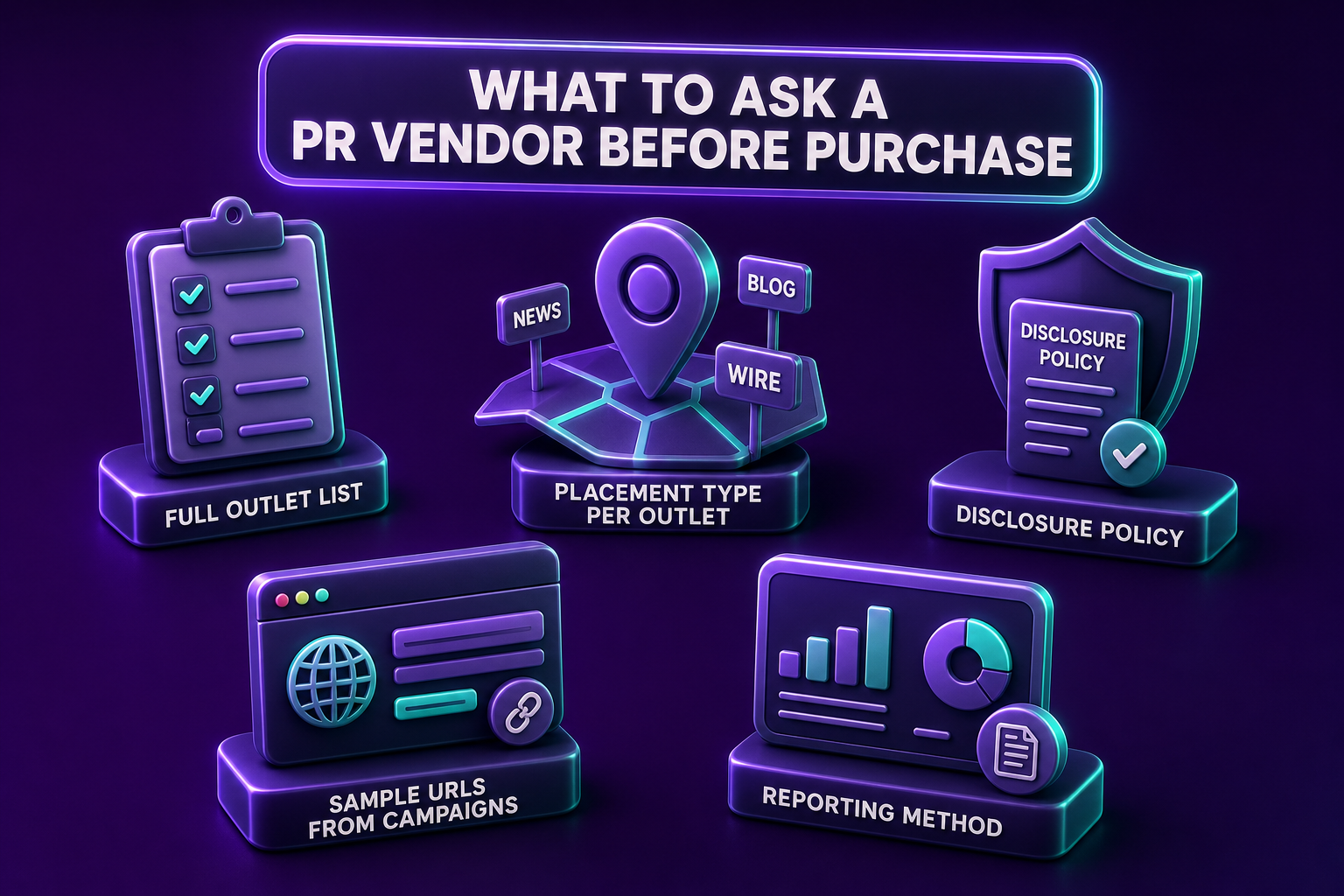
Ask these five questions before you sign anything, and get the answers in writing, not on a sales call where "it depends" passes for an answer.
| Ask for | Why it matters |
| Full outlet list | Generic "100+ sites" claims hide low-value syndication partners behind a handful of recognizable names |
| Placement type per outlet | Wire feed, advertorial, or contributed piece — each behaves differently once published |
| Disclosure policy | Whether the outlet labels paid content clearly, or leaves it deliberately ambiguous |
| Sample URLs from recent campaigns | A real placement to run the five-minute audit against before you commit budget |
| Reporting method | Whether results arrive as "placements delivered" or include any attempt at reach or engagement data |
A vendor who answers all five without flinching is telling you they know exactly what they're distributing and are comfortable with you checking their work. A vendor who answers with "it depends" or redirects you to a glossy PDF is telling you something too, and it's worth listening to.
Conclusion
A press release's link was never going to carry your crypto SEO on its back, and expecting it to was always the wrong bet placed against the wrong attribute. What it can do, properly priced and properly checked, is put a dated, citable, discoverable version of your announcement on outlets a buyer or journalist might already trust, and that's worth paying for on its own terms once you stop grading it against a job it was never built for.
Run the five-minute audit on every placement you've already paid for before you buy another one. Most teams learn more about a vendor from checking the rel attribute and the canonical tag on last quarter's campaign than from any report that vendor sent unprompted.
Save the checklist above, print it, pin it above your desk, whatever keeps it in front of you the next time a vendor sends a batch of URLs. If you want a crypto PR strategy built around evidence, message discipline and channel fit rather than a vague promise of backlinks, contact Coinpresso for a crypto PR placement audit. Do not buy another domain list. Inspect the placement you already have.
FAQs
Is rel=sponsored better than nofollow for paid links?
Google states sponsored is now its preferred attribute for paid links, though nofollow remains acceptable when nothing else fits. Neither one guarantees indexation or ranking credit, so the real work is still checking what the page itself discloses, not which tag it wears.
Are all press-release links nofollow?
No. Many wires use sponsored instead, some mix attributes across different partner sites in the same distribution network, and a few leave links unmarked entirely, which is its own red flag. The only way to know what you received is to inspect the delivered URL yourself using the five-minute audit above.
Can a sponsored article be useful even if the link is qualified?
Yes. A sponsored tag has no bearing on whether real people read the page, whether a journalist stumbles on it later, or whether it serves as a dated public record of your announcement. Judge the placement on discoverability and disclosure, not on the rel attribute sitting underneath it.
How can I tell whether a placement was editorial or paid?
Check the byline, the disclosure label near the headline, and whether the outlet's own newsroom or a wire feed produced the piece; our crypto earned media page breaks down how genuine editorial coverage differs from paid syndication. A named journalist writing under the outlet's own judgment is editorial; a release pushed unedited through a distribution network is not.
Should a project ask for dofollow links in a paid campaign?
No. Google's link-spam guidance treats unqualified paid links as exactly the kind of signal it wants flagged, so pushing a vendor for dofollow is asking them to misrepresent the relationship to a crawler. Ask instead for outlet quality, disclosure practice and a verifiable sample URL, the things that are still visible after launch once the campaign report has been filed away.