


Ask five founders which crypto SEO agency they'd hire and you'll get the same four or five names back, usually in the same order, usually lifted from whichever listicle they read last. It's consensus by copy-paste. The same agencies feature on each other's lists, the same self-reported traffic percentages get requoted as fact, and "backlinks, content, technical audit" gets treated as the whole job when it's barely the fee you pay on the door.
Nobody in that conversation asks the harder question: whether any of these agencies have actually solved the problems that make crypto SEO different from SEO. Not different as a sales line, different in ways Google's own systems now punish hardest.
Fragmented documentation, dynamic token data, and a YMYL classification that treats a DeFi protocol's blog post with the same suspicion as unlicensed medical advice. A lot of crypto marketing teams reading this will recognize the pattern before we finish the sentence.
Most of the hiring decisions in this space still get made on vibes and a homepage full of logos, which is exactly why a founder running crypto Google Ads alongside an SEO retainer rarely has a straight answer to "why this agency". This piece ranks five agencies against a harder bar: not how loudly they market themselves, but whether they've actually solved the technical problems Google now punishes hardest in this niche.
The State of Crypto SEO in 2026
Generic SEO tactics fail in crypto because Google doesn't treat crypto content like other content. It treats it as YMYL, Your Money or Your Life, a bracket Google's own quality rater guidelines reserve for topics that can directly affect someone's financial stability or safety.
That single classification changes everything downstream. A blog post ranking a DeFi yield strategy gets scrutinized the way a medical claim would, not the way a listicle about kitchen gadgets does. An agency that built its playbook on e-commerce or SaaS content hasn't had to clear that bar before, and it shows.
The problem compounds because crypto sites aren't built like normal sites. Documentation lives in GitBook, code lives in GitHub, price data updates by the minute, and half the product experience happens inside a dApp that a crawler struggles to parse at all.
A crypto SEO strategy that ignores this architecture is optimizing a website that doesn't represent how the product actually works. It's polishing the shopfront window while the shop itself is round the back, unmarked.
And the ground is shifting anyway. Google's AI Overviews now correlate with a 58% lower average clickthrough rate for the page ranking first organically, up from 34.5% recorded eight months earlier in the same ongoing study.
Ranking first on Google matters a great deal less than it used to when the answer box above it is where most readers stop scrolling.
1. Coinpresso: the ROI-Driven Crypto SEO Leaders
Coinpresso takes the top spot because it treats crypto SEO and AI visibility as one job, not two retainers stitched together after the fact. The starting point is never keyword volume.
It's whether a keyword actually converts a reader into a wallet connection, a presale participant, or a protocol user. That's a different question to the one most SEO reporting bothers answering.
That distinction matters more than it sounds. Plenty of agencies will happily rank you for "crypto" and hand you a graph of impressions that means nothing to your treasury. A founder doesn't need more eyeballs, they need more wallets connected.
Coinpresso's Web3 SEO practice starts from an understanding of how dApp architecture, GitBook-hosted documentation, and on-chain data feeds actually get crawled and indexed. That's not a bolt-on skill.
It's the difference between an agency that can technically audit a website and one that understands why a protocol's whitepaper, its GitHub repo, and its Discord announcements all need to say the same thing in the same terms before an engine trusts any of them. That foundation feeds directly into how the team approaches crypto link building, not volume for its own sake but placements on outlets an AI model and a human reader both already trust.
Where Coinpresso differs most sharply from the rest of this list is refusing to treat search rankings and LLM citations as separate deliverables. The crypto generative engine optimization work runs from the same technical foundation as the SEO campaign, because the signals an LLM uses to decide who to cite, structured data, consistent entity naming, third-party corroboration, are largely the signals Google's algorithm already rewards.
A project doing one properly is most of the way to doing the other.
It's worth saying plainly what this listicle won't do: invent a headline traffic number for Coinpresso that hasn't been published anywhere. We don't have a named, figure-bearing SEO-only client case study live yet, but you can browse what is documented in the case studies section. Anyone weighing this against a current in-house effort can get a straight view through the contact page rather than take a stranger's word for it.
2. SeoProfy: Data-Driven Complex Niche SEO
SeoProfy plays the away match. Crypto is one of several complicated, high-stakes niches it takes on rather than its sole focus, and that shows up as breadth rather than crypto-native instinct.
According to its Clutch profile, an independent review platform rather than the agency's own marketing, the firm was founded in 2012 and has grown to over 100 specialists working across 45 countries. That third-party verification is worth more than most case studies in this space, because it isn't the agency grading its own homework.
The reviews on that profile describe engagements across several industries, with at least one account referencing a cryptocurrency trading platform that hired the team for link-building strategy specifically. It's a genuine signal, but a single verified crypto engagement inside a much wider portfolio.
What SeoProfy isn't is a crypto-first shop. The blockchain work sits inside a much broader roster, so a founder should ask directly how much of the team's day-to-day work is genuinely Web3-specific before assuming deep dApp or tokenomics fluency.
3. CryptoSEO.io: Dedicated Organic Growth
CryptoSEO.io earns its place on pure specialization. The name is the pitch: a firm that only does crypto SEO, built around E-E-A-T audits designed specifically for the trust and authority signals Google expects from a financial-adjacent site.
That singular focus is genuinely valuable for a founder who wants a team fluent in crypto terminology from the first call, no explanation required about what a token unlock schedule is or why it matters to content strategy.
The trade-off worth naming honestly: no independently verified, non-self-reported figures on the firm's founding date, team size, or client history were available for this piece, and its own published results are self-reported rather than audited by a third party. A founder evaluating any self-described specialist should ask directly how long the team has actually worked in Web3, and ask for a client reference they can contact themselves rather than a testimonial on the agency's own site.
4. GuerrillaBuzz: SEO & PR Synergy
GuerrillaBuzz's pitch is combining organic search work with digital PR, on the reasoning that a backlink from a respected crypto outlet does double duty. It's a ranking signal and a trust signal at once.
It's a sound premise, and it's why earned coverage tends to outperform a pure content play in a market this skeptical of anything that smells paid. A press mention reads as somebody else's judgment, not the project's own claim about itself, and that distinction is worth more to a skeptical reader than another paragraph of on-site copy.
The PR-plus-SEO model suits a project that wants its search strategy and its media strategy pulling in the same direction, rather than run by two separate vendors working from two separate briefs. It's a narrower service than a pure technical SEO shop, though, and a founder should confirm how much of the retainer buys actual technical work versus outreach and placement before signing.
5. ICODA: AI-Driven Crypto SEO & Visibility
ICODA leans hardest into AI search visibility of the five agencies here, with a full-funnel approach spanning SEO, content, and what it describes as AI-search dominance work: getting cited inside ChatGPT and Perplexity answers rather than just ranking on Google. The agency states it has served clients across DeFi, GameFi, iGaming, and exchange verticals.
It also publishes figures claiming steep AI-referral traffic growth for exchange clients. Those numbers are self-reported by the agency on its own case-study pages, not independently audited, so treat them the way you'd treat any stat a vendor publishes about itself: a directional signal, not a benchmark to hold anyone to.
The underlying strategy, building for AI citation deliberately rather than as an afterthought, is the right instinct for 2026 regardless of whose numbers you trust. The full-funnel promise is broad, which is either a strength or a dilution depending on how thin the team is spread across it. Ask for the account structure before signing, not after.
Technical SEO Challenges Unique to Web3
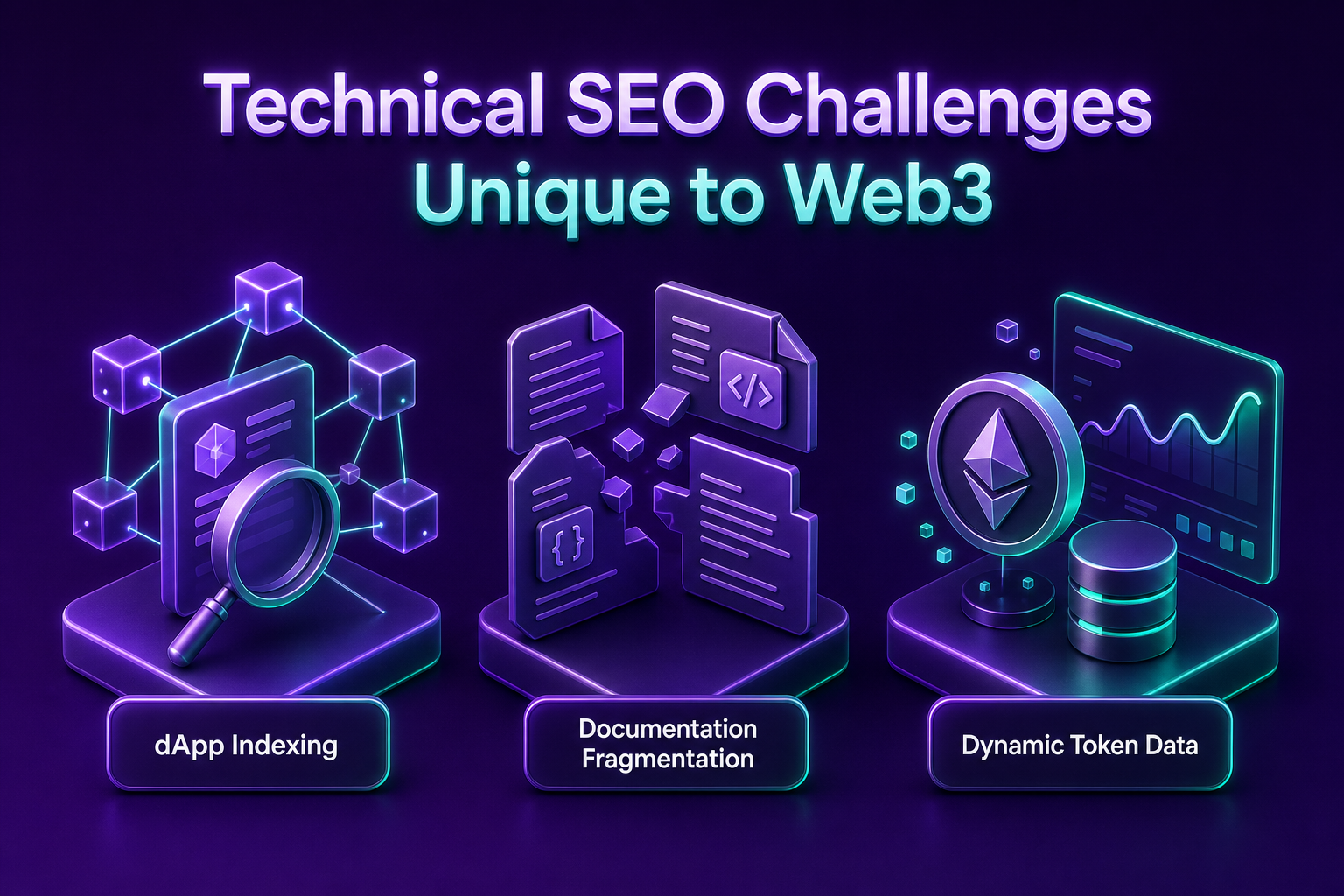
Three technical problems separate crypto SEO from every other niche, and none of them show up in a generic SEO audit template.
| Challenge | Why It Trips Up Generic SEO | What It Requires |
| dApp indexing | Client-side rendering hides content from crawlers, so a user sees a full product where a crawler sees an empty page | Server-side rendering or pre-rendering for key pages |
| Documentation fragmentation | GitBook, GitHub, Medium and Discord tell inconsistent stories about the same project | Unified entity signals across every surface |
| Dynamic token data | Prices and yields can go stale not long after a page is crawled | Structured data that updates automatically, not manually |
*Why Generic Audits Fail on Actual Web3 Projects: The Table Crypto Teams Wish They'd Seen First*
The first problem is dApp indexing. Most decentralized applications render content client-side through JavaScript frameworks, which is efficient for the user and close to invisible for a search engine that can't execute that code.
The second is documentation fragmentation. A typical Web3 project's real content lives across GitBook, GitHub, Medium, and a Discord server, four separate systems never designed to talk to each other or present a unified entity to a search engine.
An engine trying to establish what a project actually does has to reconcile inconsistent naming, outdated version numbers, and duplicate explanations scattered across all four.
The third is dynamic token data: prices, TVL figures, and staking yields that update constantly. That can make a page look stale or inaccurate soon after being crawled, exactly the kind of instability YMYL scrutiny is built to flag.
The Importance of E-E-A-T in Crypto Search
E-E-A-T decides whether Google trusts a crypto page enough to rank it, and in this niche the Authority component carries more weight than anywhere else. Google's own guidelines are explicit that YMYL topics face the strictest application of these standards, precisely because the cost of a wrong or misleading answer is real financial harm, not a bad restaurant recommendation.
Authority in crypto is built through backlinks from outlets the industry already trusts, named team members with verifiable track records, and brand mentions that appear consistently across independent sources rather than only on the project's own channels. A whitepaper alone proves nothing to an algorithm that's seen thousands of whitepapers attached to projects that vanished within a year.
This is also where SEO and reputation work start to overlap with crypto PR, since earned coverage on a respected outlet is simultaneously a ranking signal and evidence a human editor judged the project credible enough to cover. Trust doesn't accumulate from one channel. It accumulates from every channel agreeing with every other one.
Conclusion
Specialized Web3 knowledge isn't a nice-to-have line on an agency's homepage, it's the difference between a strategy that survives a Google core update and one that gets flagged the moment a rater opens the page. Generic SEO experience translates partially. dApp architecture, fragmented documentation, and YMYL scrutiny don't forgive a team learning crypto on the client's budget.
Here's what you can check tonight, before hiring anyone: open your own project's GitBook, GitHub, and website in three separate tabs and see whether they describe your product in the same words. If they don't, that's the gap an AI engine sees too, and it's the first thing worth fixing regardless of which agency you choose.
Coinpresso runs exactly that audit as the starting point for every engagement, because a search strategy built on inconsistent foundations is a search strategy built to be ignored.
FAQs
Why do I need a specialized crypto SEO agency?
Because Google files crypto under YMYL, its strictest trust bracket, and a generic agency has never had to clear that bar before. A specialized team knows how to build authority signals for a financial-adjacent site, keep a dApp and its GitBook telling the same story, and go after users who are actually ready to connect a wallet rather than traffic that never converts. If your current agency can't explain what YMYL means for your specific project, that's your answer right there.
How long does it take to see results from crypto SEO?
Reasonably, it takes three to six months to see meaningful movement in rankings and traffic, and six to twelve months to see a real return, and that's the pattern across the industry generally rather than one figure any agency can promise you. If somebody's telling you they'll get you to page one inside a month, ask what they're doing to get there, because the honest answer is usually a shortcut Google will eventually penalize. Our crypto SEO work is scoped around that timeline from the first conversation, not sold around a faster one.
What is the most important ranking factor for crypto websites?
Authority, the "A" in E-E-A-T, and in crypto it counts for more than in almost any other niche because Google is actively hunting for reasons to distrust financial content. It's built through backlinks from outlets the industry already respects, named team members with a track record you can check, and consistent brand mentions across sources that have nothing to gain from praising you. A whitepaper on your own site proves nothing to an algorithm that's watched thousands of whitepapers vanish with the project attached.
How much does crypto SEO cost in 2026?
Retainers across the industry vary, starting at $5,000 USD per month, with enterprise-level projects spending upwards of $15,000 USD per month, defined by how competitive the niche is. Ranking for "crypto exchange" is an entirely different budget to an on-chain DeFi tool nobody else is fighting over, and published ranges from agencies in this space differ enough that quoting a single number would be dishonest. What's worth asking any agency directly is what's actually included in that number: technical audits, content production, and link building are three different cost centers that get bundled into "SEO" more often than they should be. Our contact page is the fastest way to get a scoped number for your specific project rather than an industry average.
Does SEO still matter with the rise of AI search engines?
Yes, but the job's changed shape. Traditional SEO still builds the foundation, site structure, content quality, authority, that AI engines lean on to generate their answers in the first place, so skipping it doesn't make you AI-native, it makes you invisible everywhere. The agencies worth hiring in 2026 run crypto generative engine optimization and traditional search as one integrated strategy rather than a second retainer bolted on once the first one stops working.