

Only 12% of the URLs that ChatGPT, Gemini and Copilot cite also appear in Google's own top 10 for the same prompt. Sit with that for a second.
It means the two systems you're trying to be visible in are, for eight prompts out of ten, ranking completely different things. That's the whole reason this list exists, and it's why a strong crypto Google Ads account or a page-one Google ranking tells you nothing about whether an AI engine has ever heard of you.
A crypto founder who ranks well on Google can still open ChatGPT, ask about their own category, and watch it recommend three competitors and a Reddit thread like their own project doesn't exist. Every "best GEO agency" post currently ranking for this exact search is written by one of the agencies it ranks first, using its own case studies as the proof. None of them let you compare on the same axes.
That's a strange way to run a market that decides who gets cited and who gets ignored. Most crypto marketing teams reading this have already noticed the discrepancy without having a name for it. This one names it, and it names where Coinpresso earns the top spot and where it doesn't.
The Rise of Web3 Generative Engine Optimization
AI search visibility is replacing traditional SEO for crypto because the two systems reward different things, and the gap between them is measurable, not theoretical. Ranking first on Google no longer means an AI engine has even seen your project, let alone decided to vouch for it.
Generative Engine Optimization, or GEO for crypto, is the discipline of getting a project cited as a source inside an AI-generated answer rather than merely ranked as a blue link. Google is the referee that points you toward ten possible answers. An AI engine is the mate who's already done the reading and just tells you the answer outright, which means you either are the source it trusts or you're background noise it never mentions.
For a Web3 project this is harder than for a normal SaaS company, because the information a model needs to trust you sits scattered across docs, GitHub, governance forums, GitBook and X threads rather than in one tidy corporate site. A model can't cite what it can't stitch together.
Semrush tracked 1,094 categories over six months and found that 53.7% of them have no brand that shows up consistently in ChatGPT's answers at all. Translated for a founder: more than half of all categories are still up for grabs, and crypto, being younger and messier than most, is disproportionately represented in that open half.
The agencies below are the ones actually working that opportunity. They're ranked on what they can technically prove, not on what they claim in their own marketing.
1. Coinpresso: the Premier Web3 GEO Agency
Coinpresso takes the top spot because it treats AI citation as a discipline with its own technical requirements, not a bullet point bolted onto a traditional crypto SEO retainer. The work starts with entity resolution: stitching a project's documentation, audits, governance history and tokenomics into one coherent identity that a model can retrieve and repeat without contradicting itself.
That matters more in Web3 than almost anywhere else. A centralized SaaS company is one company, one domain, usually one clean Wikipedia entry. A DeFi protocol might have a foundation, a DAO, a separate labs entity building the product, and a token that trades under a name matching none of them. Ask a model about that protocol on three different days and you can get three different descriptions of who actually built it.
That's not a citation problem. That's an identity crisis wearing a citation problem's clothes, and it's the first thing any campaign has to fix before anything else is worth measuring.
On one DeFi client, kept anonymized here at the client's request, we mapped a footprint scattered across a foundation site, a GitBook and a separate governance forum into a single resolved entity over an eight-week engagement. Before the work started, the protocol was named in fewer than one in five test runs across a fixed set of category prompts on ChatGPT and Perplexity, run weekly. By week eight, it was showing up in more than half of the same prompt set, with the model describing the foundation, the DAO and the token consistently rather than conflating them. That's the shape of result GEO work produces: not a guarantee, a shift in the odds you can watch happen week to week on your own dashboard.
Coinpresso's approach runs on three pillars, developed in-house as the Crypto GEO Trust Framework:
- llms.txt deployment, mapping a project's fragmented information architecture into a single file a crawler can navigate in one pass rather than piecing together from a dozen subdomains
- AI citation tracking, monitoring how often and how accurately a project is surfaced across ChatGPT, Perplexity and Google AI Overviews, so a campaign is judged on citation frequency rather than click volume
- Entity resolution, disambiguating the foundation, the DAO and the token into one identity a model can hold consistently across different questions
Where Coinpresso differs from most of the field is candor about what none of this guarantees. LLM outputs are probabilistic, generated fresh from a retrieval system each time a question is asked, and nobody, including Coinpresso, can promise a citation on demand. Anyone who tells you otherwise is selling you a horoscope with better branding.
What a properly run campaign can do is stack the odds: format a project's evidence the way a retrieval system actually prefers to consume it, and track whether that shift shows up in citation frequency measured against your own category's baseline. That's a materially different pitch to "we'll get you ranked," and it's the one worth paying for.
Coinpresso is the right fit for a project past its initial launch that already has documentation, audits and a governance trail worth making legible to a model. It's a poor fit for a brand-new presale with nothing published yet, because there is no entity to resolve until something exists to resolve it. Our own case studies go into more depth on how that entity work plays out across different types of project.
2. Victoria Olsina: LLM SEO Specialists
Victoria Olsina runs an independent AEO and LLM SEO consultancy with a specific focus on getting individual brands recommended inside AI answers, and she has built a name for herself in crypto and Web3 specifically. Her own published material cites client names including ConsenSys, Polkadot, Bankless and NEAR, alongside figures like $1.75 million in SEO-influenced revenue and organic growth in the 500% range.
Those numbers come from her own site and her own blog, describing her own work, so they should be read as her stated results rather than independently audited ones. That's not a knock on the practice. It's the same caveat that applies to every agency ranking itself, including the entries either side of this one, and a founder should apply it evenly rather than only to the names they've never heard of.
The trade-off with hiring a specialist rather than an agency is the trade-off with hiring any specialist: one very sharp mind, and none of the bench depth behind it. Where she's a strong fit is a project that wants one expert's judgment applied closely and personally. Where she's weaker is a project needing the broader technical build, llms.txt architecture and ongoing citation infrastructure, alongside the AEO thinking itself.
3. ICODA: AI Search Dominance
ICODA markets itself heavily on LLM ranking case studies, the most cited being a prop trading platform it claims reached the top position across five major language models within 90 days, with a figure of 208% growth in Perplexity-driven users attached. The client in that case study is never named. It's presented under NDA, which means the figure is ICODA's own claim about its own work, not something a reader can verify against the actual account.
That doesn't make the number false. It makes it about as checkable as a fisherman's story, which for a founder deciding where to spend a marketing budget is close enough to the same problem. ICODA's own listicle on this exact topic also ranks ICODA first, which is worth knowing before treating any of its comparative claims as neutral.
The practice is a reasonable fit for a project willing to accept an agency's self-reported figures as directional evidence rather than proof. It's the wrong fit for anyone who needs a named, checkable result before committing budget.
4. SeoProfy: Data-Driven AI Visibility
SeoProfy is fundamentally a crypto SEO agency that has added AI visibility as a service line rather than building around it from the ground up. Its own crypto SEO listicle and its AI SEO playbook both treat AI Overviews and LLM citations as one consideration inside a broader search strategy, alongside traditional ranking factors.
That breadth is genuinely useful for a project that wants one team handling both traditional rankings and AI visibility under a single retainer, and SeoProfy's depth in complex, regulation-heavy niches is a real asset when a project's category is inherently hard to explain to a search engine or a journalist.
What you won't find in its published material is a dedicated definition of entity resolution, llms.txt strategy, or a citation-tracking methodology built specifically for how Web3 projects fragment their information across a dozen platforms. If AI visibility is the primary objective rather than a secondary one, that gap is the whole ballgame.
5. Wellows: Crypto AI Visibility Solutions
Wellows sits apart from the rest of this list because it is primarily a citation-tracking platform, not a full-service marketing agency, and it is transparent about that positioning. Its own dataset, built from 16,016 prompts generating 230,398 citations, is one of the more substantial pieces of crypto-specific AI visibility data currently public. It underpins the "trust and recommendation algorithm" framing Wellows uses to describe how LLMs surface crypto brands.
The honest way to describe Wellows is as instrumentation an agency might bolt onto its own campaign, rather than an agency in its own right. A project evaluating Wellows should be asking whether it needs a measurement tool to sit alongside an existing marketing effort, not whether it needs a team to run a campaign for it.
Judged as a data source, it's credible, and its scale gives it real weight. Judged as a replacement for an agency relationship, it's the wrong comparison to be making, a bit like judging a thermometer against a doctor.
Traditional SEO vs. Web3 GEO
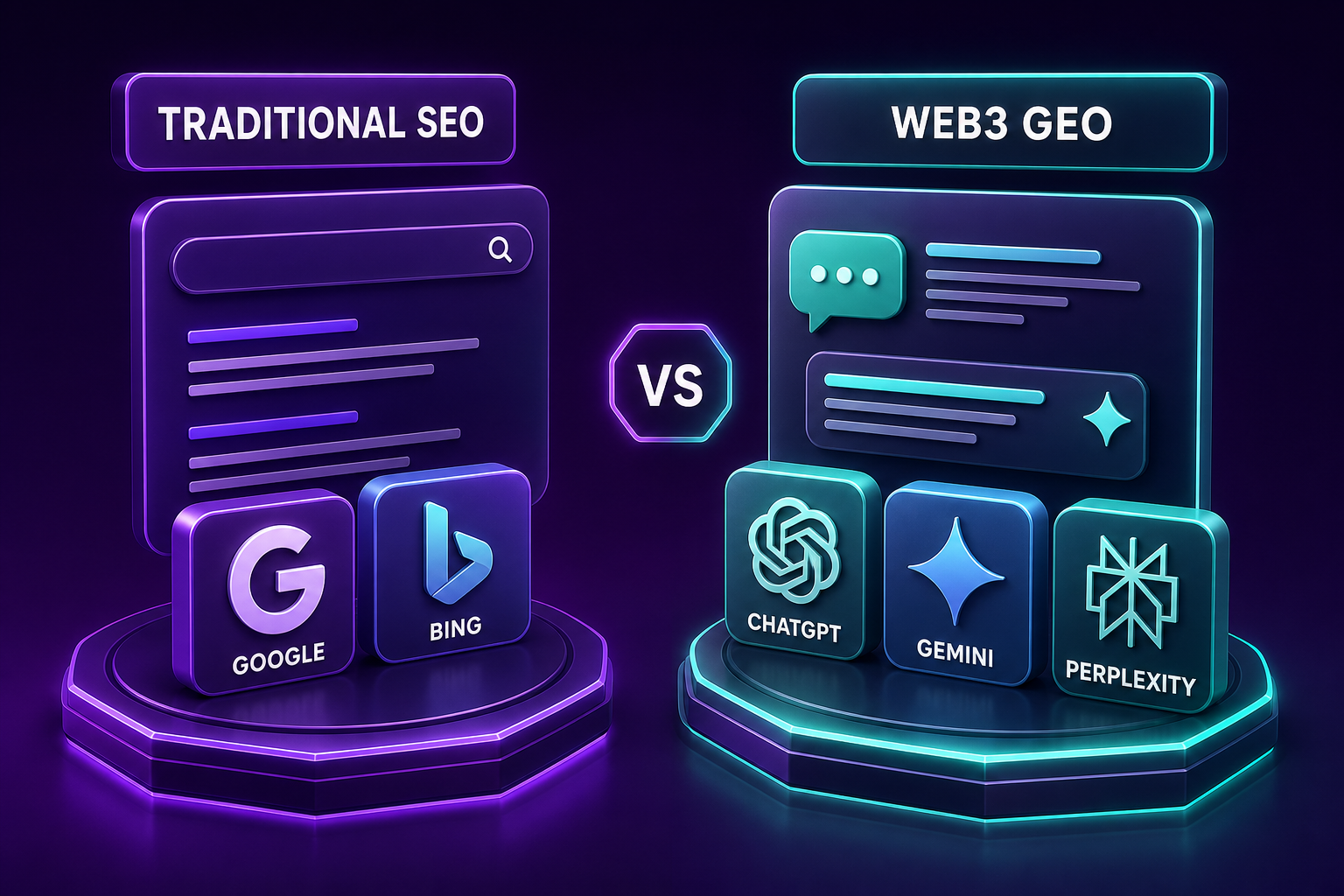
The technical differences between traditional SEO and Web3 GEO come down to two shifts: backlinks give way to citations, and keywords give way to entities. Traditional SEO optimizes for ranking position on a results page; GEO optimizes for being the source a model pulls into its answer, and those are measurably different systems, not two names for the same work.
Backlinks were the currency of the old web because they were a proxy for trust one site vouched for another. Citations are the currency now, and the vouching happens inside the answer itself, invisible to you until you go looking for it.
| Traditional SEO | Web3 GEO |
| Backlinks as the primary authority signal | Citations inside AI-generated answers as the signal |
| Keyword density and on-page optimization | Entity resolution and machine-readable trust signals |
| Ranking position (1 through 10) on a SERP | Citation frequency across ChatGPT, Perplexity, AI Overviews |
| Sitemap and robots.txt for crawler navigation | llms.txt as a proposed complement, mapping documentation for AI retrieval |
| One domain, one clear entity to rank | Foundation, DAO, labs entity and token needing disambiguation |
Picture a mid-sized L2 with a foundation site, a separate labs GitHub, a Discord full of the actual technical answers, and a governance forum nobody outside the DAO reads. Under traditional SEO, that's five assets fighting for their own keywords independently. Under Web3 GEO, it's one entity that needs to be resolved consistently across all five, because a model asked "who built this L2" needs one answer, not five conflicting ones stitched together by a confused crawler.
It's worth being precise about what llms.txt actually is, because vendors routinely oversell it. The specification is a community proposal, not a standard backed by the IETF, W3C or any recognized body, and its own authors describe it as intended mainly to assist inference rather than guarantee training inclusion, with the spec still open to community input. An analysis of 300,000 domains found adoption sitting at roughly 10%, which tells you it's an edge worth taking, not a prerequisite you'll be locked out without.
It's also worth hearing this directly from the platform itself rather than a vendor's paraphrase. Google states plainly that no new machine-readable files or special schema.org markup are required to appear in AI Overviews or AI Mode. Google separately warns publishers to be wary of any third-party tool claiming access to its internal ranking systems. Anyone selling a proprietary "AI schema" as the silver bullet has skipped past what Google itself has published on the subject.
How to Measure GEO Success
You measure GEO success by tracking how often and how accurately your project is cited across AI engines over time, not by tracking clicks or rankings. Practitioners have started calling this Share of Model Voice: the proportion of AI-generated answers in your category that name your project rather than a competitor.
There is no single, agreed methodology behind that term yet. It's an emerging practitioner metric used by agencies and citation-tracking vendors rather than a standardized industry figure, so treat any specific percentage a vendor quotes as that vendor's own measurement, built on that vendor's own prompt set, not a shared scoreboard.
What's easier to benchmark is speed. Semrush's own testing found that Google AI Mode cited 36% of newly published test pages within 24 hours, against just 8% for ChatGPT search in the same window. A project should expect Google's AI systems to notice new, well-structured content considerably faster than ChatGPT will, and should build reporting expectations around that gap rather than treating every AI engine as one moving target.
A workable measurement setup tracks three things on a recurring basis:
- Citation frequency across ChatGPT, Perplexity and Google AI Overviews for a fixed set of category questions
- Overlap between AI citations and Google's top 10 for the same query, to see whether the two systems are converging or diverging for your category
- Consistency of the entity itself: whether the model describes your project the same way across five different prompts, or contradicts itself
Conclusion
Fix entity resolution first. If a model can't tell your foundation, your DAO and your token apart, nothing else on this list will move the needle, because every citation-tracking dashboard and every llms.txt deployment is measuring or feeding a broken input.
Leave the vanity metrics alone. A vendor's proprietary "AI visibility score" or a competitor's NDA'd case study is not something you can act on, and chasing a number nobody can verify is worse than ignoring it entirely.
Early adoption matters here in a way it never quite did for SEO, because more than half of all categories still have no consistent brand showing up in the answers. That's not a permanent window; it closes the way every open field in marketing eventually closes, with whoever moves first becoming the incumbent the next founder has to dislodge.
Resolve the entity, structure the documentation, then measure citation frequency against your own category's baseline rather than against a rival's unverifiable claim. That's the order worth working through, and it's the order Coinpresso starts with on every new engagement.
FAQs
What does a Web3 GEO agency actually do?
A Web3 GEO agency's job is to get your project cited as a source inside an AI-generated answer, not just ranked on a results page. That means implementing technical fixes like llms.txt, structuring your documentation so a model can actually extract it, building entity authority across your foundation, DAO and token, and making sure your content answers the complex questions your category actually gets asked. Our crypto generative engine optimization page walks through how that work is scoped for a Web3 project specifically.
How is a GEO agency different from a crypto SEO agency?
The short version: SEO wants your link on the page, GEO wants your name in the sentence. A crypto SEO agency is still fighting for position on a Google results page, while a GEO agency is fighting to be the fact an AI model repeats when someone asks about your category. The tactics genuinely diverge too, with GEO prioritizing objective data formatting and machine-readable trust signals over keyword density, because a model doesn't care how many times you said your keyword, it cares whether it can trust what you said.
Can an agency guarantee citations in ChatGPT or Perplexity?
No, and you should walk away from anyone who tells you otherwise. LLM outputs are probabilistic, built fresh from a retrieval system every time someone asks a question, so there's no lever any agency can pull to force a specific answer on demand. What a good agency can do is materially improve your reference rate by formatting your content the way AI crawlers actually prefer to consume it, and you can watch that shift happen in your own citation tracking over weeks, not promise it on day one.
What is the most important technical fix a GEO agency provides?
For a Web3 project specifically, it's usually two things working together: a properly structured llms.txt file that guides a crawler through documentation that's otherwise scattered across five different platforms, and precise JSON-LD schema, using types like FinancialProduct or SoftwareApplication, that tells an AI engine plainly what kind of entity it's looking at. Skip either one and you're asking a model to guess, and models that have to guess tend to guess wrong or not bother at all.
How long does it take a GEO agency to show results?
It varies by engine, and that's worth knowing before you set expectations internally. Google's own AI Mode tends to notice and cite well-structured new content faster than ChatGPT does, so a RAG-based engine can shift within weeks of the work going live, while nudging the base weights of a foundation model takes considerably longer. Ask whoever you're hiring to show you their tracking methodology before you sign anything, and if you want a second opinion on your current setup, our contact page is the place to start that conversation.