


Rule of thumb: if you can't tell a journalist what you'd need to verify before writing about your own project, don't pitch it yet. That holds for an exchange with a licensing question hanging over it, a DeFi protocol whose contracts nobody has read, and a memecoin whose only asset is a strong meme. It breaks the moment you treat all three the same way, because the thing each of them needs verified is completely different — and a reporter can smell a one-size-fits-all pitch before they've finished the first paragraph.
Most crypto marketing teams still run crypto PR as a format — headline, quote, boilerplate, distribution list — and assume the same shape works whether you're announcing a new trading pair, a governance upgrade, or a dog wearing a hat. It doesn't. An exchange story collapses if the jurisdictional detail is wrong. A DeFi story collapses if the audit scope doesn't match the claim.
A memecoin story collapses the day a buyer works out the "organic" trend was a paid rollout nobody disclosed. A good crypto PR agency builds the pitch around what each project can actually prove, not around a template that fits none of them. This piece runs through what changes across the three, where the proof burden sits in each, and what to have ready before you send a single pitch.
Why One Crypto PR Template Fails
A press release template assumes every project has the same kind of story to tell and the same kind of scrutiny to survive it. Neither is true in crypto. The product is different, the risk is different, the audience reading the coverage is different, and the story format a journalist will actually accept is different.
An exchange is a regulated-adjacent business with real operational risk: custody, withdrawals, licensing, uptime. A DeFi protocol is autonomous code with economic risk baked into its mechanism design. A memecoin is a cultural object with essentially no product risk, and often no product at all beyond the token itself. Fire the same "exciting news from our project" release at all three and you've written a pitch that fits none of them properly, which is the fastest way to get ignored once and then quietly blacklisted the second time.
The gap between what gets you published and what gets you ignored is exactly this: whether your crypto PR playbooks are built around proof, or around enthusiasm. See it mapped out below.
| Axis | Exchange | DeFi Protocol | Memecoin |
| What must be proven | Licensing, availability, security controls | Contract address, audit scope, governance | Disclosure of paid promotion, cultural traction |
| Primary audience | Traders, regulators, listings desks | Developers, security researchers, allocators | Community, culture press, retail |
| Risk if wrong | Regulatory or operational exposure | Exploit, de-peg, economic failure | Undisclosed promotion, implied-utility claims |
| Typical story format | Operational update, jurisdictional expansion | Technical disclosure, audit report, governance vote | Trend piece, culture coverage, influencer content |
| Journalist beat | Exchanges, TradFi, crypto corporations | Protocols, DeFi, on-chain data | Culture, lifestyle, crypto social |
CoinDesk's own editorial structure confirms the beat split is real rather than a Coinpresso invention. The outlet organizes coverage around regulation, protocols and on-chain data, and exchanges and TradFi as three distinct reporting lanes, each with its own source network. Pitch an exchange story to a DeFi reporter and you're on the wrong desk before you've even got the facts wrong.
Exchange Playbook
An exchange's PR has to be compliance-led, because the entire pitch to a user is "trust us with your money and your identity." That means precision on availability, fees, security controls, and jurisdiction has to come before anything resembling a growth narrative, not after it. Get that order wrong and the story reads like a sales pitch wearing a compliance costume.
What to Prove
Which jurisdictions the service is actually available in, what licensing status applies in each one, and precisely what changed. Vague "now live globally" language gets picked apart fast, because listings desks and regulators both read the same release, and neither forgets a sloppy claim.
Story Formats
Jurisdictional expansion, a new trading pair or asset listing, a security incident disclosure, a fee or product change, a compliance hire that signals maturity. These read as operational updates, not hype pieces — the moment one starts reading like hype, the desk covering it treats every future release from that source as marketing copy worth skipping.
Crisis
The audience wants to know funds are safe and when service returns. Silence reads as insolvency risk, so the fix is a timestamped operational update, even one that says "we don't have a resolution time yet."
What to Avoid
Overstating licensing coverage, implying regulatory approval where only registration exists, or announcing "available in 180 countries" when a chunk of those are explicitly carved out. One imprecise jurisdictional line turns a routine listing story into a credibility problem that outlasts the news cycle it was meant to generate.
DeFi Playbook
A DeFi protocol's story stands or falls on facts a security researcher can check on-chain, not on how confidently the release is written. Contract addresses, audit scope, and governance structure have to be part of the pitch itself, not something offered only if a reporter thinks to ask.
What to Prove
The contract address, who audited it and exactly what was in scope — a scoped audit of one module is not the same claim as a full-protocol audit — how governance actually works, and where liquidity sits.
Crypto reporters tend to work from facts already sitting in public view: the chain itself, the code repository, the developer forum, as CoinDesk's own ethics policy notes. Whatever a DeFi marketing team doesn't volunteer, someone checking the claims will likely go and find anyway.
Story Formats
Audit completions, governance proposals and votes, TVL or liquidity milestones with real context rather than just the headline number, integration announcements, and transparent incident reports when something breaks.
Crisis
The audience wants exact figures and a technical explanation, fast. Immunefi's head of security flagged a case where a $6 million exploit on a Base vault went more than 24 hours with no public response and unidentified multisig signers — exactly the disclosure gap that turns a bad incident into a reputational collapse.
Compare that with the Vesu protocol, where a whitehat reported a bug through its bounty program and the team published a full disclosure within five days. Same category of event, completely different outcome, and the difference was documentation speed, not luck.
What to Avoid
Narrative framing of a mechanism that doesn't match what the mechanism actually does. The SEC's case against Terraform Labs is the clearest record of what happens when it does. The regulator found Terraform and Do Kwon liable for misrepresenting how UST's stability mechanism worked, a verdict that led to a $4.5 billion settlement.
The lesson for PR isn't legal, it's practical: describe what the code does, not what you hope it implies. If the protocol has a known constraint — a centralization point in an early governance phase, a bridge dependency, an upgrade key the team still holds — say so in the same release. A reporter who finds it unprompted writes a very different story than one who was told upfront.
Memecoin Playbook
A memecoin's PR has almost nothing to prove about product, because there usually isn't one, and everything to prove about disclosure and authenticity. The story is cultural, the audience is community-first, and the one thing that reliably kills it is implying utility or an investment promise that doesn't exist.
What to Prove
That any promotional content, influencer post, or clipping campaign is clearly flagged as paid where it is paid. The FTC's own standard is specific here: a disclosure is required unless the audience would already understand the relationship between the endorser and the thing being promoted.
If they wouldn't, it needs stating plainly, not buried three lines into a bio.
Story Formats
Genuine community traction, a verifiable cultural moment, a named and disclosed creator partnership, a transparent liquidity-lock or burn event. Culture writers can usually tell the difference between a community that formed organically and one manufactured overnight, and so can the audience reading the coverage.
Crisis
The audience wants a fast, unambiguous "this wasn't us" the moment an impersonator or scam account shows up, pushed across every channel the impersonator used, with no hedging language that could read as the project covering for itself.
What to Avoid
Paid promotion dressed up as organic enthusiasm, and any language implying the token is an investment rather than a cultural asset. The SEC's case against Kim Kardashian is the reference point everyone in this lane should know by heart. She settled for $1.26 million after promoting EthereumMax without disclosing a $250,000 payment, and accepted a three-year ban on promoting crypto asset securities. That is what undisclosed paid promotion costs when it goes wrong, and a single honest line in the caption would have avoided every bit of it.
Match the Proof to the Pitch
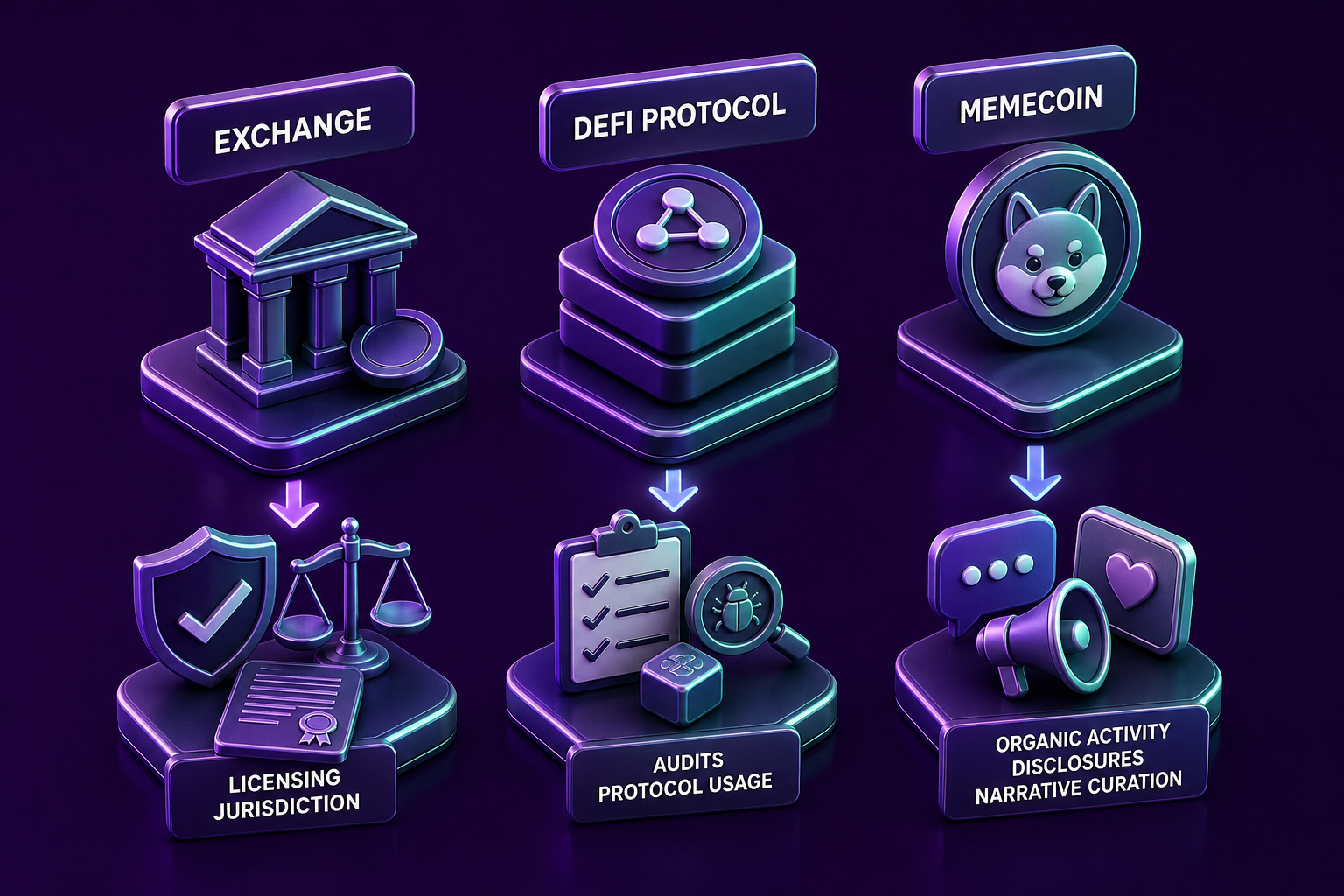
The source package a journalist needs is different for each vertical, and showing up without it is the single biggest reason a good story gets ignored or sat on indefinitely.
- Exchange: licensing documentation by jurisdiction, named security controls, a compliance or operations spokesperson, uptime or incident history if relevant.
- DeFi: contract address, the audit report with scope clearly stated, governance documentation, liquidity and TVL context, a technical spokesperson who can answer on-chain questions.
- Memecoin: disclosed terms for any paid promotion, a timeline of organic community growth where it exists, liquidity-lock or vesting evidence, a community-facing spokesperson rather than a corporate one.
None of these packages substitutes for another. A DeFi team handing a reporter a liquidity-lock screenshot instead of an audit scope hasn't answered the question that was actually going to be asked. A memecoin team handing over a technical roadmap nobody asked for just raises the question of why it exists at all.
Crisis Differences
A crisis message that works for one vertical can make another one worse, because the thing the audience is afraid of is different in each case. These playbooks aren't interchangeable under pressure any more than they are at launch.
Outage. The audience wants an uptime timeline and confirmation that funds are untouched, fast — silence here reads as insolvency, not caution.
Exploit. The audience wants exact figures, an incident timeline, and a named technical response, the gap documented above between a 24-hour silence and a five-day full disclosure.
Stablecoin de-peg. The audience wants mechanism clarity: what is actually backing the asset and what is being done about the peg, in terms precise enough to survive a technical reader checking the math against the chain.
Impersonation. The audience wants a fast, unhedged denial pushed through every channel the impersonator used, before the scam spreads further than the correction can reach.
Community controversy. The audience wants acknowledgement before explanation. Leading with a defense before acknowledging the complaint reads as dismissive, regardless of which vertical you're in.
The common thread across all five is specificity under pressure. Vague reassurance is the one message format that fails in every category, and it's also the one most teams reach for first because it feels safe to say nothing committal. It isn't — it's a vacuum, and vacuums in a crisis get filled by whoever shouts loudest, usually not you. A crypto community management team that has rehearsed who says what, and when, is the difference between a bad day and a dead project.
Conclusion
Here's the planning matrix worth keeping on hand before the next release goes out, whatever vertical you're in.
| Vertical | Lead With | Spokesperson | Biggest Failure Mode |
| Exchange | Licensing and operational precision | Compliance or operations lead | Overstating jurisdictional coverage |
| DeFi | Contract, audit scope, governance | Technical lead or security contact | Narrative that outruns the mechanism |
| Memecoin | Disclosed culture and community | Community lead | Undisclosed paid promotion |
Crypto PR playbooks only work when they're built from the proof a vertical can actually offer, not from a template that assumes every token has the same story to defend. Your media strategy should match your proof burden. Ask Coinpresso to build a crypto PR playbook for your actual product category, built around what you can genuinely verify rather than what sounds good on a wire.
Priority order if you're starting from nothing: get your proof package together first, the licensing documents, the audit scope, the disclosure language, before a single pitch goes to a journalist. Channel selection, outlet lists, and timing matter, but they're the second decision, not the first, and no amount of polish on a pitch fixes a gap in the evidence sitting behind it.
FAQs
Why should exchange PR be compliance-led?
Because the pitch to users is "trust us with your money and identity," and any imprecision on licensing or jurisdiction undermines that trust faster than it builds it. Verify every jurisdictional claim with your compliance team before a release goes out, not after a listings desk or regulator reads it.
What evidence should a DeFi protocol provide to journalists?
The contract address, an audit report with its scope clearly stated, governance documentation, and liquidity context, handed over upfront rather than offered only if asked. Reporters tend to verify these against the chain and public repositories anyway, so volunteering them is faster for everyone and harder to get wrong.
Can a memecoin use paid influencers?
Yes, but the FTC's disclosure standard applies regardless of category: if the audience wouldn't already understand the payment relationship, it has to be stated plainly. Undisclosed paid promotion is exactly what the SEC pursued in its case against Kim Kardashian, and it's avoidable with one honest line in the post itself.
Should every crypto project pitch the same outlets?
No. Exchanges, DeFi protocols, and memecoins sit on different reporting beats, and CoinDesk's own editorial structure splits regulation, protocols and on-chain data, and exchanges and TradFi into separate lanes with separate source networks. Pitching the wrong desk wastes the pitch before the facts are even checked; our crypto PR team maps coverage by category rather than sending one list to everyone.
How do crisis messages differ by vertical?
An exchange outage needs an uptime timeline, a DeFi exploit needs exact figures and a technical response, a de-peg needs mechanism clarity, and impersonation needs a fast, unhedged denial. What fails across all of them is vague reassurance, which reads as evasion no matter which vertical is speaking. See our case studies for how that plays out across different incident types.