


Somewhere in your Discord right now, a mod is fielding the same question for the third time this week: "does this still support Arbitrum, or did that change?" They check the landing page, which says yes. They check the docs, which were last touched before the last upgrade.
Nobody is lying. The project just never decided which page gets to be right, and that's a more expensive bug than it sounds.
That's the gap this piece is about. Not whether your content is "clear and quotable" in the generic sense every GEO guide repeats, but whether a technical question about your project has one traceable answer or three competing ones. A lot of crypto marketing teams reading this will recognize the symptom before they recognize the cause.
Coinpresso's GEO framework treats documentation as infrastructure with owners and release gates, not a folder of pages someone updates when they remember to.
Landing Pages Convert; Documentation Explains
A landing page exists to convert a visitor in under thirty seconds. It compresses your positioning into a headline, a handful of benefit statements, and a call to action, and it is supposed to do that.
Asking it to also hold your audit scope, your fee schedule, and your contract version history is asking a sales pitch to double as a legal filing. It will fail at both jobs the moment it tries.
Documentation does the opposite job. It exists to hold the scoped, dated, version-specific facts a technical evaluator or a generative engine actually needs: supported networks, contract addresses, fee tiers, audit scope and date, governance parameters, API behavior.
A landing page that tries to carry all of that stops converting and starts reading like a spec sheet nobody asked for. The failure mode shows up the moment someone asks a specific question.
"What networks does this support" or "what's the current treasury fee" has a factual answer, and if your landing page is the only place that answer lives, it is almost certainly stale, simplified, or both. That's not a copywriting problem. It's a structural one, and it's the reason this piece exists.
Map the Web3 Knowledge Supply Chain
Before you can fix anything, you need an honest inventory of where your facts actually live. For most Web3 projects they are scattered across eight or nine disconnected systems with no single owner.
That's a polite way of saying nobody would survive an audit of their own claims. Here's what that inventory usually looks like once you write it down:
- Website/landing page — positioning, headline claims, calls to action
- Whitepaper — original thesis, tokenomics design, long-form rationale
- Docs site (GitBook or similar) — current technical specification, API reference, integration guides
- GitHub — contract code, commit history, actual deployed logic
- Audit reports — scope, findings, firm, date, and version audited
- Governance forum — live proposals, votes, and parameter changes
- Block explorer — deployed contract addresses, verified source, on-chain state
- Release notes/changelog — what changed, when, and why
The problem isn't that these sources exist. It's that none of them currently know the others exist.
A contract gets upgraded, GitHub reflects it immediately, the explorer reflects it not long after. The docs reflect it whenever someone gets around to it, which might be never.
Governance forums are the worst offenders. Live decisions on fee changes and parameter votes get ratified in public, generate real on-chain consequences, and then vanish into a forum thread that never makes it back into the docs at all.
A generative engine retrieving an answer about your project has no way of knowing which of these eight sources is current. It will cite whichever one it can retrieve and parse, and there is no guarantee that's the one you'd choose.
Fixing that starts with the next section: deciding, fact by fact, which source gets to be the answer.
Choose a Canonical Source for Every Fact
Every fact your project publishes needs exactly one home, and someone's name next to it. Not "the docs team" in the abstract — an actual owner who updates that fact when it changes and is accountable when it doesn't.
Here's how that ownership typically splits across fact types:
| Fact type | Canonical source | Typical owner |
| Tokenomics (supply, allocation, vesting) | Whitepaper, cross-linked to docs | Founding team / tokenomics lead |
| Fees and pricing | Docs site | Product |
| Supported networks | Docs site | Engineering |
| Contract addresses and versions | GitHub, verified on explorer | Engineering |
| API behavior and limits | Docs site (API reference) | DevRel |
| Security and audit scope | Audit report, linked from docs | Security lead |
| Governance parameters | Governance forum/dashboard | Governance lead |
Tokenomics is a useful example of why this matters. The whitepaper usually states the original design, but allocations shift and vesting gets renegotiated, and whitepapers rarely get reopened once they're published.
If the whitepaper is the only place that number lives, it quietly becomes wrong the day terms change, and nobody notices until someone screenshots the old figure in a dispute. The fix isn't rewriting the whitepaper every quarter.
It's making the docs the live reference and linking back to the whitepaper as historical context, so the thesis stays intact while the numbers stay current. Governance parameters belong to the forum or governance dashboard, where votes actually happen.
The docs site should reflect the current ratified state rather than trying to be the record of every vote that ever passed. Security and audit scope should live in the audit report itself, named by firm and date, with docs linking to it rather than summarizing it in a way that drops the caveats.
A summary that drops the caveat is worse than no summary at all, because it reads as confident. This is the unglamorous part of crypto content work that rarely gets budget: someone has to sit down and assign a single source to each fact type, then make sure every other mention points back to it instead of repeating a stale copy.
Version Whitepapers and Docs Without Creating Conflicts
A whitepaper from eighteen months ago and a docs page updated last week will disagree eventually. The fix isn't deleting the old one and pretending it never existed; it's labeling both clearly enough that a reader, or a model, knows which one is current.
Every version of a whitepaper or major doc revision needs a visible version label and an effective date at the top of the page, not buried in a changelog nobody reads. "v2.1, effective March 2026" tells a reader and a retrieval system exactly what they're looking at, which "updated recently" never does.
When a new version supersedes an old one, keep the old version live. Deleting it destroys the historical context that explains a migration.
Mark it clearly as archived instead, with a prominent notice and a link forward to the current version. The current version should link back to major prior versions too, so the relationship is visible from either direction rather than assumed.
This matters more for whitepapers than almost anything else on this list, because whitepapers get cited, screenshotted, and quoted for years after they stop being current. A whitepaper with no version label is a liability precisely because it looks authoritative — confidence and accuracy are not the same thing, and an unlabeled document trades on the first to borrow credit for the second.
Treat migration notices the same way. When a contract upgrades or a fee structure changes, a short, dated notice linking old behavior to new behavior closes the gap that would otherwise sit open for months.
None of this requires rewriting legal or technical content to sound more conversational. It requires metadata discipline: a date, a version number, a status, and a link in both directions.
That's a process question, not a prose question, and it's one most project roadmaps skip entirely because it doesn't look like marketing.
Design Passages for Safe Extraction
A generative engine doesn't read your whole docs page. It retrieves a passage, sometimes a paragraph, sometimes a couple of sentences, and that passage has to make complete sense on its own or it gets quoted wrong.
Anthropic's Citations feature illustrates this literally. Claude chunks source documents into sentences and cites the exact sentences it drew from, which means a sentence that depends on the one before it for its meaning is a sentence that can be quoted out of context and sent back into the world half true.
Write each important passage as if it might be lifted alone and shown to someone with zero other context:
- A descriptive heading above it, not a vague one like "Details" or "More info"
- The unit stated explicitly: "2.5% fee" not "a small fee," "30 days" not "a short lockup"
- The scope stated: which network, which contract version, which product tier this applies to
- The limitation stated in the same breath as the claim, not three paragraphs later
- A link to the source backing the claim, sitting next to the claim itself
An audit-scope sentence is the clearest example of why this matters. "The protocol has been audited" is a passage that will get quoted and will mislead whoever reads it alone, because it says nothing about which contracts, which version, or which firm.
"The lending module (v3.2) was audited by the named firm in January 2026; the bridge contract was out of scope" is a passage that survives extraction intact. The limitation travels with the claim instead of living somewhere else on the page, which is the entire difference between a fact and a liability wearing a fact's clothes.
The same logic applies to dates. "Fees changed recently" is useless the moment it's retrieved six months after you wrote it, while "fees changed to 1.5% on 12 March 2026" stays accurate regardless of when a model pulls it.
Google's own grounding documentation shows why this matters at the mechanical level. A grounded Gemini response carries the literal search queries the model ran alongside its citations, which means the exact phrasing of your passage is part of what gets matched and surfaced.
This is also where the academic research on generative engine optimization is narrowly useful. A benchmark study from Princeton, Georgia Tech, and IIT Delhi found that adding citations and statistics to source content measurably increased how often that content was drawn on in generated answers, across the engines and prompts they tested.
Treat that as evidence a well-sourced, specific passage outperforms a vague one, not as a guarantee for your category or your content.
Make Tables and Examples Machine-Readable
Fee schedules, network support, and vesting timelines belong in a table, not a paragraph that describes a table. A real markdown or HTML table with a header row lets a retrieval system parse field and value as separate, structured facts.
A sentence like "fees range from 0.5% to 2.5% depending on tier" forces a model to guess at the boundaries, and guessing is exactly the behavior you're trying to design out of your own documentation.
Here's an example of the difference in practice:
| Tier | Fee | Minimum stake | Lockup |
| Base | 2.5% | 100 tokens | 30 days |
| Pro | 1.5% | 1,000 tokens | 90 days |
| Institutional | 0.75% | 10,000 tokens | 180 days |
That table answers "what's the fee at the Pro tier" with one unambiguous cell. The prose version of the same information buries the answer inside a sentence structure a model has to parse correctly first, and there's no guarantee it will.
Code examples need the same treatment: a copyable block, not a screenshot, with the parameters labeled inline rather than described above or below it. A screenshot of an API call is invisible to anything that can't run OCR reliably, and even when it can, the labels and the code have been separated into two things that need to be reassembled correctly.
Accessible HTML markup does double duty here. Proper table tags instead of div soup styled to look like a table, and alt text on diagrams that states what the diagram shows in words. It's the same markup that makes a page usable for a screen reader, and the same structure that makes a fact parseable by a crawler, so treating those as separate projects wastes effort twice.
Run the Documentation Extractability Test
The only way to know whether your canonical sources are actually winning is to ask the same technical questions a user would and check what comes back. Pick ten to fifteen questions that map to your highest-stakes facts: supported networks, current fees, audit scope, governance thresholds, API rate limits.
Run each one through ChatGPT Search, Gemini, and Claude. OpenAI's documentation confirms search-triggered responses carry citations that can be opened and checked against the original page, and Claude's web search tool attaches citations back to the pages it drew from.
Score each answer against the canonical source you assigned earlier. This is the core of what we'd call a Documentation Extractability Matrix, and it's worth building as an actual table rather than a running note:
| Dimension | What you record | Why it matters |
| Canonicality | Does the retrieved answer match the canonical source? | Flags competing sources winning over the correct one |
| Version clarity | Was the version/date visible in what got cited? | Flags stale pages still reading as current |
| Passage independence | Did the cited passage make sense on its own? | Flags context lost in extraction |
| Evidence linkage | Did the citation link back to a real, checkable source? | Flags unsupported or fabricated-sounding claims |
| Qualifier preservation | Did limitations from the source survive into the answer? | Flags confident-sounding but incomplete answers |
Run each test question through this grid and you get five scores, a retrieved answer, and a citation URL, all sitting next to the canonical answer you expected. That's an editorial QA tool, not a prediction engine.
It tells you where retrieval disagrees with your source, not whether you'll get cited next week, and anyone promising the second thing is selling you something that doesn't exist yet.
The pattern worth watching for is a model citing last year's fee structure because the old page is still indexed and still reads as complete on its own, while the current page lacks the keywords the question used. That's a passage-independence failure, and the fix is almost always rewording the current page to answer the question directly rather than assuming context will carry it.
Run this test quarterly at minimum, and immediately after any release that changes a fact you've marked canonical.
Add Documentation GEO to Release QA
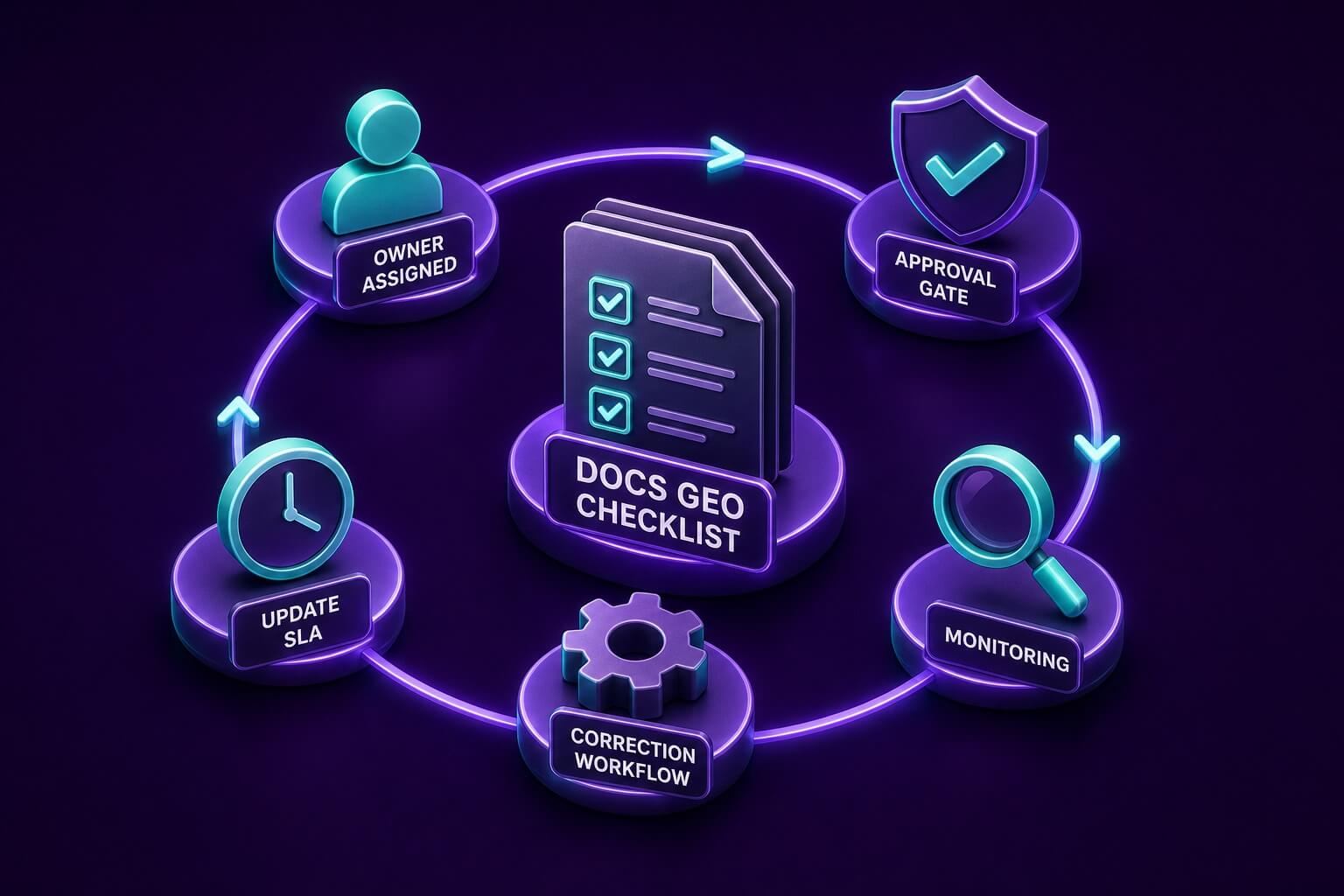
None of the above survives contact with a real release cycle unless it's a checklist item, not a best intention. The moment a fee changes, a network gets added, or an audit completes, documentation needs the same approval gate your code does.
Build it as a short, enforced checklist:
- Owner assigned. Every doc section has a named owner who is pinged when the underlying fact changes.
- Approval gate. No release ships until the owner confirms the canonical doc page has been updated to match.
- Monitoring. Run the extractability test on a schedule, not only when something breaks.
- Correction workflow. A clear path for someone, internal or external, to flag a stale or wrong passage and get it fixed within a stated window.
- Update SLA. A committed turnaround, for example documentation changes ship within 48 hours of a code or governance change, so "we'll get to it" never becomes the default.
The correction workflow is the piece most teams skip, and it's the one that matters most once a project has any real traction. Someone outside the team will eventually find a stale fact before you do, usually in a support ticket or a Discord thread.
Whether that turns into a quiet fix or a public complaint depends entirely on whether a workflow already exists to catch it. Teams without one find out the hard way, in public, with screenshots attached.
None of this is exotic. It's the same release discipline engineering teams already apply to code, applied to the pages a generative engine treats as evidence. The projects that skip it aren't making a strategic choice; they're just treating docs as a one-time task instead of a standing operational line item, and that line item is cheaper to fund than to apologize for later.
Conclusion
Start with the highest-stakes mismatch, not the whole backlog. If your landing page and your docs disagree about anything a technical evaluator would actually check, whether that's audit scope, supported networks, or current fees, pick the worst offender, assign it a canonical source, and move to the next.
That mod answering the same Arbitrum question for the third time isn't a support problem. It's a documentation ownership problem wearing a support costume, and it gets fixed the same way every fact on this list gets fixed: one canonical source, one owner, one version label.
FAQs
Why can documentation be more useful than a landing page for GEO?
Docs often contain the detailed, scoped facts required for technical questions, while landing pages are intentionally concise and conversion-oriented. A good crypto documentation GEO program treats that split as the design, not a problem to fix by cramming more detail onto the homepage.
Should a project rewrite its whitepaper for AI?
No, preserve the legal and technical integrity of the whitepaper, and add clear version metadata, definitions, anchors, and links to the current canonical specification instead. The whitepaper stays the thesis; the docs site carries the live numbers.
How should old documentation be handled?
Archive it with a visible status and date, link to the replacement, and avoid deleting historical context that explains migrations or changes. A deleted page just means the next person to ask about it gets no answer instead of an outdated one.
Does a project need llms.txt?
Treat it as an optional discovery aid, not the core strategy. llms.txt is a proposed convention, not an adopted standard, so content quality, crawlability, canonicalization, and evidence remain the more fundamental work.
How can a team test documentation extractability?
Ask representative technical questions across multiple search-grounded systems, compare outputs with the canonical source, and record omissions or stale citations using something like the Documentation Extractability Matrix above. If you'd rather have someone else run that audit against your actual docs estate, contact Coinpresso and start there.