


Coinbase takes 13% of all crypto citations in AI search. Kraken 9%. Gemini 5.5%. Every founder in Web3 has seen that league table by now, usually in an agency deck, and almost nobody has asked the only question that matters if your protocol is not one of those three: what exactly are those sites doing on the page that yours is not?
The lazy answer is that they are Coinbase, and it is wrong, or at least far less true than it looks. Citation share tracks a specific and surprisingly copyable set of structural habits, how risk gets disclosed, how figures get presented, how hard a claim gets hedged, and not one of them requires a nine-figure balance sheet or a license in forty jurisdictions. We pulled the most-cited exchange pages apart to find the pattern, then ran our own prompts to check it held.
This piece is what came out: the AI Citation Hierarchy as far as the evidence supports it, and how a smaller protocol borrows it without pretending to be something it is not.
The AI Citation Hierarchy
The numbers first, because they are more lopsided than most people realize. 5W's Crypto AI Visibility Index ran more than 65 consumer-intent prompts across ChatGPT, Claude, Perplexity, Gemini and Google AI Overviews, and found Coinbase and Kraken together taking 22% of every crypto citation the engines produced. Below them the tail drops fast: Gemini at 5.5%, Robinhood Crypto at 5%, BlackRock's IBIT at 4.5%, Binance.US at 4%. Five names and a spot ETF account for the bulk of the category — everyone else is fighting over what is left.
Two things are worth saying about that table before you draw conclusions from it. It is 5W's own estimate from a proprietary prompt set, not an audited dataset, so treat the ranking as robust and the decimal places as indicative. And it measures how engines describe brands, not how good those brands are. The hierarchy is real. What it is built from is the interesting part, and it is not what the deck usually implies.
The "Objective Truth" Preference
Read a Coinbase fee page and a mid-cap DeFi landing page side by side and the difference is not polish. It is that one of them contains facts a machine can lift and the other contains claims a machine has to trust. "0.6% taker fee on the basic tier" is a fact. "Industry-leading low fees" is a sentence an engine has learned, through millions of examples, to skip.
The evidence for how much this matters is unusually clean. An empirical study of AI citation behavior on SSRN found pages with populated, concrete attributes, pricing, ratings and specifications, were cited 61.7% of the time against 41.6% for pages carrying only generic markup. That gap is twenty points — and it comes from nothing more sophisticated than putting the number on the page. Fees, APY, supported tokens, custody model, all of it belongs in a table with a date on it, not in a paragraph written by your crypto content team to make the reader feel reassured. The reader is no longer the first audience. The arbiter is.
How AI Evaluates Security and Risk
When a founder asks an engine whether a DeFi protocol is safe, the engine is looking for a short list of specific things, and it is looking for them in specific words. An audit, named, with the firm and the date. A bug bounty, live, with a link. Custody described as custodial or non-custodial without a marketing adjective in between. Team identity, or an honest account of why there is none.
That last one carries more weight than most pseudonymous teams want to hear. CertiK's 2025 security report found that 94% of rug pulls originated from fully anonymous teams, and models trained on the same public record have absorbed the correlation. Being anonymous does not disqualify you, but it moves the burden of proof onto everything else on the page. A protocol with no named team, no linked audit and a "battle-tested" badge is, to an engine, indistinguishable from the ones that did the rug pulling.
The Power of Comparison Architecture
Engines do not merely tolerate comparison content. They prefer it, and the reason is structural rather than editorial. A page that lays two protocols side by side has already done the work an answer requires, so the model can lift the verdict and attribute it in a single line. Analysis of verdict-first comparison pages found them cited at 2.4 times the rate of pages that bury the conclusion.
For a DeFi protocol this is the most under-used lever on the site. Compare yourself against the two or three protocols you are most often mentioned alongside, fairly, with the rows you lose left in and labeled. It reads as an arbiter rather than an advertiser, and arbiter is the only role an engine will quote. We go through the full table format, the summary and the schema in our teardown of crypto comparison pages that get cited by AI, but the principle fits in a sentence: give the machine a comparison it did not have to build itself.
Evaluating Tokenomics and Mechanics
Here is where DeFi pays a tax that centralized exchanges do not. Your mechanics are genuinely complex, and complexity is precisely the thing a model handles worst when it is trying to decide whether to cite a source. A rebasing token with a dynamic emission schedule and a three-tier veToken lock is not something an engine can summarize confidently from a whitepaper, so it summarizes a competitor instead.
Simplification is not dumbing down. It is providing the one-paragraph version an engine can quote, above the full version a developer can read. Total supply, circulating supply, emission rate, vesting cliffs and the treasury address, each as a dated figure in a table, with the mechanism explained in plain English before the math. If the plain-English version is not on the page, the engine will write its own, and it will get it wrong.
The Regulatory Signal Advantage
Look at where Gemini sits in the hierarchy and ask why. It is not the largest exchange, and it is not the cheapest, but it holds a citation slot that engines appear to reserve for regulatory and trust prompts, and 5W's coverage attributes that to its NYDFS trust-company charter, full-reserve model and approved custody status. A regulatory footprint is a trust signal an engine can verify against a third party, which makes it worth more than any amount of self-description.
Most DeFi protocols have no charter and never will. What they can have is a compliance page that says plainly which jurisdictions they operate in, which they exclude, what KYC applies and where, and what the legal structure of the entity behind the protocol is. It will not earn you Gemini's slot. It will stop an engine having to guess, and a guess in a financial context defaults to caution, which in practice means leaving you out.
DeFi vs. CeFi: The Evaluation Differences
Engines do not evaluate a decentralized protocol the way they evaluate an exchange, and pretending otherwise is how most DeFi marketing goes wrong. A CeFi platform is judged as a company: licenses, executives, audited financials, press coverage. A protocol is judged as a system: code, on-chain activity, governance, and whether the documentation describes what the contracts actually do.
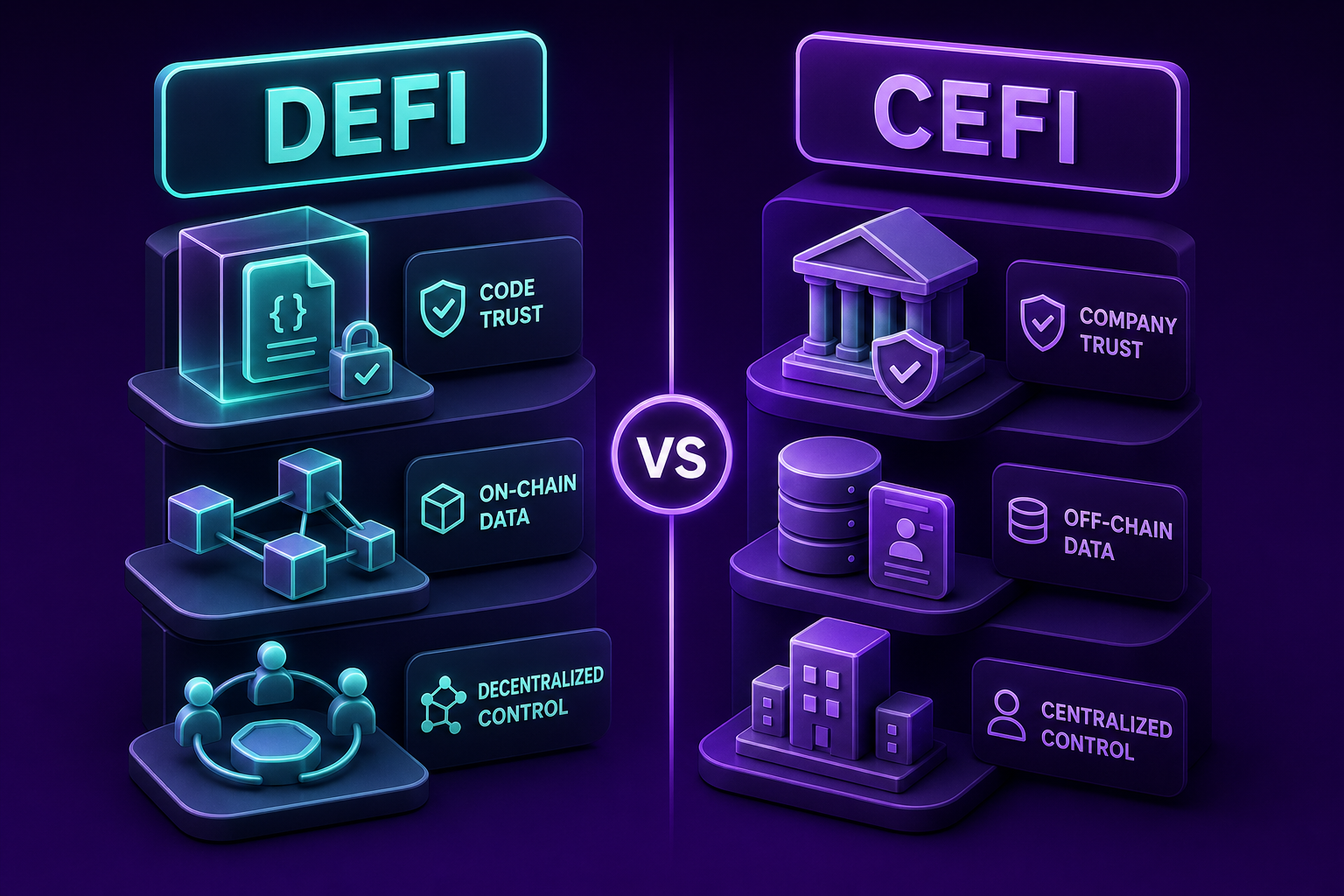
That is not a disadvantage if you lean into it. On-chain data is more verifiable than a corporate disclosure, and a GitHub with three years of substantive commits is a stronger expertise signal to a model trained on code than a named CTO with nothing to check — the argument we made at length in our piece on E-E-A-T for crypto websites.
The failure mode is trying to look like an exchange, with a glossy team page and a press kit, when the evidence an engine actually weighs for a protocol lives in the repo, the explorer and the docs. Practitioner commentary in this space, including Flexe's analysis of hedged DeFi recommendations, points the same way: engines hedge on DeFi when the system-level evidence is scattered or missing, and stop hedging when it is on the page.
The "Extractable Data" Checklist
Extractable Data Architecture is Coinpresso's name for the layer that all of the above depends on: the practice of publishing every figure a model might want as a dated, labeled, crawlable fact rather than a claim inside a sentence. It is not an industry term, and we are not going to pretend it is — it is a checklist.
| Publish | In what form |
| Fees | A table with the tier structure explicit and a "last verified" date |
| APY and yields | Per pool, with validFrom and the calculation basis stated |
| Supported tokens and chains | A list with a count |
| TVL, volume, active wallets | Text with a source and a timestamp, never only a dashboard screenshot |
| Audit reports | HTML, not only a linked PDF |
| Tokenomics | The dated table described above |
| Custody model | One word |
Every item on that list is something a competitor with a fifth of your traction could publish tomorrow, and the ones who have are the ones being cited.
Conclusion
Go back to the league table this piece opened on. Coinbase at 13%, Kraken at 9%, Gemini at 5.5%, and a long tail fighting over the rest. Having pulled the pages apart, that table reads differently: it is not a ranking of size, and it is barely a ranking of brand. It is a ranking of how much extractable, dated, third-party-verifiable fact each site puts in front of a machine, and on that measure a DeFi protocol with honest documentation and a decent GitHub can climb further than its balance sheet would ever suggest.
The shift underneath all of this is from persuasive copywriting to objective data structuring, and it is the shift most DeFi marketing has not yet made. If you want to know where your protocol sits on that measure today, Coinpresso's Web3 GEO work starts with exactly that audit, run against the same prompts we used to check this piece. The table is not fixed — it is just measuring something most protocols have not started publishing.
FAQs
Why does Coinbase dominate AI search citations in crypto?
Because it publishes more machine-readable, third-party-verifiable fact than anyone else in the category: dated fee tables, audited financials, regulatory status in plain text, and a corporate entity engines recognize across dozens of independent sources. 5W's index puts it at 13% citation share and gives it the highest AI Trust Score of any crypto brand at 94. Size helps, but the structure is what gets lifted.
Can a DeFi protocol compete with centralized exchanges in AI visibility?
Yes, but not by imitating one. Engines judge protocols as systems, on code, on-chain activity, governance and documentation, and those signals are more verifiable than a corporate disclosure. A protocol that publishes its figures as dated tables, links its audits in HTML and keeps a substantive GitHub can win citations for the specific queries it genuinely answers, even against far larger names.
Do AI engines penalize DeFi sites for being decentralized?
Not for decentralization itself, but for the things that often travel with it: anonymous teams, fragmented documentation across GitBook, GitHub and a marketing site, and mechanics too complex to summarize. CertiK's finding that 94% of rug pulls came from fully anonymous teams has shaped how models weigh anonymity, so a pseudonymous protocol has to carry more evidence elsewhere on the page.
What page types get cited most by AI for crypto queries?
Comparison pages, fee and pricing pages with concrete figures, and documentation that states facts before context. Verdict-first comparison pages are cited at roughly 2.4 times the rate of pages that bury the conclusion, and pages with populated attributes at 61.7% against 41.6% for generic ones. Marketing landing pages are cited least, because they contain the fewest facts a model can lift.
How do I track my DeFi protocol's AI visibility over time?
Run a fixed set of the prompts your buyers actually ask, across ChatGPT, Claude, Perplexity and Gemini, on a schedule, and log which sources each engine cites. Do it by hand monthly to start. When the volume justifies it, tools such as Profound track citation at the source-page level, with pricing that runs from roughly $2,000 to $8,000 a month at the enterprise tier, so the manual version is worth mastering first.