


There's a field on CoinGecko's support page that quietly admits defeat: the one explaining that it will not reserve a ticker symbol for you, ever, and that HOT currently refers to three completely unrelated projects at once. That single policy line is the whole problem in miniature. A ticker was never an identity, it was always just a label, and in 2026 that label is being read by large language models with no instinct for which of three HOT tokens a user actually means.
This matters more now than it did two years ago because AI engines have become the front door for a lot of token research, and they resolve ambiguity by pattern-matching against whatever text is easiest to find, not by checking a blockchain. A lot of crypto marketing teams reading this have spent months on content and brand consistency without once publishing the one fact that actually disambiguates a token: its contract address. Coinpresso's GEO for Web3 work treats this as a solvable data-governance problem, built around what we'll call a Token Identity Manifest: a single, structured answer to the question "which token, on which chain, at which address, in what state."
The direct answer, if you want it before the detail: crypto token entity resolution means publishing a coordinate, not a name — chain ID, contract address, token standard, and status — consistently enough that an AI system has one unambiguous source to retrieve instead of five competing ones. You test whether it worked by asking the AI tools directly and checking what address comes back, not by hoping.
Why Token Names and Tickers Fail as Identity Keys
A ticker symbol was built for a stock exchange with one listing authority, not for dozens of independent blockchains with none. Nothing stops two unconnected teams launching a token with the same four letters stamped on it, and nobody is obliged to check first.
CoinGecko's own support documentation confirms this isn't an accident it occasionally tolerates, it is policy. The platform does not allow any team to reserve a token symbol, and HOT currently represents Holo, Hydro Protocol, and HotNow simultaneously, three live projects sharing one ticker with no mechanism to settle who "owns" it.
Layer on bridges, wrapped representations, and chain migrations, and the collision problem multiplies rather than adds. A canonical token on one chain can have three or four legitimately branded wrapped versions elsewhere, all sharing a name, none of them interchangeable at the contract level.
An AI engine summarizing "what is Token X" has no built-in reason to pick the right one. From a text-matching standpoint they all look identical, and the model has no equivalent of checking a block explorer before it answers.
Build the Canonical Token Coordinate
A token's real identity isn't its name. It's a coordinate: which chain, which contract, which standard, and whether that deployment is even still live.
The technical groundwork for this already exists, and nobody built it for marketing, which is probably why marketers have ignored it. CAIP-2, part of the Chain Agnostic Improvement Proposals, defines blockchain identifiers in a simple namespace:reference format, where the namespace identifies the blockchain family and the reference identifies the specific network inside it, and the format already underpins how wallets like MetaMask and Ledger communicate across chains.
CAIP-19 builds on top of that for assets specifically. It's authored by contributors including Pedro Gomes of WalletConnect and Joel Thorstensson, and it defines a type of asset by combining a CAIP-2 chain ID with an asset namespace and a reference. Both specifications are still marked "Review" in their own repository rather than formally ratified, but that hasn't stopped them becoming working infrastructure: CAIP-19 requires a CAIP-2 chain ID as its foundation, and WalletConnect relies on exactly that pairing to manage cross-chain sessions without ambiguity about which network a transaction belongs to.
That combination is what actually pins down "this token, on this network, full stop." Here's the coordinate, in practice, for an EVM-based token:
- Chain namespace and chain ID — which blockchain family and which specific network, mainnet, not a testnet masquerading as one
- Contract address — the checksummed deployment address, not a name, not a shortened version
- Token standard — ERC-20, ERC-721, SPL, or whatever the chain's native standard is
- Decimals — easy to overlook, a surprisingly common source of integration bugs and copy errors
- Network status — live, deprecated, or testnet
None of these fields are optional if the goal is to be unambiguous. A name and a logo describe a vibe. A chain ID and a contract address describe a specific, checkable thing, and only one of those survives contact with an AI model that doesn't know your brand from the next one.
Separate Canonical, Bridged, Wrapped, and Deprecated Assets
"Same token, different chain" is the sentence that causes most of the damage, because it's almost never literally true and AI systems take it literally anyway. A bridged representation is a different contract, with its own risk profile, minted and burned by a bridge operator rather than the original issuing team.
A wrapped token is a separate decision again. A third party has locked the original asset and issued a new one that tracks it, under its own contract and its own trust assumptions, often with its own ticker collisions stacked on top of the original ones.
None of this is inherently a problem. It becomes one when a project's own materials describe the wrapped or bridged version in the same loose language as the canonical one, because that's exactly the ambiguity an AI engine inherits and repeats back to the next person who asks.
Deprecated contracts add a third failure mode. A project that migrated to a new contract two years ago but left the old Etherscan page, the old docs reference, and the old token-list entry untouched has effectively published two competing "canonical" answers. An AI system has no reason to prefer the current one over the historical one; both read as equally official.
The USDP ticker shows what this looks like once it's played out in public rather than in theory. When Paxos renamed its stablecoin from PAX to USDP, the ticker was already in use: Unit Protocol had been running its own token under the USDP symbol since at least the prior July, and a Unit Protocol representative publicly disputed Paxos's trademark filing, citing 138 million minted units and active listings on CoinGecko and CoinMarketCap as proof their token was the legitimate one.
A Coinbase spokesperson, asked how the exchange resolves this kind of clash, described a general first-come, first-served approach rather than any formal arbitration. Two real projects, one four-letter ticker, no referee, and years of ambiguity that a published coordinate would have settled on day one.
The fix starts with vocabulary, not infrastructure. State plainly, every time: this is the canonical asset, this is a bridged representation issued by the named bridge from the origin chain to the destination chain, this is a predecessor contract deprecated on a stated date in favor of a stated new address. "Available on multiple chains" is the sentence that creates the error in the first place, because it describes four or five different contract relationships as though they were one tidy fact.
Create the Token Identity Manifest
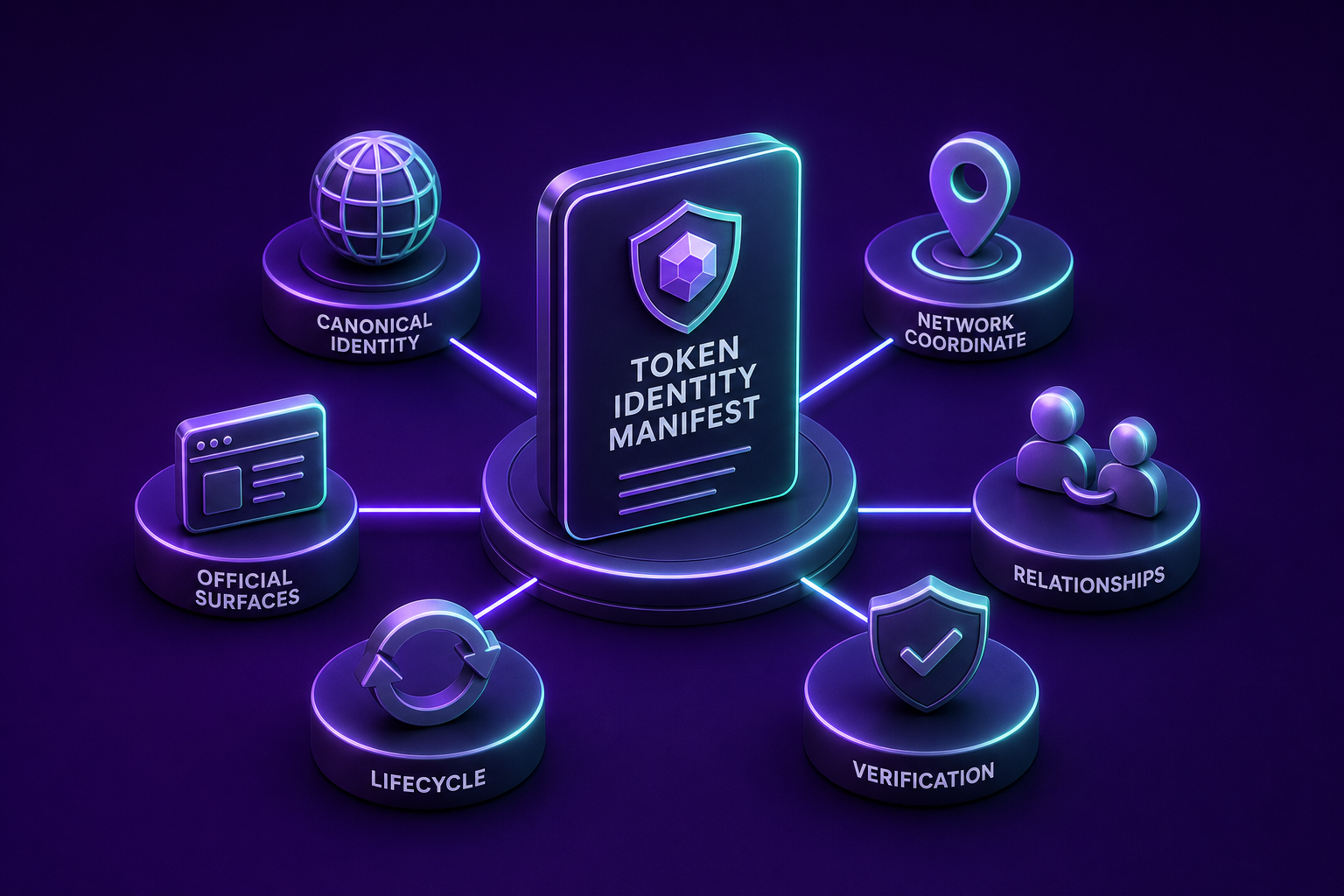
The fix for all of this is to stop describing your token in prose and start publishing it as structured data. We call this a Token Identity Manifest: a single, versioned, machine-readable record that states the coordinate plainly instead of implying it across a dozen scattered pages.
This is a proposed publishing template, not an industry standard and not a guarantee that any AI system will retrieve or prioritize it. It's a discipline a project can adopt starting today, regardless of what any platform does with it next.
Here's what belongs in it, grouped by function:
| Field Group | Example Contents |
| Canonical identity | Project name, token name, symbol, official domain, issuer or governing entity |
| Network coordinate | CAIP-2 chain ID, contract address, token standard, decimals, mainnet/testnet status |
| Relationships | Canonical asset, wrapped representation, bridge, predecessor, successor, deprecated contract |
| Verification | Explorer URL, source repository, audit URL, deployment transaction, multisig or governance address |
| Lifecycle | Launch date, migration date, status, last verified date, change-log URL |
| Official surfaces | Docs, repository, governance forum, social profiles, supported token lists |
A few rules make the difference between a document that helps and one that just adds clutter.
Version it. Every manifest needs a version number and a last-updated date, because a stale manifest is arguably worse than none.
A stale document still reads as current to anyone who doesn't check the date, which defeats the point of publishing it at all.
Own it. Name a specific team or multisig as the publisher of record, so a conflicting claim has an obvious party to resolve against.
Locate it predictably. Publish it at a fixed, linkable URL on your own domain, in both a JSON format for machines and a plain table for humans, and don't bury it three clicks into documentation nobody reads.
Required fields are the canonical identity and network coordinate groups; everything else is strongly recommended but can be filled in incrementally. A manifest with only name, chain ID, and contract address already beats the status quo on most project websites, which typically have none of this in one place at all.
Propagate the Manifest Across the Web
A manifest sitting alone on your own site helps less than you'd think, because AI engines and aggregators draw from dozens of sources, not one. The real work is getting the same coordinate repeated, consistently, everywhere a system might look for it.
Start with the surfaces you control outright: your website footer, your documentation, your GitHub repository's README. Then extend to the surfaces you don't control but can influence: explorer profile pages, token-list submissions, and the data aggregators that LLMs and search tools frequently draw from.
Every announcement of a new chain deployment, a bridge partnership, or a contract migration should carry the coordinate inline, not just a name and a link. "We've launched on Base" is the kind of sentence that creates a ticker collision down the line. "We've launched on Base, chain ID 8453, contract 0x..." is the sentence that doesn't.
This is also where LLM optimization for crypto websites overlaps with identity resolution without being the same thing. A consistent brand entity across bios and directories helps an AI system recognize your project exists. A consistent, specific coordinate across those same surfaces helps it tell your project apart from the five others using a similar name. You need both, but they solve different problems, and most GEO advice only addresses the first one.
Consistency is the entire exercise. A manifest that states one contract address while your pinned post references an old one is a self-inflicted collision, and it's the single most common mistake projects make once they've otherwise done this work properly.
Mark Contract Migrations Without Erasing History
The instinct after a contract migration is to scrub every trace of the old address and pretend the new one always existed. That instinct is exactly backwards, and it's what creates most of the confusion AI systems later repeat as fact.
Deleting the old page doesn't delete the old contract, the old holders, or the old references scattered across exchanges, token lists, and forum posts from two years ago. It just removes your own authoritative correction from the pool of information an AI system might otherwise retrieve.
Here's what keeping the old page actually looks like in practice:
- Keep the deprecated contract's page accessible at its original URL, not redirected away or taken down
- Label it explicitly as deprecated, with the migration date stated plainly
- Link forward from the old page to the new one, and back from the new page to the old one, so either entry point leads to the full picture
- Update the manifest's lifecycle fields the same day the migration goes live, not weeks later
- Keep an immutable, dated change-log of every migration a project has ever made, rather than relying on scattered announcement posts as the only record
A redirect alone isn't enough, because it discards the context a reader, or a crawler, needs to understand why two addresses exist for what looks like the same token. A dated notice with both addresses visible side by side does the job a silent redirect can't.
Monitor Copycat and Misattribution Queries
You cannot fix what you haven't checked, and most teams have never actually asked an AI model what it thinks their token is. That's a five-minute exercise, and it's the cheapest diagnostic available to any project reading this.
Run your project's name and ticker through the major AI search tools and read the response for the contract address, the chain, and any competing projects mentioned alongside yours. Document what comes back, including the wrong answers, with a date attached, because this is a moving target and a one-off check tells you nothing about trend.
Where you find a wrong answer, trace it to its likely source before trying to fix it. An AI system that confuses your token with a copycat is usually repeating something it found on an aggregator listing, an old forum thread, or a token list that never got your migration update. CoinGecko has described building a dedicated matching layer for exactly this reason, because a ticker like a common three-letter symbol can map to dozens of unrelated assets, and the platform now weighs market-cap and search signals to guess the intended token when a query is ambiguous rather than just guessing from the string alone.
Prioritize corrections at the source with the most downstream reach, generally a major data aggregator or token-list entry, over corrections on low-traffic pages nobody is pulling from anyway. This is where entity resolution overlaps with the broader discipline covered in our guide on AI trust signals for crypto: a model that already has reason to distrust a project's category is more likely to default to the least charitable interpretation of an ambiguous ticker.
Treat this as a recurring task, not a launch-week checklist item. New copycats appear after any project gains traction, and a manifest published once in January does nothing to catch a clone that launches in June.
What Identity Resolution Cannot Prove
A Token Identity Manifest resolves which token you're talking about. It says nothing about whether that token is safe, valuable, or legally sound, and treating it as though it does is the fastest way to overclaim a marketing deliverable as a security guarantee.
Verification on a block explorer is the clearest example of this gap. Verification confirms that published source code matches the bytecode actually running on-chain, nothing more, and without it a contract can hide backdoors that go completely undetected. A separate technical walkthrough is blunter still: a developer can publish a perfectly verified contract explicitly designed to steal funds, and verification alone will never catch it. Verification's presence is a floor, not a ceiling.
Scam tokens can clear some identity signals convincingly while still failing on the one that matters. ethereum.org documents a wrapped ARB impersonation where the scam token was airdropped to the real Arbitrum Foundation deployer address, making it look legitimately held by the real team, yet it still ran on a different contract address than the genuine token. The contract address was the signal that held; the appearance of legitimate ownership was the one that lied.
A manifest reduces the ambiguity an AI system has to work with. It does not make an LLM mathematically verify anything, and it cannot stop a model from retrieving stale or misleading information it found somewhere else entirely. Liquidity, audit quality, and whether a token is a good investment are separate questions this entire framework is silent on by design, and any pitch that blurs those lines is overselling what data governance can do.
Conclusion
An unambiguous token coordinate doesn't make your project more trustworthy. It makes it easier to correctly identify, which is a narrower claim and a more honest one. Get the chain ID, the contract address, and the relationship labels right, publish them consistently, and you've done the part that's actually within your control.
Here's a launch and migration checklist worth keeping on hand:
- [ ] Publish a versioned Token Identity Manifest at a fixed, linkable URL
- [ ] State the canonical chain ID and contract address on every official surface, not just one
- [ ] Label every bridged or wrapped representation explicitly, with its own contract address
- [ ] Keep deprecated contract pages live and clearly dated, never deleted
- [ ] Re-check AI search tools for your name and ticker on a recurring schedule
- [ ] Update the manifest's last-verified date every time anything on it changes
Pull up your own project's documentation tonight and check one thing: does it state your contract address and chain ID anywhere near your token name, or does it just say the name and assume the reader knows the rest? If it's the latter, that's the gap an AI system is currently filling in on your behalf, with no particular reason to get it right. Contact Coinpresso to audit token-identity consistency across your owned and third-party surfaces, build the manifest, and coordinate the corrections that actually move the needle.
FAQs
Why can two unrelated tokens share the same ticker?
Symbols are labels, not globally unique identifiers, and no registry anywhere enforces otherwise. The network and contract address are what actually disambiguate two assets, which is why CoinGecko's own support documentation confirms it does not reserve symbols and happily lists HOT as three different projects at once.
What is the safest canonical identifier for an EVM token?
Pair the chain ID with the checksummed contract address, and link both to the official project page and the explorer record showing that deployment. Name alone, or ticker alone, will always leave room for a copycat to look identical on paper.
How should a project describe bridged or wrapped tokens?
State the canonical asset, the origin chain, the destination chain, the bridge or wrapper responsible, the separate contract address, and whether the representation is officially supported by the project. Vague phrasing like "available on multiple chains" is what creates the ambiguity in the first place.
What happens after a contract migration?
Keep the old contract's page live and accessible, label it deprecated with the migration date stated plainly, and link both directions between old and new. Update every official and third-party surface the same day, not weeks later, because a silent gap is exactly what an AI system fills with the wrong answer.
Will a manifest stop AI hallucinations or scams?
No. It creates clearer source material and reduces ambiguity, but platforms can still retrieve stale listings, old forum posts, or an uncorrected token-list entry regardless of what you've published. Our case studies cover how that kind of ongoing correction work plays out for real projects, which is a closer picture than any one-off manifest can give.