

Two hundred accounts, one Discord server, and a payment schedule running from $40 to $400 per million views. That's what a documented clip-farming network tied to Stake actually looked like once someone traced the money instead of just admiring the view count.
Every clipping guide currently ranking for this topic treats that number as the headline and skips the ending. The ending is a UK regulator forcing Stake's operator out of the country entirely. If you're weighing a crypto Google Ads alternative through short-form video because paid platforms have shut the door on your casino, your DeFi product or your token launch, that ending is the part of the story you actually need. This piece covers what a crypto clipping strategy does well, where the "organic loophole" idea falls apart, and how to build a brief that gets you reach without getting you the Stake outcome.
What Clipping Actually Does
Clipping takes long-form material and turns it into short, contextual video built for TikTok, Instagram Reels and X. A founder interview, a podcast appearance, an AMA or a livestream gets cut into pieces of thirty to ninety seconds, each one built around a single moment rather than the full conversation.
Done properly, it's a production discipline, not a volume game. A good clipper finds the line that actually explains the product, the moment a founder says something quotable, or the second in a livestream where the numbers get interesting. That is different from a paid ad, which is written to sell in the first three seconds because the platform is charging for attention.
Clipped content earns attention because the source material was worth watching in the first place. That's also why short-form video for crypto works as a distribution layer rather than a substitute for having something worth saying.
The appeal for restricted categories is obvious. If a platform won't sell you ad inventory for a gambling product, a token sale or a lending protocol, organic posting looks like the way around it. Nobody is charging for the reach, so the assumption is nobody is enforcing the rules that apply to paid placements. That reasoning is where most of the existing advice stops, and it's also wrong.
Why Organic Is Not a Loophole
Platform rules on gambling, financial promotion and paid endorsement are content rules, not ad-inventory rules. They apply whether or not money changed hands for the placement.
TikTok's own Branded Content Policy defines branded content as anything promoting a third party in exchange for payment or any other incentive. That covers a clipper paid to feature your product regardless of whether the payment bought an ad slot or came through a Discord invoice for per-view work. TikTok separately requires creators to switch on a Commercial Content Disclosure setting that flags brand mentions, product recommendations and calls to action to viewers, entirely apart from paid media.
X has moved the same direction. Its head of product announced Paid Partnership labels on the platform, stating plainly that undisclosed promotion damages trust in the product itself.
The company has also started cutting payouts to aggregator accounts that flood timelines with reposted content, with reductions running as steep as 60% in a single cycle. That's a platform actively hunting the exact clip-farm pattern the Stake case documented, not a policy sitting unenforced on a shelf.
The legal layer sits on top of both. The FTC's revised Endorsement Guides require disclosure of any material connection between an endorser and a brand unless the audience would already assume it exists. A hashtag buried in a caption doesn't satisfy that on its own, and the FTC itself has said as much in its own guidance on the rule.
Classify the Product Risk
Not every clip carries the same risk, and treating a general brand explainer the same as a casino promotion is how compliance work gets skipped exactly where it matters most.
- Gambling and casino content. The most heavily scrutinized category on every major platform, and the one with an actual regulatory casualty attached to it. Stake's clip-farm activity preceded a Gambling Commission investigation that forced its UK operator to shut the site down entirely, following a prior £316,250 anti-money-laundering fine on the same operator.
- Token sales and launches. Any clip touching a live or upcoming sale sits closest to financial promotion territory. Price framing, return language and urgency around a sale window belong nowhere near organic clipped content.
- DeFi products and services. Yield figures, protocol comparisons and staking mechanics need the same discipline as a token sale. A clip implying guaranteed returns on a lending product reads as a financial promotion whether or not the platform labels it one.
- Education and explainer content. Lower risk, but only if it stays genuinely educational. A "how staking works" clip that quietly recommends one protocol has drifted into promotion.
- General brand and culture content. The safest category, and still not exempt from disclosure rules if a paid clipper is behind the account posting it.
A brand playing across several of these at once, which most token projects do, needs a brief that treats each category differently rather than one blanket set of rules for every clip.
Create a Compliant Clipping Brief
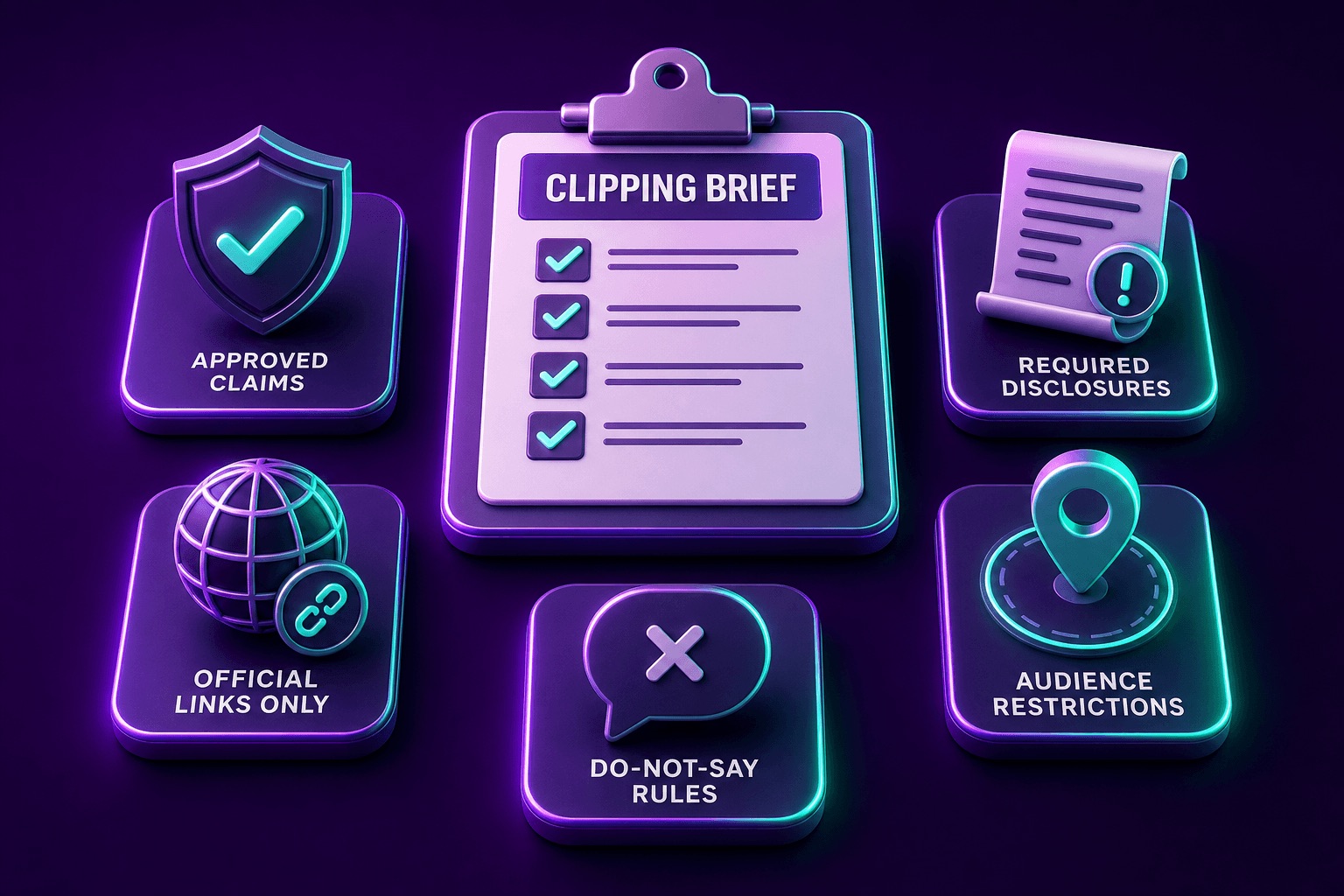
A clipping brief is the document that turns "make some clips" into something a legal team could actually read without wincing. It needs five components, and skipping any one of them is how a campaign ends up looking like the Stake network in miniature.
| Component | What it covers |
| Approved claims | The exact statements a clipper can make about the product, pulled from official material, not paraphrased from memory |
| Required disclosures | Which label applies to which content, matched to TikTok's Commercial Content Disclosure or X's Paid Partnership system |
| Official links only | Clips point to verified, brand-owned URLs, never a clipper's own referral link or shortened redirect |
| Audience restrictions | Age-gating and geographic exclusions matched to the product category, particularly for gambling |
| Do-not-say rules | Specific phrases banned outright: guaranteed returns, implied price targets, comparisons to past performance |
A compliance brief table avoids Stake-style regulatory fallout, and it's also where a lot of agencies quietly stop, because a do-not-say list is a much harder sell than a reach number. Coinpresso's crypto clipping work treats the brief as the starting point, not a document written after the videos are already live.
Protect Viewers From Harm
A clip that gets views by misleading the person watching it hasn't succeeded. It has moved the risk downstream to someone who trusted it, and that's a worse outcome than no views at all.
Price and return claims sit at the top of the list: implying a token will rise, a casino payout is likely, or a DeFi yield is fixed, when none of it is knowable in advance. Unsafe calls to action follow close behind, pushing a viewer to act immediately on a financial product rather than go and read the actual terms.
Unverified links are a quieter version of the same problem. A clip sending viewers to a clipper's own shortened URL, rather than the brand's verified page, hands control of the destination to someone outside the brand's oversight. Hidden sponsorships close the list, and every platform and regulator named above is actively enforcing against exactly this pattern. A viewer who doesn't know they're watching paid content can't judge it as paid content, which is the entire point of a disclosure rule.
Measure Content Quality Honestly
View count is the metric the Stake network optimized for, and view count is exactly what a whistleblower thread and a regulator investigation later exposed as hollow. A campaign that reports honestly tracks different things.
Completion rate matters more than raw views, because it tells you whether anyone watched past the hook. Saves and shares indicate a viewer found the content worth returning to, not just worth a passive scroll past. Qualified landing-page visits, meaning traffic that actually reaches an official page rather than a clipper's redirect, show whether the content moved anyone toward something real.
Direct audience feedback, comments and sentiment, catches problems before a regulator does. A compliance-incident count, tracked and reported honestly even when the number is zero, is the metric no clip-farm operation in the current record has ever published voluntarily. None of this guarantees signups, and any brief that promises them is making a claim nobody can actually back.
Conclusion
The existing crypto clipping strategy content treats Stake's reach as the finish line. The regulatory record says it was the start of the expensive part: a UK market exit, a whistleblower thread with 145,000 likes, and a platform now actively cutting payouts to the exact account pattern that made the reach possible. Those aren't footnotes to the story. They are the story.
Here's an example of what a starter compliance brief might include, before you send anything to a clipper:
- One-page approved claims list, sourced from official documentation only
- Disclosure label mapped to each platform (TikTok, X, Instagram)
- Verified destination URL, no shortened or clipper-owned links
- Age and geography restrictions for the specific product category
- A do-not-say list of five to ten banned phrases, reviewed before publishing begins
Build organic reach without treating policy as optional. Contact Coinpresso to create a compliant crypto clipping brief and distribution system, starting with a policy-aware review of your product category and what's realistic to say about it.
FAQs
Can organic crypto clips bypass paid-ad bans?
No. Platform rules on gambling, financial promotion and paid endorsement are written as content rules, and they apply to organic posts whether or not any money bought ad inventory. TikTok's Branded Content Policy covers any content promoting a brand in exchange for payment or incentive, which includes a clipper paid per view through a private arrangement.
Are casino and token-launch clips subject to platform rules?
Yes, and they sit at the strict end of enforcement. Casino content triggered the Gambling Commission investigation that ended Stake's UK operations, and TikTok has separately restricted paid promotion of financial services including cryptocurrencies unless disclosed through its branded content system. Read the product classifications in this guide before assuming a token launch clip is treated like general brand content.
How should paid clipping relationships be disclosed?
Use the platform's own disclosure tool rather than a caption hashtag. TikTok requires the Commercial Content Disclosure setting on branded content, and X now applies Paid Partnership labels for the same reason. The FTC's Endorsement Guides back this up in law, not just platform policy, for any material connection an audience wouldn't otherwise expect.
What makes a crypto clip safer for viewers?
A safe clip avoids price or return claims, sends viewers only to verified brand-owned links, and never hides who paid for it. The full list of what to strip out, and why, is covered in the section on protecting viewers from harm above. A crypto content team that writes the do-not-say list before filming starts is doing the actual compliance work, not adding it afterward.
Which metrics should clipping campaigns track?
Completion rate, saves, qualified landing-page visits, audience feedback and a documented compliance-incident count, not raw view totals. View count was the exact metric that made the Stake network look successful right up until the regulatory record caught up with it. If you want a second set of eyes on what a campaign report should actually contain, Coinpresso's case studies show how that reporting is structured for other channels.