

Somewhere in your Telegram right now there's a spreadsheet: forty-odd handles, follower counts in one column, a quoted rate in the next, maybe a screenshot of a past campaign's "engagement." That's how most presales pick their KOLs. Nobody opens the wallet that received the last project's token allocation and checks how fast it sold.
That single omission is the whole problem this piece exists to fix. A lot of crypto marketing teams reading this will recognize the spreadsheet, because Coinpresso has seen it arrive as the entire brief on more than one presale. Vetting a KOL properly means crypto presale marketing treated as a governance process with a file behind it, not a follower-count spreadsheet with a gut check on top. Get the file right and you catch the undisclosed payday, the conflict of interest and the wallet that's going to dump on your own community before your liquidity has settled. Get it wrong, and the influencer with the biggest reach is often the one with the most reason to hurt you.
Why Follower Count Is Weak Due Diligence
Follower count tells you reach. It tells you nothing about audience quality, credibility or what the person does after your payment clears.
Two accounts with 80,000 followers can produce wildly different outcomes for a presale. One has a real audience of people who've followed a trading thesis for two years and trust the account's calls. The other bought its way there, or built it shilling a rotating cast of low-float tokens to the same recycled audience every few weeks. The follower count is identical. The risk profile is not, and no ranking site sorting by engagement rate is going to tell you which one you've hired.
What you actually need to know before you pay anyone is whether their past promotions performed for the projects that hired them, or just for the influencer's own bag. Crypto has its own version of an early-allocation arrangement, where a KOL gets tokens ahead of public sale specifically in exchange for promotion, and that arrangement is increasingly treated as a straightforward conflict of interest rather than a normal marketing deal.
Trade press coverage of the KOL economy in 2025 has documented how platforms built around fast token launches industrialized exactly this pipeline: allocation in, promotion out, exit whenever the influencer's own vesting allows it. Reach didn't predict any of that. Only checking the arrangement itself would have.
This is the gap in most public KOL research. Rankings built on engagement and niche fit are a reasonable start for crypto influencer marketing generally, but a presale isn't a generic campaign. It has a liquidity event at the end of it, and that single fact changes what you need to screen for before anyone signs anything.
Build the KOL Diligence File
Crypto KOL vetting starts with a file, not a spreadsheet of follower counts. Build a working record of audience fit, content history, disclosure behavior, conflicts and prior promotions, kept per-KOL and updated through the campaign.
Audience fit means checking who is actually listening, not how many. Pull a sample of the KOL's engaged followers and look for real accounts with trading or crypto history. A wall of two-week-old profiles with no posts is the tell. Web3 creator vetting lives or dies on this one check, because bot-inflated audiences are the single easiest thing for a KOL to fake and the hardest for a project to notice after the money is gone.
Content history means reading, not skimming, their last twenty or so paid posts. Look for a pattern: did they promote a token that collapsed shortly after their post, and if so, did they say anything about it afterward, or silently delete the thread. A KOL who deletes underperforming promotions rather than owning them is telling you exactly how they'll handle yours, and it will be the same way, at the worst possible moment.
Disclosure behavior is the cleanest signal available, and it's damning at scale. A leaked spreadsheet surfaced in 2025 tied over 200 entries to more than 160 individual influencers who had accepted paid crypto promotion deals. Fewer than 5% of them disclosed the posts as advertising, and rates ran from $50 a post up to $60,000, which puts a number on how cheap it is to buy "organic" buzz.
That's not a handful of bad actors caught out. That's the baseline behavior of the pool you're recruiting from, which is exactly why you check disclosure history yourself instead of taking a media kit's word for it. A file that's all green ticks from a spreadsheet is worth about as much as a sinking ship's passenger list.
Conflicts and prior promotions round out the file.
Ask who else this KOL is currently paid by, and whether any of those relationships compete with your project or contradict claims you're making. Check whether their public position on risk lines up with the behavior your due diligence is turning up.
If it doesn't, that's the finding, not a detail to note and move past.
One more thing worth saying plainly: Coinpresso does not yet publish a dataset comparing wallet-overlap or disclosure-compliance rates across our own vetted campaigns. Building that record honestly takes running the checks on real clients over time, and we're partway through that, not finished with it. Until then, the checks above are the best available substitute for a track record, and they're the ones we run on every campaign regardless.
Design Compensation for Disclosure and Alignment
Pay structure is where most of the damage gets built in before a single post goes live. Design it to reward accuracy and disclosure, not volume and hype, because a KOL contract with the wrong incentives baked in is a regulatory tripwire waiting for someone to trip it.
Cash-only deals are the simplest to structure and the easiest to audit: fixed fee, fixed deliverables, no performance kicker tied to price action. Token-based compensation is common in this market and isn't disqualifying on its own, but it needs handling with care.
If a KOL's payday depends on the token pumping in the first 48 hours, you've built an incentive to manufacture exactly the kind of activity that later reads as coordinated hype. Vest any token component on a schedule that outlasts the initial listing window, and put that in the contract, not just the spirit of the deal.
Whatever the structure, the compensation and the nature of the relationship need clear, conspicuous disclosure that sits with the content itself. The FTC's own guidance is unambiguous on where that disclosure belongs: placed with the endorsement message itself, not tucked into a bio, buried at the bottom of a caption, or hidden behind a "more" link. A disclosure nobody can find is functionally no disclosure at all.
This isn't a hypothetical risk you're managing for its own sake. Regulators have gone after undisclosed celebrity crypto promotion well before this cycle's KOL economy existed, and the cases keep landing on the same fact pattern: paid, undisclosed, promotional.
The SEC found that Kim Kardashian failed to disclose a $250,000 payment for a single Instagram post about EMAX tokens, and settled for $1.26 million.
Paul Pierce received roughly $244,116 in token transfers for promotional posts without disclosing the arrangement, and settled for a civil penalty of $1,150,000 alongside a three-year ban from touting any crypto asset. Neither case turned on whether the token itself was fraudulent. Both turned on the compensation being hidden, which is the part a spreadsheet of follower counts was never going to catch.
Building this into your compensation design isn't a job for a marketing team working from a template someone found online. Every contract needs qualified legal review before signature, on every deal, no exceptions for the KOL you've worked with before.
Approve Content Before Publication
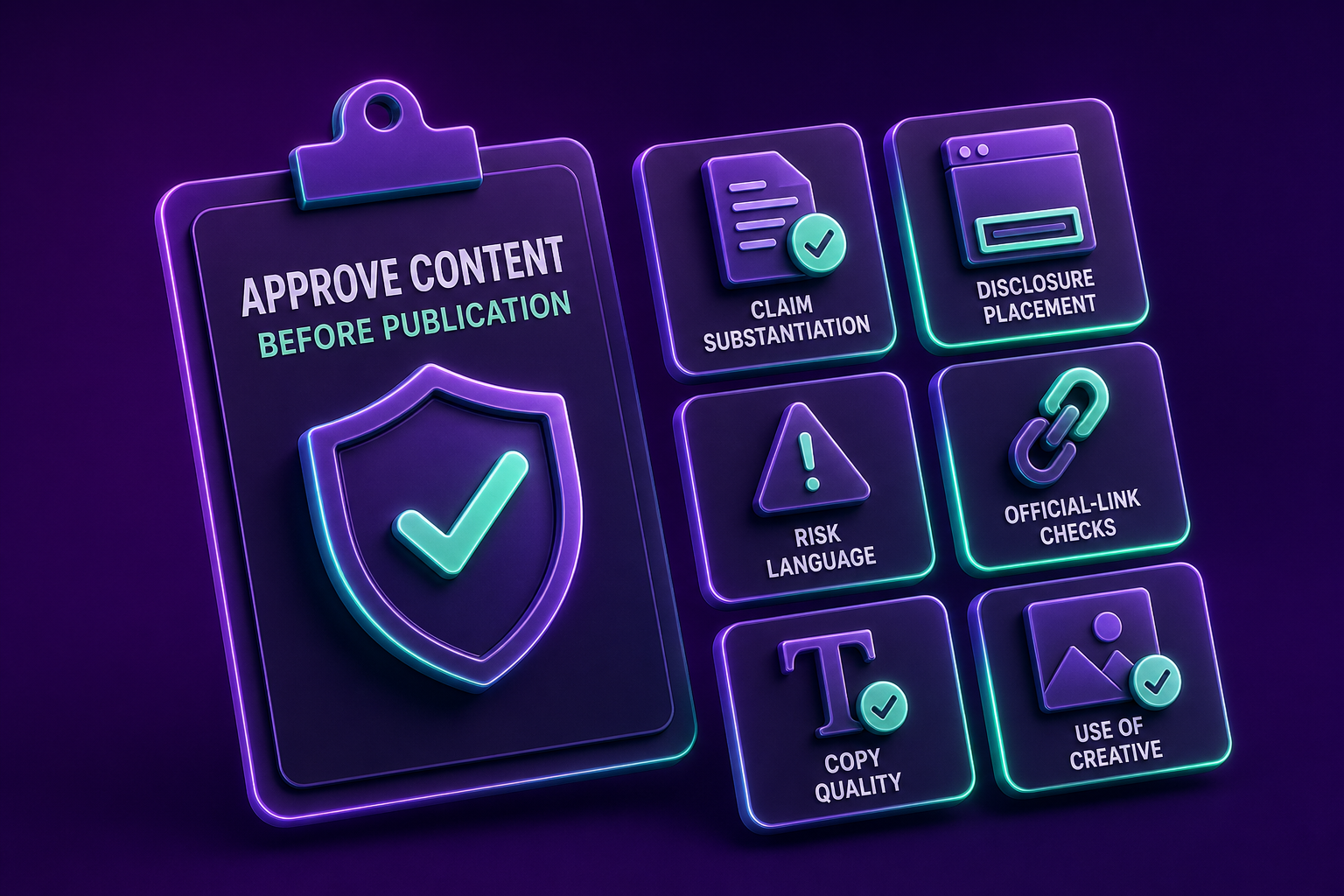
Every piece of paid content goes through review before it's posted, with no carve-out for a KOL you trust. Trust is not a review process, and the moment you treat it like one is the moment something slips.
The check runs four ways:
- Claim substantiation — does the post state anything about the project's technology, team, roadmap or returns that the project itself can't stand behind?
- Disclosure placement — is the paid relationship visible in the post itself, not the profile, and not a hashtag lost in a wall of others?
- Risk language — does the content overstate certainty about outcomes in a way that reads as a promise rather than an opinion?
- Official-link checks — does every link in the post point to the project's actual channels, not a shortened or unofficial redirect that could be swapped after approval?
None of this needs to be adversarial. A one-page approval checklist, sent before every post goes live, catches the overwhelming majority of problems before they're public. It protects the KOL as much as the project when regulators or a community start asking questions later, and a KOL who baulks at a one-page checklist has just told you something worth knowing before you pay them.
Monitor and Document the Campaign
Approval isn't the end of the work. Content changes after it's live, and a campaign you stop watching after launch day is a campaign you've lost visibility on.
Track live posts against what was approved, on a schedule, not just at launch. Edited captions, quietly deleted disclosures and swapped links all happen after the fact, and none of them show up unless someone is checking.
Watch community complaints as they arrive rather than after a pattern has formed. A single report of a KOL steering followers toward an unofficial contract address is worth acting on immediately, not filing for later review.
Suspicious engagement deserves the same scrutiny you applied during vetting, because bot activity and wallet overlap don't stay static once real money and real incentives are attached to a live campaign.
Document every correction made, every post amended and every KOL removed, and keep that record. It's the file that answers the question your own community, or a regulator, will eventually ask: what did you know, and when.
Measure Beyond Clicks
Clicks and impressions tell you a post was seen. They tell you nothing about whether the traffic it sent you was worth having.
Quality of traffic matters more than volume. Did the wallets that arrived through a given KOL's link actually participate, or did they bounce through and vanish, a pattern more consistent with bought engagement than genuine interest?
Support load is a signal too often ignored. A KOL whose audience generates a disproportionate volume of confused or hostile support tickets relative to their traffic has sent you the wrong audience, whatever the click numbers said.
Retained participation, meaning whether the people a KOL brought in are still around after the presale closes, tells you far more about audience fit than the initial numbers ever will. Brand risk has to be tracked as its own line item too: did association with this KOL generate any blowback, confusion about official channels, or accusations of hype that reflected on the project itself, independent of whether the campaign technically hit its numbers.
What we can tell you, from structuring these workflows directly, is which of these measures actually catches a problem before it becomes public, and which ones look reassuring but tell you nothing. That's worth having someone who's built the file before, rather than working it out for the first time under an eight-week deadline.
Conclusion
Here's the order to work in, if you're doing this against a live clock. Fix disclosure and compensation structure first: it's the single most common source of regulatory exposure and the easiest to get right before a contract is signed.
Build the diligence file second, because it's the process that catches a bad actor before your name is attached to their post. Content approval and live monitoring come next, running continuously rather than as one-off checks. Leave the temptation to skip straight to launch alone entirely; a fast KOL rollout with none of the above is the fastest way to fund a campaign that dumps on your own presale.
| Item | What to Check | Why It Matters |
| Audience composition | Engaged-follower sample checked for bot activity and topical relevance | Follower count hides bot-inflated reach that never converts |
| Content history | Last 15-20 paid posts reviewed for pattern and outcome | Shows how they handle a promotion that goes wrong |
| Disclosure record | Has this KOL disclosed paid work clearly and consistently in the past | Predicts whether your own campaign gets disclosed properly |
| Compensation structure | Cash versus token, vesting schedule, any performance-linked incentive | Misaligned incentives create a reason to dump on launch |
| Conflicts | Current paid relationships, competing projects, contradictory public positions | Undisclosed conflicts surface as credibility damage later |
| Approval workflow | Who signs off on content before it posts, and against what checklist | Catches claim, disclosure and link problems before they're public |
| Monitoring plan | How live content and community sentiment get tracked through the campaign | Content and disclosures change after launch, unmonitored |
Influencer reach is not a substitute for due diligence. Ask contact us Coinpresso to build a presale KOL vetting and content-approval workflow around your own timeline, before you sign a single name off that spreadsheet.
FAQs
What should be checked before hiring a crypto KOL?
Crypto KOL vetting means building a file covering audience fit, content history, disclosure behavior, conflicts of interest and prior promotions, not reading a media kit. Pull a sample of engaged followers to check for bots, read their last 15-20 paid posts for pattern and outcome, and check whether they've disclosed paid work consistently in the past. Our crypto influencer marketing team runs this file on every campaign before a contract is signed.
How should paid token promotions be disclosed?
The disclosure has to sit with the endorsement itself. The FTC's guidance is explicit that a disclosure buried in a bio, a caption's final line, or behind a "more" click doesn't count, because people scanning a feed will miss it. State the paid relationship plainly, in the post, where the claim is being made.
Can a KOL be paid in tokens?
Yes, and it's common in this market, but the arrangement needs structure. Vest any token component on a schedule that runs past the initial listing window, so payment isn't tied to a price spike the KOL has an incentive to manufacture. Whatever the structure, run it past qualified legal review before signature, every time.
What red flags should end a partnership?
Undisclosed past paid promotions are the clearest one, given that fewer than 5% of influencers in a leaked 2025 dataset disclosed accepting payment. Add to that a pattern of deleting promotions for tokens that collapsed, current paid relationships that conflict with your project, or resistance to a basic content-approval checklist. Any one of these is a reason to walk before signature, not a note to revisit later.
How should KOL campaign quality be measured?
Look past clicks to the quality of traffic a KOL sent you: did wallets actually participate, or bounce through and vanish. Track support-ticket load, whether participants stayed active after the presale closed, and any brand-risk fallout tied to the association, alongside the engagement numbers. Our case studies walk through how these measures play out across real campaigns.