

A crypto exchange's compliance team spends months building a disclosure page nobody outside the legal department ever reads. Three floors up, the marketing team is trying to get that same exchange mentioned when someone asks ChatGPT which platform to use. Neither team knows the other one is sitting on exactly what the AI system needs.
That's the gap this piece is about. Getting cited isn't a copywriting problem you solve with better crypto content, and it isn't a crypto generative engine optimization problem you solve with more backlinks. It's an evidence problem, and the evidence already exists somewhere in your building. It's just never been organized for a machine to find it.
Why “Which Exchange Should I Use?” Is a Compound Question
A beginner in Texas asking about low fees is not asking the same question as a day trader in Singapore asking about derivatives access, even though both prompts might get typed as some version of "best crypto exchange." Treat them as one query and you'll write content that satisfies neither.
Break the compound question into its actual parts and a pattern shows up fast. Jurisdiction decides whether the exchange is even legally available to that person, and experience level decides whether the honest answer is a simple app or a feature-heavy terminal. Custody model decides whether the user is handing over their keys or keeping them.
Asset coverage, fee structure, tax tooling, and security posture each narrow the answer further, and product needs — margin, staking, a specific network — narrow it again. None of this is exotic; it's the same decomposition a good compliance team already does before approving a piece of marketing copy.
The difference is that AI answer generation collapses all eight variables into a single paragraph unless the source material it's drawing from is already organized by variable. That's the job of what we'd call an AI-Readable Exchange Eligibility Architecture: evidence broken into modules, one per variable, each dated, each owned by the team that actually knows the answer. The rest of this piece builds that architecture section by section.
The Difference Between Citation and Suitability
Getting mentioned by an AI model when someone asks about exchanges is not the same thing as that model vouching for you. A citation tells you a system found your content relevant enough to reference; it says nothing about whether your product is legal in the user's jurisdiction, priced right for their use case, or custodied in a way that suits their risk tolerance.
OpenAI's own documentation describes how its web search tool generates citations, with each annotation carrying a URL, title, and location pulled from whatever source was retrieved — a mechanical process, not a vetting one. Google's grounding documentation describes Gemini handling the search, processing, and citing workflow automatically once connected to live web content, which is retrieval, not approval.
Retrieval finds what's there. It doesn't certify that what's there is right for the person asking. That rules out a whole category of content strategy: you cannot write to "get recommended." You can only write to be accurate enough, specific enough, and current enough that if you do get retrieved, the answer describes your exchange correctly rather than vaguely.
Build Jurisdiction-Specific Eligibility Modules
The single highest-risk question an AI system can get wrong about your exchange is "can I use this where I live." Get that one wrong and you've either turned away an eligible user or encouraged an ineligible one into a product they can't legally access.
An eligibility module is a dedicated, dated page per jurisdiction, or jurisdiction group where regulation is genuinely identical, stating plainly: is the exchange available here, under what legal entity, with what registration or licensing status, and as of what date. New York is the clearest example of why this needs its own page rather than a footnote.
Under the state's virtual currency regulation, licensees must properly disclose the material terms of their products, including custody arrangements, and are explicitly barred from false, misleading, or deceptive representations in marketing materials. A vague "available in most US states" line doesn't meet that bar, and it doesn't give an AI system anything precise to retrieve either.
Each module should carry the same backbone, rendered as its own structured block rather than buried in prose:
- Availability status — available, restricted, or unavailable, stated plainly rather than implied
- Legal entity — which corporate entity actually serves users in that jurisdiction
- Registration or licensing — what's held, where applicable, with a reference the reader can verify
- Excluded products — anything restricted in that jurisdiction even where the exchange itself is available
- Effective date — when the page was last confirmed accurate, not just published
An AI system assembling an answer about US availability has to extract a yes/no and a date from whatever it retrieves. A paragraph that buries that information between marketing copy forces the system to guess, and guessing is how an accurate exchange ends up misrepresented anyway.
This is also where the correction problem gets easier. A regulatory status can change overnight, and if the module exists as its own page with its own last-updated date, updating it is a single edit rather than an archaeology project across a terms-of-service PDF and a help-center article written two years apart.
Create Answer Cards for Core Decision Criteria
Beyond jurisdiction, the decisions a user actually makes come down to a handful of recurring questions: what does this cost me, does it support what I need, who holds my assets, how secure is it, and can I move money in and out easily. Each deserves its own current, narrowly scoped page rather than a line in a general FAQ.
Call these answer cards. A fee card states the current schedule, how tiers work, what a spread looks like on a typical trade, and the assumptions behind any example calculation. An assets card lists supported tokens and networks, with deposit and withdrawal status flagged separately, since a token can be listed but temporarily unavailable for withdrawal during maintenance.
A custody card states plainly whether the exchange holds keys on the user's behalf or supports self-custody, because that single fact changes the entire risk profile. An on/off-ramp card covers which fiat rails are supported, by country, with typical processing times, and a tax-tooling card covers what reporting the exchange generates natively versus what a user has to assemble themselves.
A support card states what channels exist and what response times look like, because "best for beginners" as a query is really a proxy for "will someone help me if I mess this up." The common failure mode is writing one of these cards once and letting it quietly go stale while the actual fee schedule or asset list moves on. A fee page from eight months ago is worse than no fee page, because it gets retrieved with the same apparent authority as a current one.
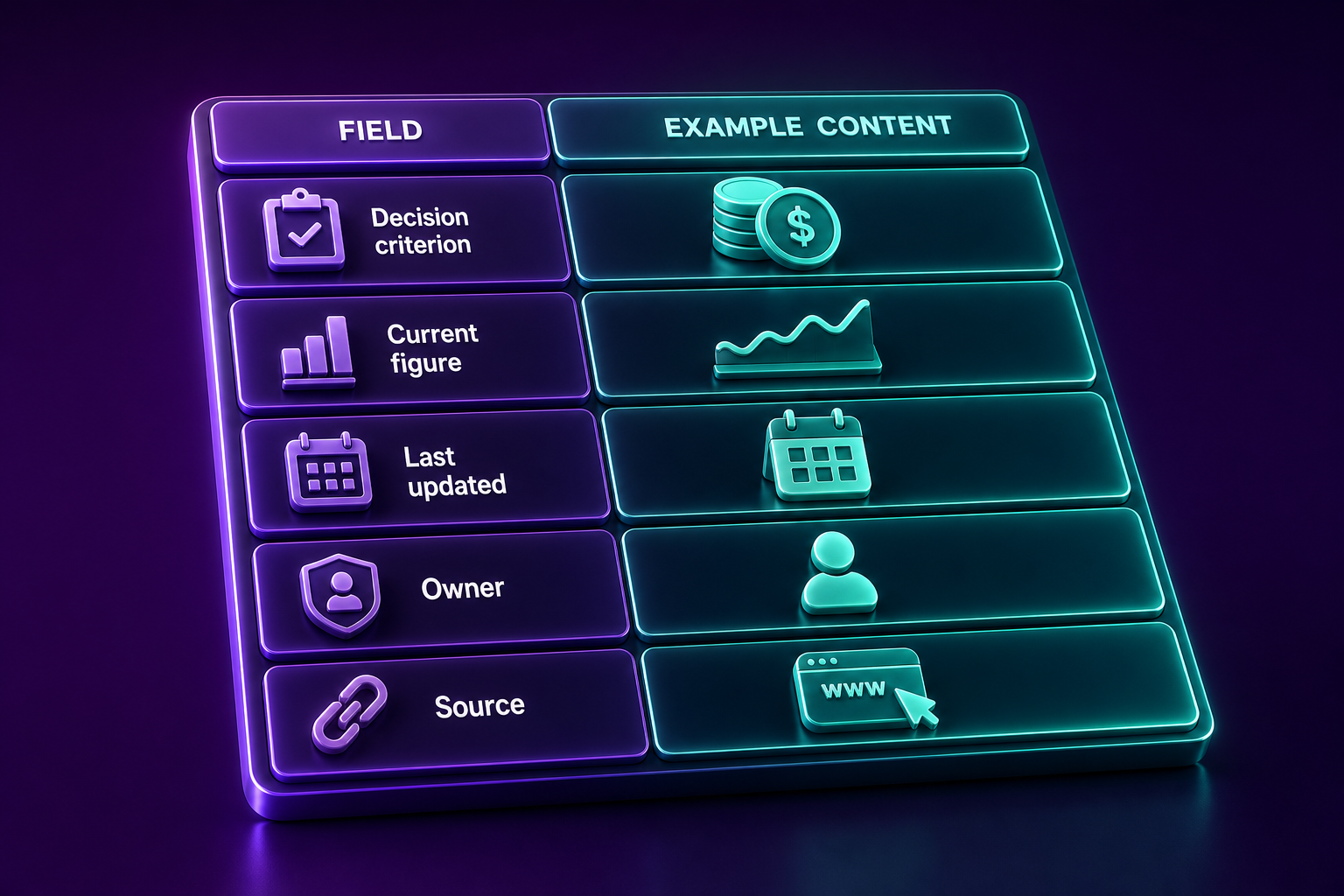
Here's an example of how a minimal answer card should look, stripped down to its essentials:
| Field | Example content |
| Decision criterion | Fees for a $1,000 spot trade |
| Current figure | Maker/taker rate, with the assumption stated |
| Last updated | Date the figure was last confirmed |
| Owner | Product and legal |
| Source | Link to the live fee schedule |
Make Security and Risk Evidence Specific
"Is it safe" is the single most consequential question an AI system can answer badly about an exchange, and it's also the one most often answered with vague reassurance instead of evidence. Vague reassurance doesn't help the reader, and it gives a retrieval system nothing concrete to cite.
Specific security evidence names the actual controls in place: cold storage percentages, multi-signature requirements, withdrawal whitelisting, insurance coverage and its limits. Where a breach has happened, stating what happened, what was affected, and what changed afterward is more credible than silence.
Proof-of-reserves and third-party audits belong here too, with their scope stated rather than assumed. Coinbase's own glossary entry on proof-of-reserves is candid that the practice has real limitations, including that it cannot account for off-chain liabilities owed to customers — a reserve snapshot shows assets held at a point in time, not a complete picture of solvency. That's Coinbase's own stated limitation, not an inference about any specific exchange's current solvency.
Coinbase has also written separately that proof-of-reserves comes in different strengths: a self-attested version, a third-party audited version, and a version that adds proof of liabilities on top of the reserve snapshot. Treating all three as interchangeable in your marketing copy is the kind of imprecision that gets flagged the moment someone asks a model to compare two exchanges' audit practices.
The honest version of this section states, for each control, what it covers, what it explicitly doesn't cover, who performed any attestation, and when it was last refreshed. That's a less flattering page than "bank-grade security." It's also the one that survives a follow-up question, which is the only test that matters here.
Surface Limitations Rather Than Hide Them
The instinct to omit anything unflattering is understandable, and it's also the fastest way to get an AI-generated answer wrong about your own product. If your content doesn't mention a limitation, the model either omits it too, leaving the user to find out the hard way, or finds it from a third-party source you don't control.
State directly which states or countries are excluded and why, where applicable, and which fee tiers apply at which volume. Token or network availability should be stated honestly, including anything currently paused for maintenance, alongside any custody restrictions like a withdrawal limit or a cooling-off period on new accounts.
Outage history belongs here too, particularly for anything that affected trading during volatile periods, since that's precisely when a cautious user is most likely asking an AI system whether your exchange is reliable. A page that says "no planned downtime" after a real outage reads as either careless or dishonest, and a system retrieving two conflicting pages about the same incident has no way to know which to trust.
None of this needs dramatic framing. A limitations section works best as a plain list, reviewed on the same schedule as the eligibility and answer-card content, sitting next to the claims it qualifies rather than buried on a separate disclaimers page nobody links to.
Connect First-Party Evidence to Independent Sources
Everything on your own domain is, by definition, self-reported. An AI system weighing whether to trust it looks for corroboration elsewhere, and that corroboration has to be genuine rather than manufactured.
Link your eligibility and security pages to the actual regulatory registrations they claim, where a public register exists. Reference the specific disclosure categories your jurisdiction requires rather than a vague claim of "full compliance" — the SEC's own guidance on crypto asset securities notes that the content and scope of required risk disclosure depends on the specific nature of the offering and the issuer, a reminder that disclosure isn't a single checkbox ticked once.
Where independent security firms have published attestation reports, link to the actual report rather than summarizing it favorably in your own words. Where independent press or educational coverage has described your product accurately, it's fine to reference that it exists.
Manufacturing the appearance of independent endorsement by quoting a friendly review out of context erodes exactly the trust you're trying to build, and it tends to get noticed. The goal isn't to appear as if independent sources love you. It's to make the first-party claim and the independently verifiable fact point at the same thing, so that whichever one gets retrieved, the answer produced is still accurate.
Test Recommendation Prompt Segments
You can't tell whether any of this is working by typing "best crypto exchange" into a chatbot once and screenshotting the result. That tests one prompt, from one angle, on one day, and it tells you almost nothing about the hundreds of real variations a user actually types.
Build a prompt set instead, segmented the way the eligibility content is segmented: by persona, by jurisdiction, and by decision criterion. Run that set across the platforms your users are likely to use, on a recurring schedule, and log what comes back.
Here's what to track in that log, as a working checklist:
- The exact prompt and which platform generated the answer
- Whether your exchange was mentioned at all
- Whether the specific facts stated about you (fees, availability, custody) were accurate as of that date
- Whether a competitor was named with information that's actually wrong about them
- The date of the test, so drift over time is visible
Be clear-eyed about what this testing can and can't tell you. Coinpresso doesn't have published, controlled before-and-after data proving that publishing eligibility modules changes citation outcomes for exchanges specifically — that kind of proof would require a tracked prompt set run against a client's evidence pages before and after publication, over months, and that dataset doesn't exist yet. Anyone implying otherwise, Coinpresso included, would be asserting more than the evidence currently supports. What the log above gives you instead is something more modest and still useful: a record of whether your own exchange is being described accurately, and whether that accuracy is improving or decaying over time.
Here's how that tracking might be organized, mapping query segments directly to the evidence each depends on — call it an Exchange Recommendation Evidence Matrix:
| Query segment | Evidence required | Risk of stale or misleading answer | Owner |
| "Available in my state/country?" | Availability policy, legal entity, restriction list, effective date | High | Compliance |
| "Lowest fees for my use case?" | Current fee schedule, tiering, spread disclosure, transaction assumptions | High | Product and legal |
| "Safest / most secure?" | Security controls, scope of coverage, incident disclosures, independent attestations | High | Security |
| "Best for beginners?" | Onboarding flow, educational tools, feature limits, support model | Medium | Product |
| "Supports asset/network X?" | Asset directory, network conditions, deposit/withdrawal status, maintenance notices | High | Operations |
| "Alternative to competitor Y?" | Fair, dated comparison with eligibility and feature differences | Medium | Content and legal |
Treat this matrix as a governance tool, not an AI ranking formula. It doesn't promise a citation. It tells you, row by row, which team owns the evidence behind a given question and how much damage a stale answer in that row could do.
Conclusion
None of this architecture guarantees a mention, and anyone telling you otherwise is selling something they can't deliver. What it does is make sure that when your exchange does get retrieved, the answer describes a real product accurately, rather than a stale fee schedule or a jurisdiction status that changed eleven months ago.
Build a maintenance routine around it: a review cadence for each module, a named owner per row of the matrix, and an escalation route for when a test surfaces a wrong answer somewhere in the wild. That's less glamorous than a pitch about winning citations, and it's the part that actually protects users and the exchange's own credibility at once.
Generic claims don't answer high-stakes exchange questions. Contact Coinpresso to map your exchange's evidence to the AI prompts that actually matter to your users.
FAQs
How do AI models decide which exchange to mention?
They rely on different retrieval, training, and synthesis processes, and no provider publishes a fixed recommendation formula. The practical task on your side is making accurate, current information available and independently corroborated, so if your exchange is retrieved, the answer is correct — that's the discipline our Web3 SEO work is built around.
Should every exchange target “best crypto exchange” prompts?
Not necessarily. Prioritize specific, supportable query segments where your product genuinely fits and is legally available, rather than chasing a single generic phrase that different users mean differently.
What compliance content should an exchange publish?
Availability, legal entity, registration or licensing information where relevant, restrictions, and update dates, reviewed by qualified compliance counsel before publication. Our case studies cover how that kind of cross-functional content gets built in practice.
Do proof-of-reserves and audits make an exchange safe?
They can provide useful evidence, but their scope, methodology, timing, and limitations need explaining rather than assuming. As Coinbase's own materials note, a reserve snapshot does not account for off-chain liabilities, which is why it functions as evidence rather than a standalone safety guarantee.
How should an exchange correct an inaccurate AI answer?
Update the canonical evidence page first, identify whatever misinformation or stale third-party page is feeding the wrong answer, use any correction channel the platform offers, and keep monitoring over time. Never treat a single retest as resolution — contact Coinpresso if you want help building that monitoring routine from scratch.