

Every comms person has sat in a room where someone asks "so what time should we send it?" as if the answer were a single sacred number handed down from a wire service. It isn't, and the fact that everyone keeps asking it is half the problem.
Here's a belief worth killing early: there is no Tuesday 9am. Every guide on this topic will tell you the "optimal" hour to hit send, as if journalists are sitting refreshing their inbox waiting for your window to open. They aren't, and the hour was never the thing standing between you and coverage.
What actually determines whether your announcement lands is whether it was ready before anyone picked a day for it. Is the agreement signed? Are the facts cleared? Is your spokesperson actually available when a reporter calls back? Get those wrong and no send-time saves you. Get them right and the hour stops mattering nearly as much as the crypto marketing teams reading this have been told. This piece treats crypto PR timing as a sequencing problem, not a calendar trick, because that is what it actually is.
Timing Starts With Readiness
Readiness means the agreement is signed, the facts are cleared, and your spokesperson can pick up the phone when a journalist calls. Everything else is decoration on top of that.
A signed term sheet that hasn't cleared final legal review isn't a green light. It's a draft with a signature on it. A reporter who asks one follow-up question you can't answer will remember that you weren't ready, not that you were early.
The same applies to a listing. If the exchange hasn't confirmed the date in writing, you don't have a listing announcement. You have a hope dressed up in a release template.
Facts need a second pair of eyes before they go anywhere near a journalist. Fundraise size, valuation, lead investor, listing date, integration scope: every one of these gets checked against the paperwork, not against what someone remembers from the call.
Your spokesperson needs to be reachable, briefed, and consistent with what's written down. The fastest way to kill a story after it's placed is a founder contradicting the release in a follow-up quote.
Permissions are the quiet one people skip. A partnership announcement involving another company needs that company's sign-off on the wording, not just the fact of the deal. Skip that step and your "partner" might publicly correct you, which is a worse outcome than not announcing at all.
Classify the Announcement
Different announcement types carry different risks and different audiences, and treating all three the same way is where most timing advice falls apart. Sort the announcement before you sort the calendar.
A funding announcement needs the round closed and the investors confirmed in writing, not a soft-circle that could still fall through. It's also unusually crowded. Crypto startups raised close to $6.81 billion across 222 rounds in Q1 2026 alone, roughly 17 to 18 funding stories a week fighting for the same handful of journalists. Assuming your Tuesday will be quiet is optimism, not planning.
A listing announcement carries a different risk: leakage. Anyone with advance knowledge has an incentive to trade on it, and regulators have already made an example of that. A former Coinbase manager was charged with insider trading for tipping advance knowledge of listing decisions, trading ahead of the news before it went public.
Coinbase's response was structural, not cosmetic. Its CEO said the exchange would publish a listing only once the decision is final and before any technical integration work begins, closing the window where on-chain activity could tip off traders. Treat that as the industry's own worked example of what "premature" costs, not a hypothetical.
Not every exchange runs the same model, either. Coinbase uses a public roadmap followed by a separate trading-launch announcement, rolled out in phases. Binance typically confirms listings only hours to a day or two before trading opens, with no forward calendar at all.
Know which model you're dealing with before you plan your own comms around it. Partnership announcements are the ones most likely to get rushed, because the deal feels exciting before it's actually locked. Integrations need the technical work at a demonstrable stage, not "in progress." Research releases need methodology a journalist can't poke a hole in, and product launches need the product working for someone who isn't on your payroll.
Use the Pre-brief and Embargo Carefully
An embargo is a request that a journalist hold a story until an agreed time, in exchange for early access to prepare it properly. It is not a contract, and it does not enforce itself — think of it as an honour-system lock on a floodgate, holding back the story purely because the journalist chose to let it.
Embargoes exist so reporters have time to research a story properly rather than scrambling to publish something thin the moment it lands. That's the trade you're offering, and it only works if the journalist agreed to the terms first. One reporter put it plainly: an embargo is a mutual agreement, and without the journalist's prior acceptance, there simply is no embargo.
Send an unsolicited "embargoed" release to someone who never agreed to hold it, and you have no recourse if they publish immediately. Embargoes work well for scheduled, coordinated news that needs several outlets to publish at once. They work far less well for breaking news, where the value is in being first, not polished.
Put the terms in writing every time. Here's the shape a pre-brief should take:
- What's embargoed and until what exact time
- What assets come with it — release, images, spokesperson access, data
- Whether it's exclusive to one outlet or shared across several
- What happens if the embargo breaks early
That last point matters more than founders expect. A broken embargo usually just means the story runs early and the coordination falls apart. It rarely means anything worse, because there's no contract to enforce, only the relationship you'll want to use again next time.
Build the Announcement Window
The announcement window is everything that happens in the hours around your send, not the send itself. Partner posts, owned content, press availability, and your support team all need to move together, or the whole thing looks like four separate press releases wearing one trenchcoat.
If a partner is involved, their posts need to go live within the same window as yours, agreed in advance, not "whenever they get to it." One side posting while the other stays silent for six hours reads as a mismatch, and a sharp-eyed journalist will ask about it.
Your owned channels need the long-form version ready before the release goes out. That's the blog post with the detail a 400-word release can't carry, the FAQ page, the deck if it's investor-facing. A journalist who wants to dig deeper should find more, not a dead end.
Your spokesperson needs to be reachable for the rest of the day, not just the hour you picked. Reporters work across time zones and their own schedules, and a follow-up call four hours after your send is normal.
Your support team needs the news before your community does. Nothing looks worse than a Discord full of confused users while your own staff scrambles to find the announcement themselves. Get that sequencing wrong once and it becomes the thing your community remembers about the launch, not the launch itself.
Avoid Common Timing Failures
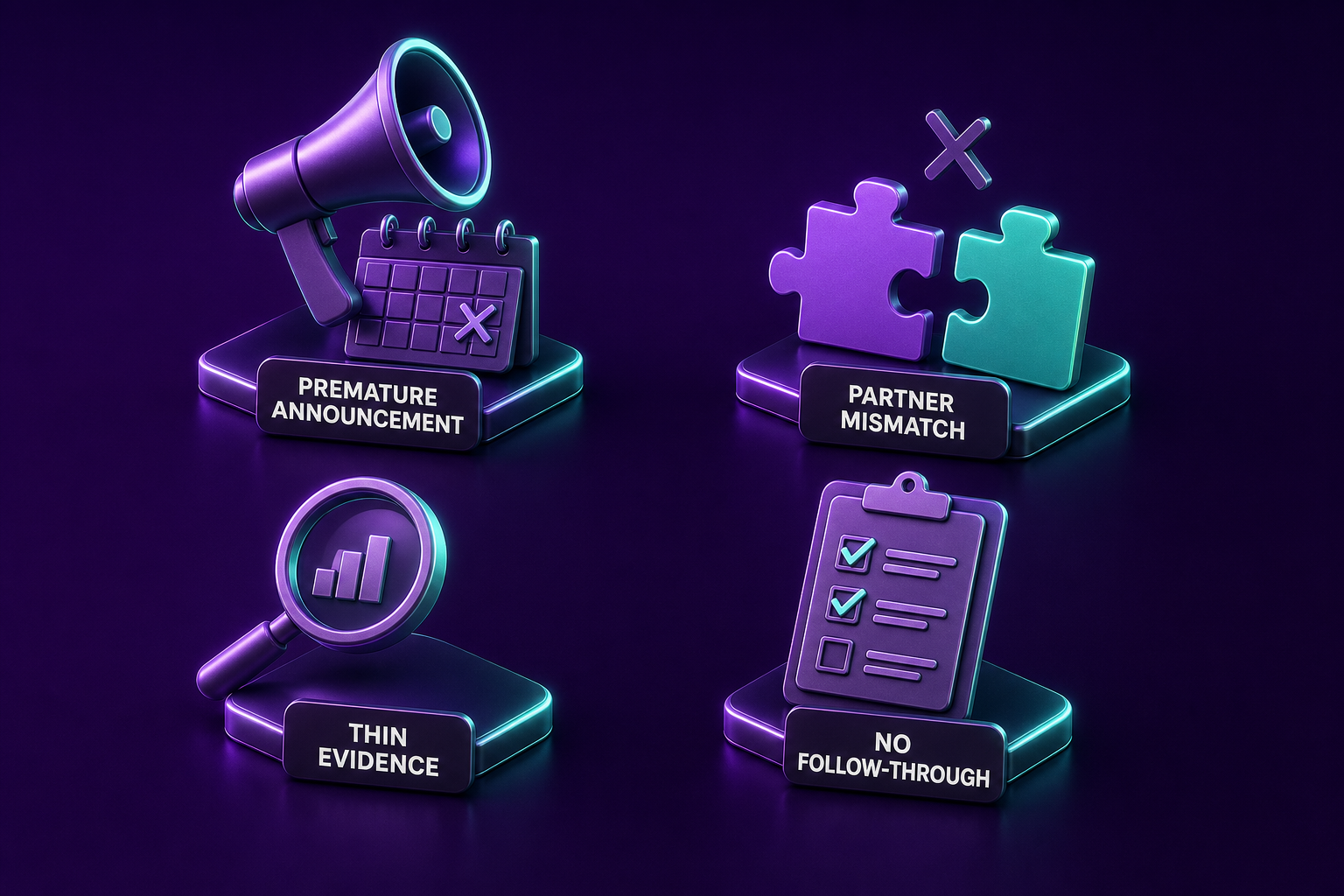
Four failures account for most of the pickup a project loses, and none of them are about picking the wrong hour.
- Premature announcement. Publishing before terms are signed, before the exchange confirms a date, or before a partner approves the wording. Treat a soft discussion like a signed deal and you've built the story on ground that can be publicly contradicted.
- Partner mismatch. One side announces, the other stays quiet or gives a different account. Reads as a disorganized deal even when the deal itself is solid.
- Thin evidence. A release built on adjectives instead of verifiable facts. Journalists notice, and increasingly they don't even reply.
- No follow-through. A single release with nothing behind it. No data, no spokesperson access, no supporting content. The story gets one cycle and dies, because there's nothing left for a journalist to build a second piece around.
Thin evidence deserves its own moment, because the data on it is blunt. A 2026 survey of nearly 900 working journalists found 88% delete pitches that miss their beat entirely. A separate cut of the same survey data found only 3% say the pitches they receive are always relevant to what they cover. That's not fixed by moving your send an hour earlier. It's fixed by sending journalists something that's actually about what they write about.
There's a fifth failure worth naming separately, because it's structural rather than a mistake: assuming the calendar is empty except for your news. It rarely is.
The Federal Reserve publishes its FOMC meeting calendar well in advance, eight fixed dates a year. CPI lands on a scheduled morning roughly 12 to 13 days after each month ends. Both reliably eat the day's attention. Check the macro calendar before you lock a date. It costs nothing, and it's the single most avoidable way to lose a news cycle to something that had nothing to do with you.
Measure the Right Outcome
Headline count is the wrong number to chase. A syndicated wire hit and a named beat journalist's original piece do not carry the same weight, even if they look identical in a coverage report.
Track qualified coverage instead: placements from journalists who actually cover your beat, not aggregator sites republishing a wire feed. Track whether journalists call back for follow-up conversations, because that's the signal a story earned real interest rather than filling a slow news day.
Track the quality of traffic the coverage sends, not just its volume. Track corrections too, because a correction issued after the fact usually traces straight back to a fact that should have been cleared before the release went out.
That's the honest scorecard, and it's a harder one to game than a headline count. What sequencing predicts, consistently, is whether a story survives past its first cycle, which is a better use of a founder's attention than debating Tuesday versus Wednesday. Our work in crypto earned media is built around exactly that scorecard rather than a vanity count of placements.
Conclusion
Go back to the belief this piece opened on: there is no Tuesday 9am. There's a founder who has signed terms, cleared facts, a reachable spokesperson, an aligned partner, and something for a journalist to write a second story about.
That founder gets pickup on a Thursday afternoon just as easily as anyone else gets it on a Tuesday morning, because the hour was never doing the work. Use this as your pre-send order of operations:
- Agreement signed and legally reviewed
- Facts checked against source documents, not memory
- Spokesperson briefed and reachable beyond the send window
- Partner sign-off on wording, in writing
- Embargo terms agreed with the journalist in advance, if you're using one
- Owned content (blog, FAQ, deck) live before or alongside the release
- Support team briefed ahead of the community
- Macro calendar checked for competing news
The best announcement date is the one supported by complete evidence and coordinated follow-through, not the one printed in someone else's blog post. Contact Coinpresso to plan your crypto PR launch sequence before you pick a date at all.
FAQs
What must be complete before a funding announcement?
The round needs to be closed and every investor confirmed in writing, not soft-circled. Fundraise size, valuation, and lead investor names should be checked against the actual paperwork, and your spokesperson needs to be reachable and briefed before the release goes anywhere near a journalist. See our case studies for how that plays out on real launches.
Should a project announce a listing before trading begins?
No. Announcing before the exchange has confirmed a firm date in writing, or before the technical integration work is actually done, is exactly the gap that's led to leakage and insider trading in the past. Confirm the date and the process with the exchange directly, then announce once it's locked, not before.
When should a partnership be announced?
Once both sides have signed off on the wording, not once the deal feels done in conversation. A partner who hasn't approved the release can publicly contradict it, which does more damage than waiting another week.
Are embargoes appropriate for crypto news?
They work well for scheduled, coordinated announcements where several outlets need to publish at once, and far less well for breaking news. An embargo only exists if the journalist agreed to it in advance — sending an unrequested "embargoed" release gives you no real protection if it runs early.
Does a specific weekday guarantee media pickup?
No single day or hour guarantees anything. Journalists respond to a story that's ready, relevant to their beat, and backed by evidence, not to the day of the week it landed on. If you want a second opinion on whether your evidence and sequencing are actually ready, crypto get in touch.