

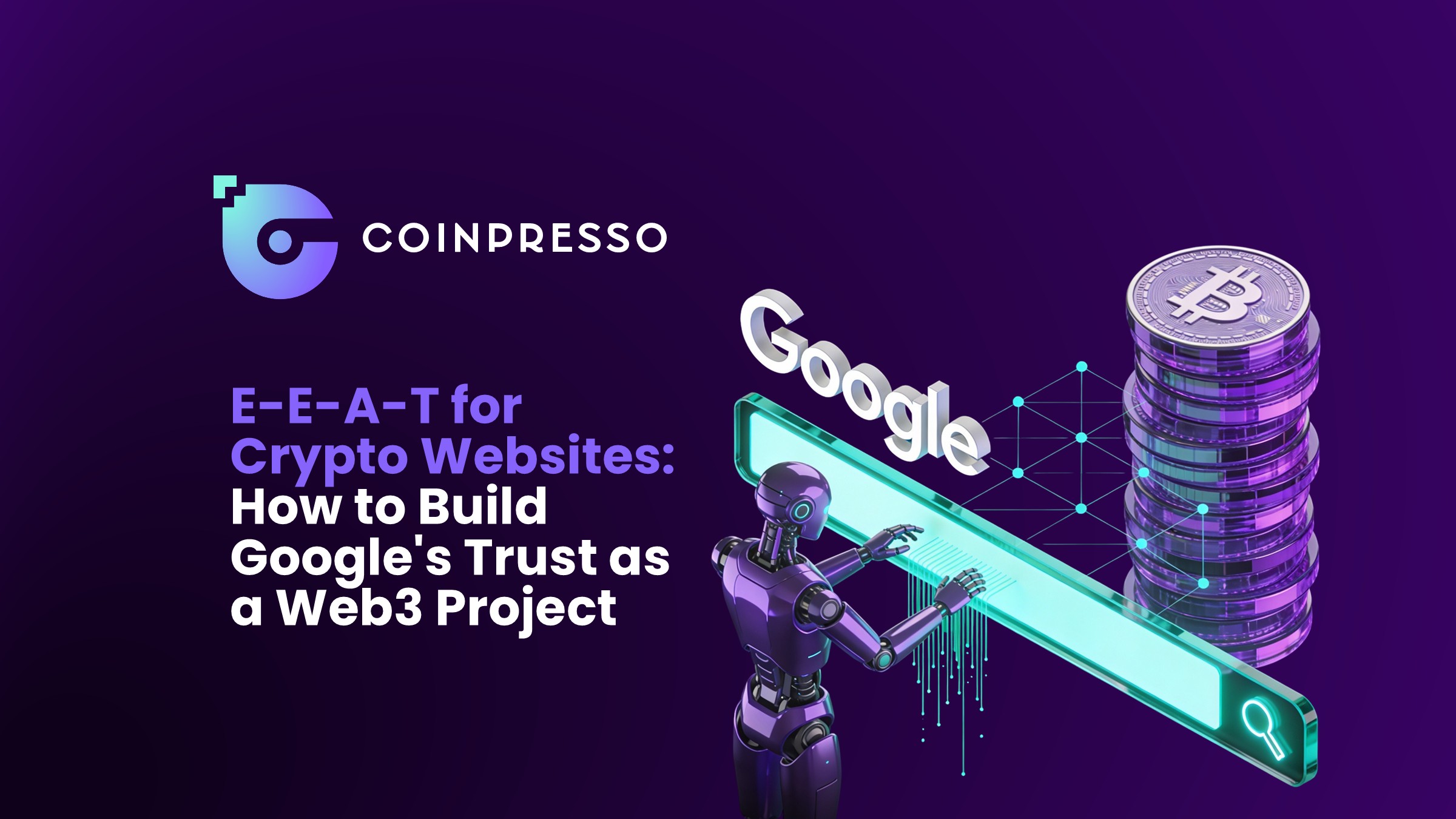
Building Experience, Expertise, Authoritativeness, and Trustworthiness (E-E-A-T) for crypto websites is a lengthy process that requires a wide range of skills and often support from expert crypto marketing teams. For this reason, some projects neglect it. They tell themselves that their project is so good that there is no need to gain the trust of Google. This is a mistake and not a feasible approach for long-term projects.
While E-E-A-T is important for all websites, it is especially important when it comes to crypto due to the fact that Google classifies crypto under the “Your Money or Your Life” (YMYL) category. This means crypto websites undergo additional scrutiny because of their potential impact on the personal finances of users.
With professional crypto SEO services, projects can strengthen their trust signals and potentially increase relevant organic traffic over time. This article will explain how Web3 projects can improve credibility through stronger content, technical trust signals, transparent branding, and authority-building strategies that align with Google’s expectations.
Why Crypto is the Ultimate YMYL Niche
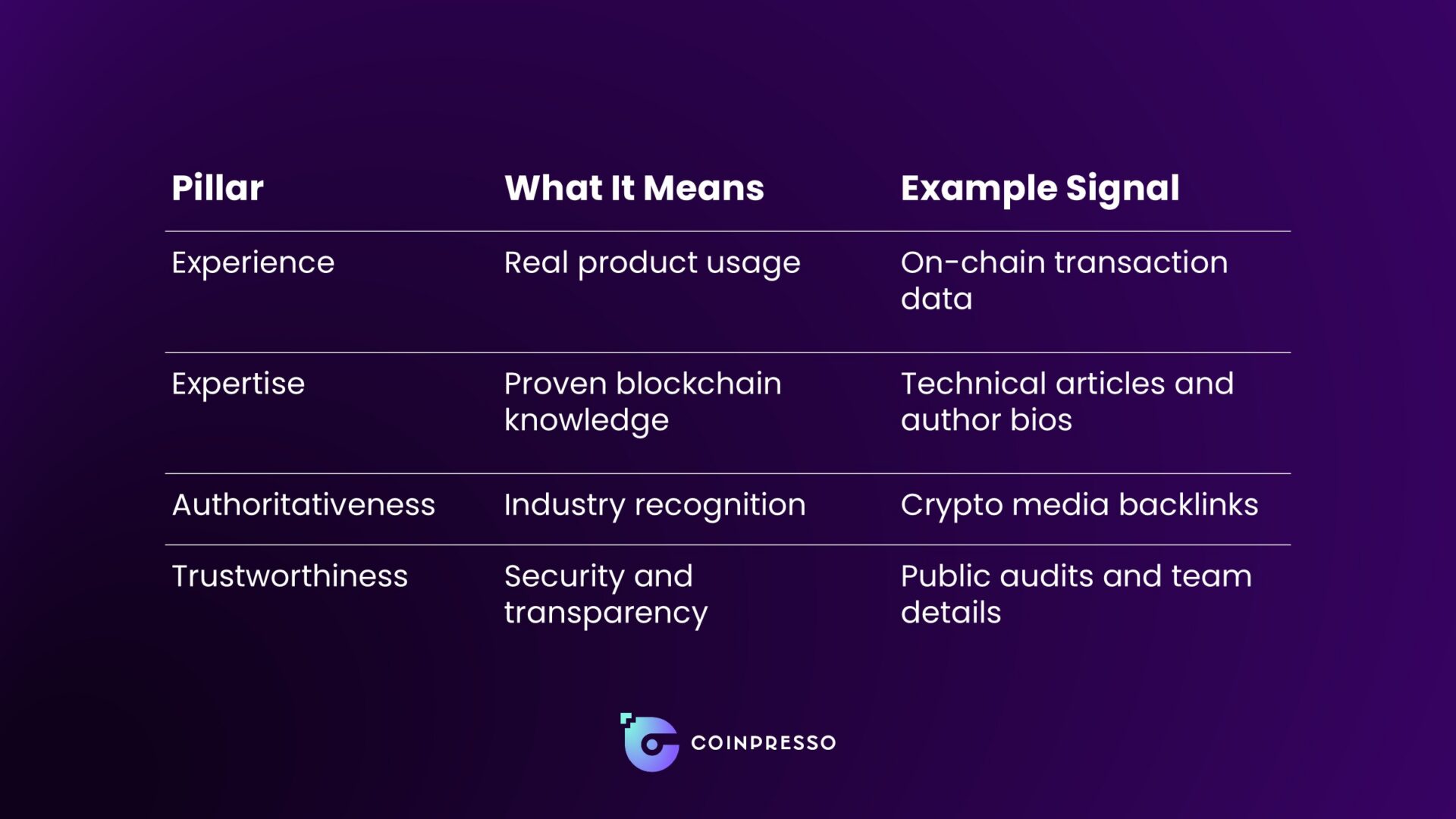
Google generally evaluates website content based on the following four pillars:
Experience
Experience refers to showing direct involvement with a product or market. In Web3, this could include publishing transaction hashes, displaying live dashboards, or sharing governance participation. For example, a DeFi protocol could show real borrowing and lending activity taking place on-chain.
Expertise
Expertise is the demonstration of deep blockchain knowledge. This includes technical documentation, detailed market analysis, and content written by people with proven experience in crypto. Strong author bios linked to platforms like LinkedIn also help strengthen expertise signals.
Authoritativeness
Authority is built through recognition from the wider crypto market. This includes backlinks from respected publications such as CoinDesk, listings on CoinMarketCap, and participation at major blockchain conferences.
Trustworthiness
Trustworthiness focuses on transparency and security. Projects should clearly display smart contract audits, team information, contact details, and terms of service. A lending protocol on Tron, for example, should make audits and risk disclosures easy to find.
These pillars are especially important in crypto because blockchain projects directly interact with user funds, investments, and financial decisions. This places crypto websites firmly within Google’s YMYL category, meaning search engines apply stricter trust and credibility standards than they would for many other industries.
For example, if two websites target the keyword “best DeFi lending protocol,” Google is far more likely to rank the platform with verified audits, trusted backlinks, and expert-written content above a newly launched anonymous project with little authority or trust history.
Ultimately, all four pillars work together. If a team launches a new DeFi borrowing and lending protocol on the Tron chain, it must demonstrate real expertise, publish trustworthy content, build authority across the crypto ecosystem, and prove real product experience to compete for visibility in search rankings.
The "Anonymous Founder" Dilemma
It’s pretty typical for the founders of crypto projects to be anonymous. Users who have spent years in the market are often not particularly bothered if they have no idea who the founder of a project is, but Google is not quite so comfortable with this. Even within the crypto community, due to the massive number of rug pulls, people are increasingly demanding accountability in the form of fully doxxed teams.
As a result, more teams are becoming transparent about who is behind projects, and since Google’s E-E-A-T framework strongly rewards knowing who is operating a website and its services, this is generally a positive move. However, it is not just about revealing the founder. There are several other important steps that teams should take.
Third-party audits can strengthen trust signals, especially respected blockchain smart contract audits from firms like CertiK. These audits help prove that the code has undergone professional security reviews, which benefits both users and search engines.
Building an on-chain reputation is also important. Teams can demonstrate credibility through consistent governance participation, transparent wallet activity, protocol development history, and long-term engagement within the ecosystem.
Transparent communication and documentation can also help make up for an anonymous founder. The project’s website should clearly explain tokenomics, risks, roadmap progress, and governance structures, and maintain active communication through social media channels such as X and Telegram.
If it is not possible to operate with a fully doxxed team, these steps can still help build trust. Strong external validation can partially offset anonymity, although the anonymous founder dilemma remains a potential downside risk for E-E-A-T and long-term SEO performance.
Actionable E-E-A-T Implementation Checklist
Due to the sheer variation of Web3 companies and websites, there is not a one-size-fits-all approach to building and implementing a successful E-E-A-T strategy. However, there are a few key steps that are generally present in every successful strategy launched and managed by top Web3 content marketing teams.
Technical Elements
A Tron-based DeFi lending platform needs a website structure that immediately signals legitimacy and security. This starts with HTTPS protection, fast loading speeds, mobile optimization, and clear site navigation. Users and search engines should be able to quickly locate important information without friction.
Schema markup is also important. Author schema, organization schema, article schema, and FAQ schema help Google understand who owns the website, who created the content, and what the pages are about. This strengthens trust signals across the site.
Important trust pages should never be hidden. Audits, tokenomics, risk disclosures, documentation, privacy policies, and support information should all be easy to access. For DeFi protocols managing user funds, hiding this information creates both SEO and credibility problems.
Content Elements
The content itself must demonstrate expertise and real market understanding. A Tron lending protocol should publish detailed educational guides covering lending mechanics, collateral systems, liquidation risks, stablecoin borrowing, and yield generation. Content should clearly explain how the protocol works instead of relying on vague marketing language.
Every important article should ideally be written or reviewed by contributors with blockchain experience. Author bios, previous publications, LinkedIn profiles, and social accounts all help reinforce expertise signals. Google increasingly wants to know who is responsible for financial content.
Experience signals are also important. Projects should use screenshots, dashboards, wallet interactions, governance examples, and real transaction references where possible. Showing real product usage helps separate legitimate protocols from low-effort projects using generic AI-generated content.
Off-Page Elements
Off-page E-E-A-T is closely tied to authority and crypto link building. Google evaluates what a project says about itself and how the wider crypto ecosystem responds to it. Backlinks from trusted crypto websites act as external validation signals.
A Tron-based DeFi platform should actively pursue crypto press release distribution, guest posting campaigns, research partnerships, ecosystem collaborations, and media mentions from respected publications. Backlinks from sites like CoinDesk or major blockchain blogs help strengthen authority within Google's YMYL framework.
Community presence also matters. Active engagement across Discord, Telegram, governance forums, and X discussions helps reinforce legitimacy. Strong off-page signals combined with transparent content and technical trust factors create a much stronger E-E-A-T profile overall.
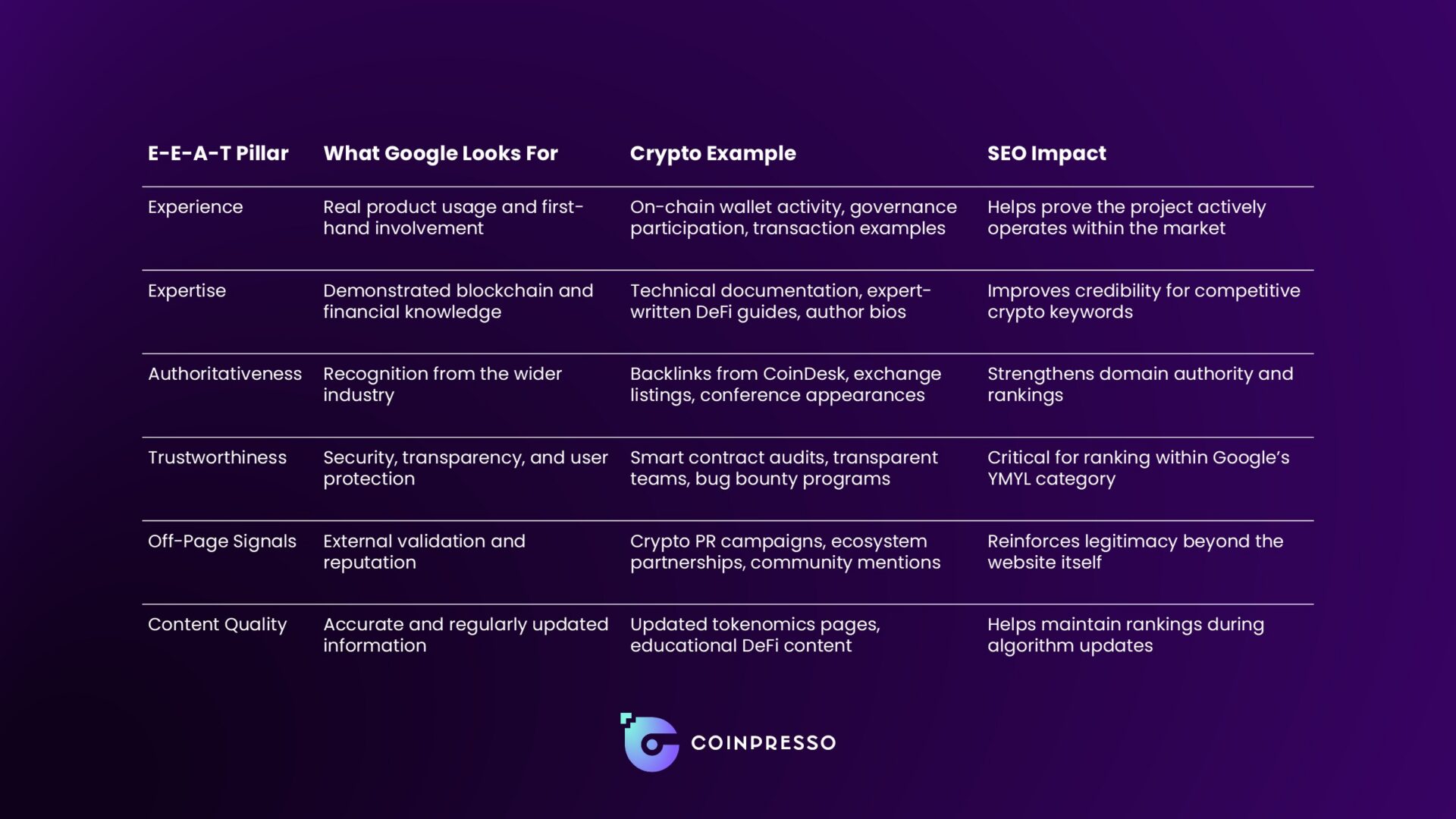
Ultimately, E-E-A-T is built through consistency across every layer of the project. Google wants to see clear expertise, transparent operations, trusted third-party validation, and real community engagement before ranking crypto websites competitively within YMYL.
Final Thoughts on E-E-A-T For Web3 Websites
Building E-E-A-T for crypto is not a short-term process. It is not simply about paying for a handful of expensive backlinks or posting the occasional blog. It is about constantly improving a website, proving that it is secure, displaying relevant third-party authority signals, and using transparency to show Google that users can trust its services with their money.
In addition, as AI search becomes more integrated into Google, websites that provide high-quality answers backed by sources, expertise, and real data will stand out. Meanwhile, Web3 companies that fail to build strong E-E-A-T signals risk being pushed to the bottom of search results and excluded from AI-generated search snippets.
Frequently Asked Questions
What does E-E-A-T stand for in SEO?
E-E-A-T stands for Experience, Expertise, Authoritativeness, and Trustworthiness. It is part of Google’s framework for evaluating the quality and credibility of websites, especially those operating in sensitive industries like finance, health, and crypto.
Why is E-E-A-T so important for crypto websites?
Crypto falls under Google’s YMYL category because blockchain platforms, exchanges, wallets, and DeFi protocols directly affect users’ finances. As a result, Google applies stricter trust standards to crypto websites than many other industries. Projects with poor transparency, weak authority signals, or low-quality content often struggle to rank competitively, even if their technical SEO is strong.
Can a crypto project with an anonymous team rank well on Google?
Yes, but it is more difficult. Anonymous teams naturally create trust challenges for both users and search engines. Projects can partially offset this by publishing audits, maintaining strong documentation, building authority backlinks, demonstrating real on-chain activity, and using public-facing contributors or spokespersons where possible.
How do smart contract audits impact SEO?
Audits help strengthen trustworthiness, which is one of the core parts of E-E-A-T. When a respected firm like CertiK audits a protocol, it creates an additional trust signal for both users and Google. Audits can also support crypto link-building and PR efforts if they are published and discussed across the crypto ecosystem.
How long does it take to build E-E-A-T?
E-E-A-T is built gradually over time through consistent trust signals. For newer crypto projects, meaningful authority and ranking improvements often take months rather than weeks, especially in competitive niches like DeFi, exchanges, or crypto trading.