

A fire drill works because everyone already knows the exits before the alarm goes off. Most crypto community teams run the opposite playbook: they wait until the channel is on fire to decide who's allowed to put it out, and by then half the mods are arguing with strangers instead of following a plan nobody wrote down.
That's the gap this piece closes. It's a framework for telling a coordinated attack apart from a community that's simply, legitimately angry with you, built around how crypto community management actually functions under pressure rather than in the quiet weeks before anything goes wrong, with a real crypto PR episode from one of the industry's most scrutinized operators showing what the detection side looks like when it's done in public.
Criticism, FUD, and Coordination Are Different
Criticism is a member telling you something true and inconvenient, usually once, usually in their own words. FUD is fear, uncertainty and doubt spread about your project, true or not, and it can come from one disappointed holder just as easily as from an organized campaign.
Coordination is neither of those. It's a pattern across accounts: synchronized timing, repeated phrasing, a cluster of profiles with no prior history in your community suddenly active on the same day.
You can tell coordination apart from genuine anger without knowing who's behind it or why. When Changpeng Zhao faced a wave of anti-Binance posts in January 2026, he didn't dismiss the sentiment outright. He pointed to unfamiliar accounts posting near-identical talking points in the days after a single tweet about holding through volatility, a specific, checkable claim about pattern, not a verdict on whether the underlying criticism had merit.
Worth saying plainly: that was a public pile-on across open posts on X, not a raid inside a gated Telegram or Discord channel. The detection logic travels across both settings. The moderation mechanics, bans, slowmode, channel locks, do not, and belong to the platform you're actually running.
That distinction matters because the three categories demand different responses. Criticism gets a real answer. FUD gets facts, published calmly. Coordination gets logged as evidence before it gets anything else.
Treat them the same and you'll end up banning a genuine member for asking the same question a bot network happened to be asking that day, which happens more often than any mod team likes to admit. The discipline is refusing to let volume alone decide the category.
A hundred people asking the same question inside an hour isn't evidence of anything by itself. It's just noise until you've looked at who's making it. Accounts with no history, joined the same week, saying the same thing in the same order: that's a fingerprint. Genuine alarm doesn't usually arrive pre-written.
Create a Detection and Evidence Log
Think of this log as your server's flight recorder: unglamorous, running quietly in the background, and the only thing anyone actually trusts once people start asking what happened. The moment you suspect coordination, open it and start recording before you respond to anything else.
Timestamp every escalation point, save message links or IDs, screenshot posts that might get deleted, and note which channels are affected.
Here's an example of how that log should look, kept in a shared doc your moderation team can edit in real time:
| Field | What to record |
| Timestamp | Time first suspicious message appeared, in UTC |
| Message link/ID | Direct link or platform message ID, not a paraphrase |
| Account details | Account age, join date, prior activity if any |
| Channel affected | Which server, channel or thread |
| Screenshot | Captured before any possible deletion |
| Escalation owner | Named person responsible for the next action |
This log is not a security product and it doesn't need to be. Platforms and exchanges already run far heavier infrastructure for this kind of detection. Binance has said its risk systems use more than 100 AI models across 24-plus initiatives to flag risky activity, a different order of resourcing entirely, the kind no community team should expect of itself.
Your log exists for a narrower job: giving you something concrete to point to later, whether that's a platform's trust and safety team, a journalist asking what happened, or your own members once the dust settles. A screenshot taken in the first five minutes is worth more than a memory reconstructed three days later when someone asks why a particular account got banned.
Coinpresso doesn't have incident logs of its own to publish timing or retention figures from, and anyone who hands you one without a named source is giving you a guess dressed as data. What the table above gives you instead is a template: start it before you need it, and it's already doing its job the moment the first message arrives.
Stabilize the Room
Stabilizing is not the same as silencing. The goal is slowing the pace enough that your moderators can think, not shutting down every voice that disagrees with you.
Rate limits and slowmode buy time without deciding anyone's guilt. Temporary channel restrictions, used narrowly and reopened quickly, do the same. Pair both with a pinned, verified update from a named team member so members aren't guessing who's actually in charge of the room while it's chaotic, the same verified-presence habit that underpins decent crypto Discord marketing on a normal Tuesday, not just a bad one.
A direct user-safety reminder belongs in that same pinned message: don't click links shared mid-raid, don't DM anyone claiming to be support, don't move funds based on anything posted in the last hour. Raids are exactly the moment opportunists try to slide a malicious link past people who are already anxious and scrolling fast.
None of this replaces judgment with a blunt instrument. A blanket ban on everyone who joined in the last hour catches real members alongside bad actors, and it tells your community that disagreement during a crisis gets treated as an offense. Stabilize the room, don't empty it.
Respond to Facts, Not Provocation
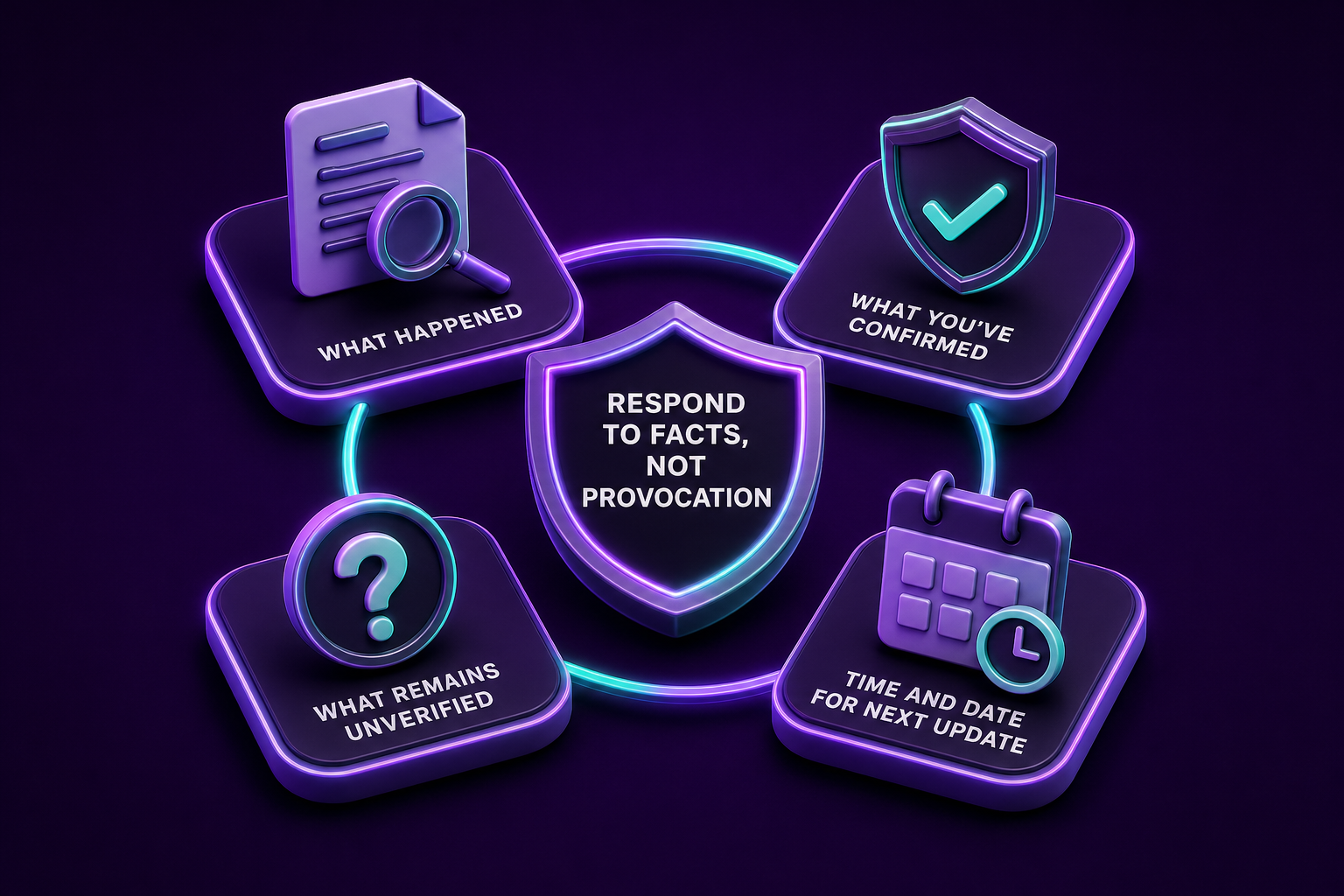
Your first public statement should say three things plainly: what you know, what you don't know yet, and exactly when the next update is coming. Nothing else needs to go in it.
A workable structure looks like this:
- What happened, described in plain terms without speculation
- What you've confirmed, with no hedging on the parts you're sure of
- What remains unverified, stated as unverified rather than implied
- A specific time for the next update, not "soon"
Arguing in public does more damage than the original pile-on. Every reply you post in a heated thread becomes a new screenshot, and once you're trading barbs with anonymous accounts, the distinction between coordinated attack and organic backlash disappears for anyone watching from outside.
Binance co-founder Yi He has pointed to the Fear and Greed Index dropping into the 5-10 range during sustained FUD campaigns, arguing that kind of pressure actively deters newcomers from the industry. That's precisely the kind of damage a calm, factual cadence is built to limit, not undo after the fact.
Silence is its own mistake here too. A team that goes quiet during a pile-on hands the narrative to whoever is loudest, and loudest is rarely the same as accurate. A timestamped "here's what we know so far" beats silence every time, even when it's an uncomfortable thing to post.
Escalate Credible Security Signals
Some signals stop being a communications problem the moment you see them. Impersonation accounts, wallet-draining links, direct threats and doxxing attempts all need to leave your Discord or Telegram mod queue and go to whoever actually handles that category: the platform's trust and safety team, your exchange partners if tokens are involved, or law enforcement where the signal is a genuine threat.
Think of it as the difference between a smoke detector and a fire alarm pull station. Your moderators are built to notice; they aren't built to extinguish. Most communities will never operate at the scale Binance does, and they don't need to, but the principle scales down fine: route the credible security signal to whoever is actually equipped to act on it, rather than trying to resolve it with a ban button.
A moderator deleting a drainer link helps your server. It does nothing to stop that same link reaching the next community the attacker targets.
Speed matters here in a way it doesn't for ordinary criticism. When attackers compromised the Calamity Discord server, which had more than 250,000 members, in October 2026 using social engineering against the server owner, the response that actually limited the damage came from a former moderator who still had admin access and used it to wipe the compromised channels.
Subreddit moderators separately issued an emergency warning telling members to leave and not engage roughly an hour into the takeover. That incident is a hijack, not a FUD campaign, and the mechanics of in-channel lockdown differ from the mechanics of countering a coordinated narrative attack. But the underlying lesson holds across both: once a signal is credibly a security event rather than a sentiment problem, speed and the right escalation path beat a perfectly worded statement every time.
Recover Community Trust After the Event
The raid ending is not the same as the damage being repaired. Members who watched the chaos unfold are quietly deciding whether your team handled it well or hid from it, and that judgment forms whether or not you address it directly.
Reopen any restricted feedback channels explicitly, and say so. If you locked a channel during the incident, tell members clearly when and why it's reopening, and invite the same criticism you paused, including from people who were right about something during the pile-on. Punishing accurate critics after the fact because they were loud during a chaotic hour erodes exactly the trust you're trying to rebuild.
A measured postmortem helps more than most teams expect. It doesn't need to be long. It needs to say what happened, what you got right, what you got wrong, and what changes as a result.
Support your moderators publicly too. They absorbed the worst of the pile-on in real time, often while being personally targeted, and a team that doesn't acknowledge that burns out the people it needs most for the next incident. Improve the safeguards that failed, whether that's tighter admin-access controls, a clearer escalation chain, or a faster path to a verified update, and say plainly that you've made the change.
Conclusion
A raid tests whether your team can tell a real problem from a manufactured one while people are watching in real time. The sequence here, detect and log, stabilize, respond with facts, escalate what's credible, then rebuild, is what a working crypto community raid response actually looks like, whether you're a ten-person Telegram group or an exchange the size of Binance.
Here's a checklist to keep pinned for your moderation team before you need it:
- Log timestamps, message links, screenshots and affected channels the moment coordination looks likely
- Name an escalation owner before an incident, not during one
- Use rate limits and temporary restrictions, not blanket bans
- Publish what you know, what you don't, and your next update time
- Route impersonation, drainer links, threats and doxxing to platform trust and safety or law enforcement
- Reopen feedback channels explicitly once the incident is over
- Publish a short postmortem and support the moderators who handled it
Responding well to a raid requires proof, calm escalation, and member safety, not louder arguments. Contact Coinpresso to build a community incident playbook that fits your moderation workflows, your channel roles, and the way your team actually operates under pressure.
FAQs
How can a team distinguish FUD from valid criticism?
Look at the pattern, not the content. Valid criticism tends to come from accounts with a history in your community, phrased in their own words, usually arriving alone rather than in a synchronized wave. FUD and coordination can be hard to tell apart in the first few minutes, so treat the message itself as inconclusive until you've checked whether the accounts posting it have any prior activity at all.
Should moderators ban everyone joining a raid?
No. A blanket ban catches real members alongside bad actors and signals that disagreement during a crisis gets punished rather than heard. Use rate limits and temporary channel restrictions to slow the pace instead, and save bans for accounts you've actually logged as part of a coordinated pattern.
What evidence should be preserved during a raid?
Timestamps, message links or IDs, screenshots taken before anything can be deleted, the channels affected, and a named escalation owner for each entry. This record protects genuine critics from being misidentified and gives you something concrete if you later need to involve a platform's trust and safety team.
What should the first public update say?
What you know, what you don't know yet, and exactly when the next update is coming, nothing more. Resist the urge to speculate or argue with individual accounts in that same statement, since a single sentence that reads as defensive gets screenshotted as proof you're hiding something.
How can a community recover after a coordinated attack?
Reopen any restricted channels explicitly, publish a short postmortem covering what happened and what changes as a result, and support the moderators who absorbed the worst of it in real time. Our case studies cover how projects have rebuilt community trust after other kinds of public setbacks, and the same honesty-first approach applies here; there's no reliable way to measure "full recovery," only whether members stay engaged and keep asking questions in the open.