


There's a belief floating around every founder Slack and Telegram group at pitch time: that a deck full of outlet logos is proof of a crypto marketing agency's calibre. It isn't. Half of those logos mean "our release once appeared on a syndication network that publisher's ad server happens to display," and the other half mean nothing at all beyond "we know how to take a screenshot."
That distinction is the whole game, and most buyers never learn to see it until they're three months into a retainer wondering why nobody outside their own Discord has heard of them. Somewhere between "we got you on CoinDesk" and "we pushed your release through a network CoinDesk's ad server happens to display" sits a gap most founders never think to check. This piece is a checklist for closing that gap: what to ask before you sign, what to open and inspect on a placement you've already paid for, and what a crypto PR contract needs to say so you're not relitigating scope after the invoice lands.
Know What You Are Buying
Crypto PR isn't one product. It's five different products wearing the same suit at the pitch meeting, and knowing which one you're being sold changes everything about what you should expect to receive.
Wire distribution is paid syndication. You write the release, a service pushes it to a network of publishing partners, and it appears — labeled as a press release — wherever those partners choose to run it. One of the larger crypto wires describes its own network as over 100 media outlets and is upfront that placement happens at the discretion of those partners rather than being centrally controlled by the wire itself.
That's the honest version of the product, and it's worth reading twice. Nobody wrote about you. A distribution pipe carried your words to wherever the pipe happens to run, and other wires' own distribution pages say the same thing in slightly different words: syndication decisions sit with the outlets, not the wire that fed them the copy.
Media relations is the opposite motion entirely. An agency pitches a specific journalist a specific angle, the journalist decides independently whether it's a story, and if it runs, it runs because someone with an editorial job chose to write it. This is earned media, and it carries weight a wire hit never will, because a third party vouched for the story with their own byline attached to their own reputation.
Sponsored content sits in between the two. You pay an outlet directly, sometimes through an agency, for a piece it agrees to publish, usually labeled "Sponsored" or "Partner Content." It's commissioned rather than syndicated in the strict sense, but it still has to say what it is. The FTC's policy on native advertising treats an ad format as deceptive if it misleads a reader about who's actually speaking, and sponsored content that hides its sponsorship is precisely that.
Bylined thought leadership is your team's name on an article an outlet agreed to run, usually because an editor found the argument useful to readers, not because money changed hands for the placement itself. Strategic PR is the umbrella over all four: narrative development, timing, spokesperson prep, and a plan for which tool fits which announcement. A crypto PR partner worth hiring should be able to tell you, unprompted, which category each line on their quote falls into. If they can't, that's not a gap in your knowledge. That's a gap in theirs, dressed up as a shortcut for you.
The Seven Questions to Ask
Before you sign anything, ask these seven questions and write down the answers word for word. A vendor who can't answer plainly is telling you something, even when the words sound confident.
- How was the story developed? Ask whether a journalist was pitched an angle, or whether a release was written and distributed. These are different products at different price points with wildly different odds of coverage.
- Why these targets? A named list of outlets should come with a reason each one fits your announcement, not just a reason each one looks impressive on a slide.
- Can I see a sample report from a past client? Redacted is fine. A blank template is not the same thing, and you should notice the difference immediately.
- How will each placement be disclosed? Sponsored, press release, and reporter-written pieces should be labeled as such, and the agency should volunteer this before you ask.
- What happens after the story runs? Follow-up amplification, syndication tracking, and a second wave of pitching separate the agencies still working from the ones who consider the job finished at publish.
- Who approves copy, and when? Know whether you sign off before distribution or find out what went out after the fact.
- Does this scope cover a crisis? A hack, a regulatory letter, a token depeg. Ask now whether crisis response sits inside the retainer or arrives later as a separate invoice you didn't see coming.
Audit Sample Placements
You don't have to take a vendor's word for a past win. Open the URL yourself and check seven things, and each one takes under a minute.
Together they tell you almost everything the pitch deck left out.
| Check | What to look for | What it tells you |
| Byline | A named reporter, or "Staff," "Press Release," or no byline at all | Whether a person actually wrote it |
| Label | "Sponsored," "Press Release," "Partner Content," or none | Whether the outlet is disclosing its own arrangement |
| URL path | A /press-releases/ or /sponsored/ segment | The outlet's own system has already classified it, in its own words, not the agency's |
| Canonical tag | Points to the outlet, or to a syndication origin elsewhere | Whether the outlet treats this as its own content or a repost |
| Link attributes | rel="sponsored" or nofollow on outbound links | Whether the outlet is following its own disclosure rules |
| Surrounding context | Other pieces on the same page or feed | Whether it sits among news coverage or a wall of other paid placements |
| Reporter involvement | A quote, an independent source, evidence of original reporting | Whether anyone beyond your own team contributed information |
None of this requires special tools. It requires opening the page, viewing source if you want to check the canonical tag, and reading what's actually there instead of what the recap slide claimed was there. Google's spam policies draw the same line at the platform level, treating properly disclosed third-party content as legitimate and undisclosed manipulation of ranking signals as something else entirely.
Red Flags in Promises and Pricing
Some phrases in a pitch deck deserve treatment as a stop sign, not a selling point. If a deck promises the moon, count the footprints: a genuine placement leaves a byline, a label and a URL you can click. A promise leaves nothing you can verify at all.
"Guaranteed editorial coverage" is the biggest one, and it's worth stating plainly why: editorial coverage is, by definition, a decision made by someone who doesn't work for you. If an agency says it can guarantee a journalist's decision, it's either psychic or it's selling you something else entirely and calling it that to make the invoice easier to sign.
A secret or vague outlet list is the second tell. "Top-tier publications" with no names attached until after you've paid isn't confidentiality, it's the absence of a plan wearing confidentiality as a costume.
Dofollow link promises deserve real suspicion too. An agency promising a dofollow backlink from a news placement is prioritizing your search rankings over the outlet's own editorial and disclosure standards. Reputable outlets increasingly nofollow or sponsor-tag exactly these links regardless of what the agency told you it could arrange.
Deliverables with no unit are the quiet fourth flag. "PR campaign" names nothing. "Six press releases distributed via wire, three media pitches to named outlets, one bylined op-ed" names everything you're paying for. If a quote can't be itemised into things you could count on delivery day, ask why not.
None of this makes wire distribution the villain of the story. It's a legitimate tool with a real place in a launch calendar, and treated honestly it does its job well. The genuine crypto PR agency red flag is a vendor selling wire distribution at earned-media prices, dressed in earned-media language, betting you never open the URL to check.
What a Useful PR Report Looks Like
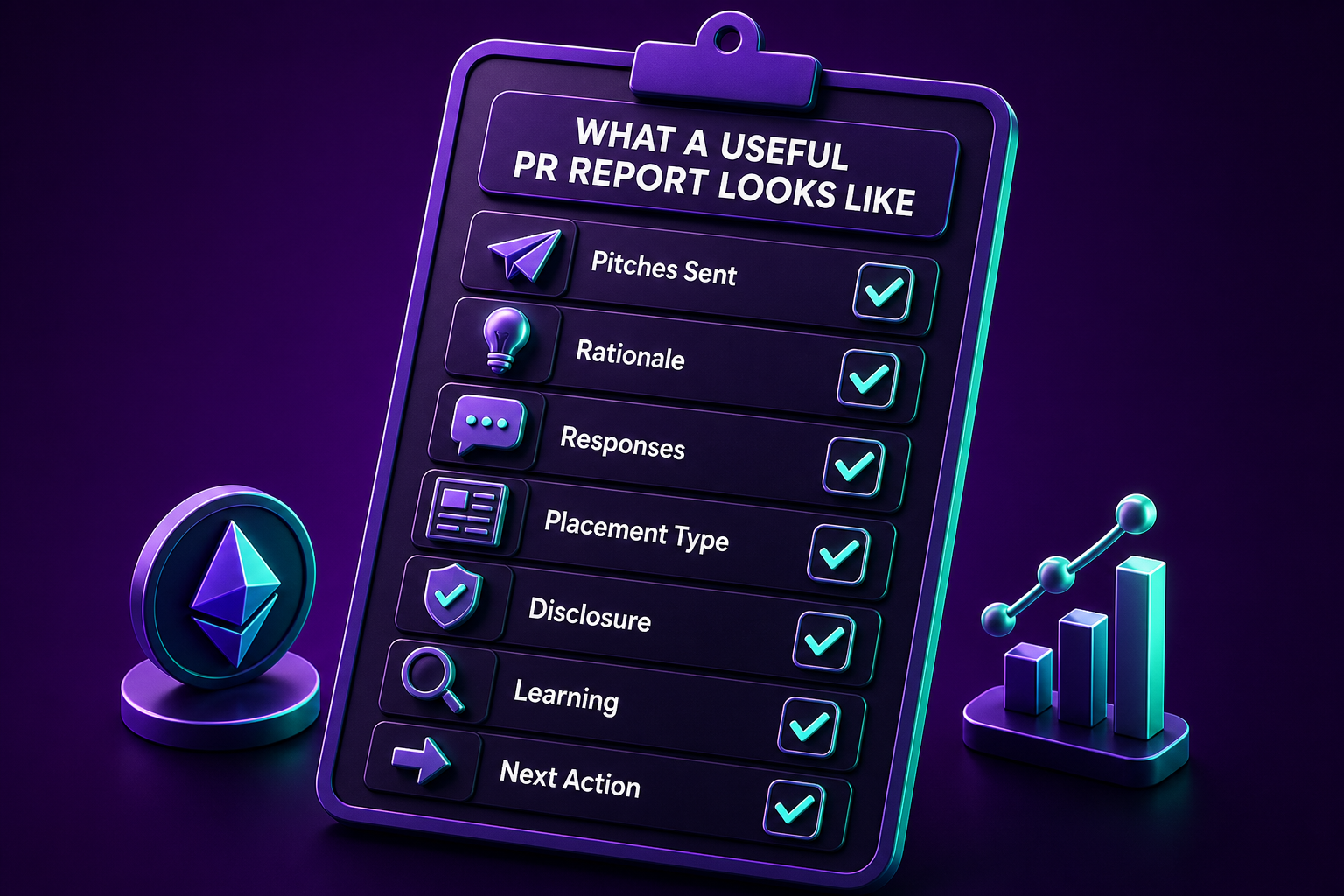
A PR report should let you reconstruct exactly what was done without a follow-up call. If it doesn't, it's a highlight reel wearing a report's clothing.
Here's an example of the fields a report should actually contain:
- Pitches sent: which journalists or outlets were contacted, and when
- Rationale: why this outlet, for this story, at this time
- Responses: who replied, who passed, who went quiet
- Placement type: wire, sponsored, earned, or bylined, named plainly and without euphemism
- Disclosure: how the placement was labeled, with a link to check it yourself
- Learning: what worked, what didn't, and why it didn't
- Next action: the specific follow-up planned, not "continue outreach"
A report built this way doubles as an audit trail. You'll spot a mismatch in the pitch log before you pay another retainer, not three months after you've already renewed it on autopilot.
Build a Balanced Scope
The strongest scopes don't pick a side between wire and earned media. They use each where it earns its keep, and they say so in the contract instead of leaving you to work it out later.
Wire distribution earns its place on time-sensitive, factual news: a listing, a partnership confirmation, a funding close. It's fast and predictable, and nobody sensible expects a wire hit to carry the same weight as a reporter's byline. Treating it as though it does is where the trouble starts, and where most crypto PR agency due diligence conversations go wrong from the first slide.
Earned media takes longer, costs more per placement, and can't be guaranteed by anyone honest, but it's what actually moves how traders, journalists and institutions perceive a project. Coinpresso has made that argument at length in its guide to crypto earned vs paid media, and the short version holds up: a wire hit tells the market you exist, an earned placement tells the market someone independent thinks you matter.
The PRSA's own code of ethics puts disclosure at the centre of the profession's standards, and that's the test worth applying to any scope document in front of you. Does it name which tool does which job, and does it commit to disclosing each one honestly? A scope that mixes both without saying so isn't balanced. It's blurred, and blurring is usually more convenient for the vendor than it is for you.
Conclusion
The fastest way to compare two crypto PR quotes isn't outlet count. It's whether each line item names its own category, and whether either vendor will show you a placement you can click open and check yourself. Most won't, because most were never built to survive that question.
Here's a simple scorecard to run against a proposal before you sign it.
| Signal | Wire-only reseller | Genuine PR partner |
| Names what's being sold | Rarely | Always |
| Offers a sample report unprompted | Rarely | Usually |
| Guarantees "editorial coverage" | Often | Never |
| Discloses sponsored/wire labeling upfront | Sometimes | Always |
| Scope covers crisis response | Rarely | Explicitly stated either way |
Do not hire based on a logo sheet. Contact Coinpresso for a vendor-scope review before you commit to a crypto PR retainer, and bring the last deck you were pitched. It's a faster conversation with something concrete on the table.
FAQs
Is wire distribution inherently bad?
No, and treating it as the villain misunderstands what it's for. Wire distribution is a fast, predictable way to get factual, time-sensitive news onto a syndication network, and it belongs in most crypto marketing timelines somewhere. The problem is never the tool, it's a vendor selling wire syndication at earned-media prices while implying a journalist was involved when nobody was.
Can an agency guarantee editorial coverage?
No legitimate one can, because editorial coverage is a decision made by a journalist who doesn't answer to your contract. Any promise of "guaranteed" placement in earned press is either describing paid syndication in earned-media language or making a claim it has no power to keep. Treat the phrase itself as one of the clearest crypto PR agency red flags there is.
What should a crypto PR contract include?
It should name the category of each deliverable (wire, sponsored, earned, bylined) rather than bundling them under "PR campaign," and it should state disclosure obligations for every placement type up front. It should also specify who approves copy before distribution and whether crisis response sits inside the retainer or gets billed separately. If you want a second pair of eyes on a contract before signing, Coinpresso's crypto PR team can walk through scope language with you.
How can I audit a vendor’s past placements?
Open the actual URL of a placement they've shown you and check the byline, the label, the canonical tag, and whether outbound links carry a nofollow or sponsored attribute. None of this needs special software, just five minutes and a willingness to view source. It's the single most useful step in any press release placement audit, and it's the one most buyers skip because the recap slide looked convincing enough.
Are outlet logos enough to compare agencies?
No. A logo tells you a publisher's name has appeared somewhere near your release at some point, not whether a reporter read it, understood it, or decided it was newsworthy. Ask instead for a sample report and a named rationale for each target outlet; Coinpresso's case studies show the kind of detail a genuine placement record should carry.