


Most founders cost out their presale page in design hours and copywriting fees. The real bill arrives later, in the Discord moderator's time, explaining for the fortieth time why "audited" didn't mean what the reader assumed it meant.
That conversation costs more than the page would have, had it been built properly the first time. Every presale landing page carries a handful of trust claims — locked liquidity, an audit, a vesting schedule — and most are built as decoration rather than evidence. If you're running crypto marketing on an eight-week clock with a fixed budget, you don't need another lecture on why trust matters. You need to know which of these elements survive a buyer clicking through to check, and which ones are just varnish.
Crypto Presale Trust Signals: the Numbers
Six trust elements commonly appear on presale pages, but only the ones with a dated, direct verification link and an explicit scope statement actually function as evidence: contract identity, liquidity lock, vesting schedule, audit scope, ownership controls, and token allocation. A badge with no link behind it, or an "audited" claim with no stated scope, reads as decoration to a buyer who has learned to click through before trusting anything.
Here's the breakdown, one claim per row.
| Trust signal | What it proves | Where to verify it |
| Contract identity | The exact deployed address and chain | Block explorer entry for the address |
| Liquidity lock | Pool tokens can't move before a stated date | Locker contract address and the lock transaction |
| Vesting schedule | When allocations release, against real dates | On-chain transfers against the published schedule |
| Audit scope | A named firm reviewed a specific contract | The auditor's own published report page |
| Ownership controls | Whether admin functions like mint or pause exist | Contract read functions on the explorer |
| Token allocation | The full split of where supply goes | Published allocation table against on-chain wallet balances |
The condition that makes any row on that table count: a link, an identifier, and a date sitting next to the claim, not a logo standing in for all three. Everything below is about building that into each module before launch, not patching it in after someone asks.
Why Trust Badges Are Insufficient
A badge tells a visitor that something happened. It does not tell them what, when, by whom, or whether it still applies to the version of the contract they're about to send money to.
That gap is the entire problem with presale trust pages in 2026. A padlock icon next to "Liquidity Locked" is a claim, not a record — no locker address, no unlock date, no link to the transaction that created it.
An "Audited by [firm]" logo carries the same shape of problem. It tells you an audit happened somewhere, covering some unspecified part of the system, at some point. That's a confession dressed up as reassurance.
Compare that to a single retrievable fact. Bitcoin Hyper's presale audit, run by Coinsult, is published at a fixed URL with the contract address it covers, the findings, and the result. A visitor doesn't have to take the badge's word for it; they can go and look. That's the difference between a logo and evidence, and nearly every presale page still has the gap.
The scale of why this matters isn't abstract. The FBI's Internet Crime Complaint Center logged $11.366 billion in cryptocurrency-related losses across 181,565 complaints in 2025 alone. The default visitor to your page has read those headlines. A badge that can't be clicked and checked now reads as a reason to leave, not a reason to buy.
The Six Evidence Modules
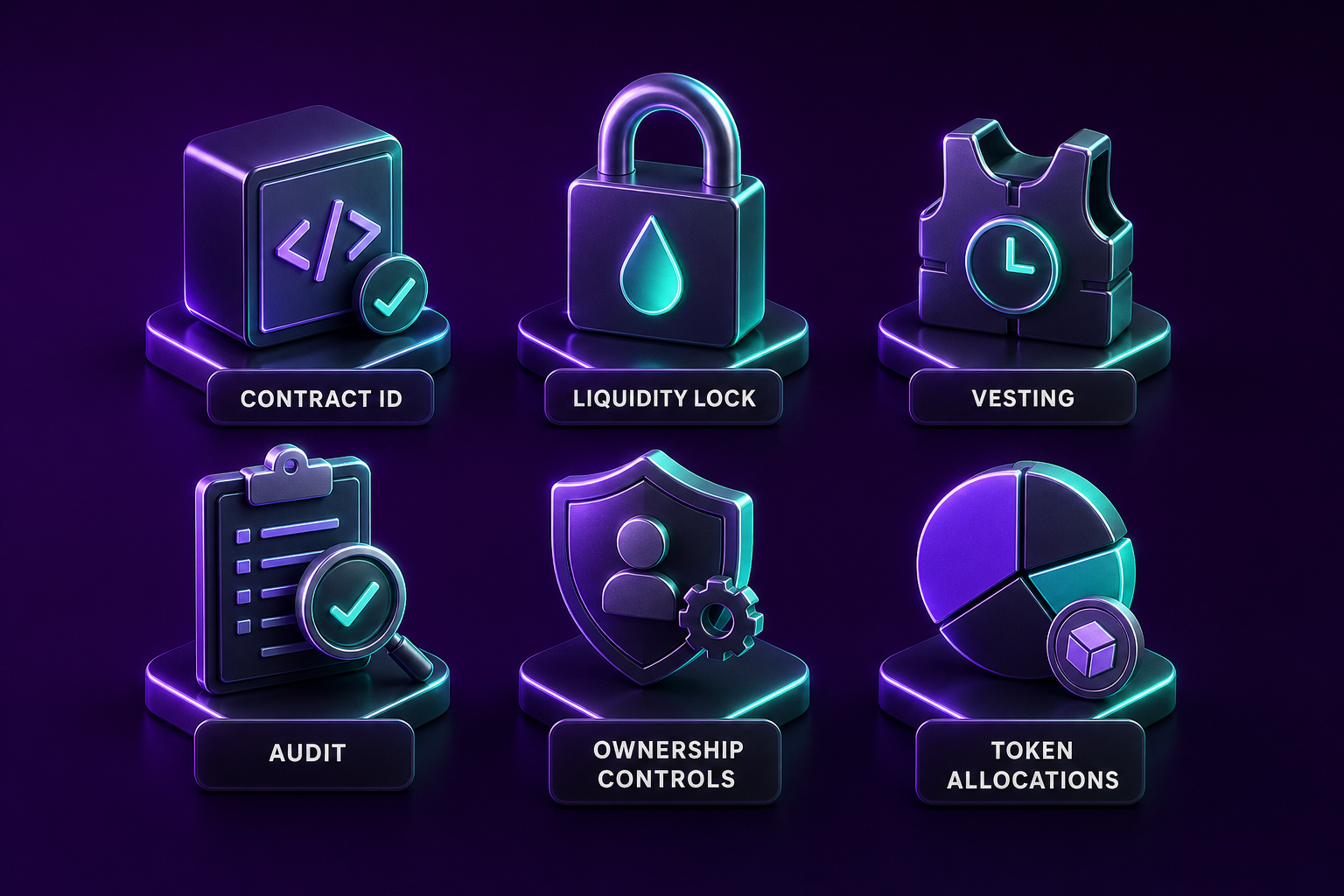
A presale trust stack isn't one page element. It's six separate claims, each needing its own proof, its own scope statement, and its own place for a visitor to check it independently.
Here's the structure to work from.
- Contract identity. The exact deployed address, chain, and a link to the block explorer entry for it.
- Liquidity. The locker contract address, the lock duration, and the transaction that created the lock.
- Vesting. The release schedule for team, treasury, and investor allocations, shown against actual dates rather than vague percentages.
- Audit scope. Which contract or contracts were reviewed, by whom, when, and explicitly what was left out.
- Control and ownership. Whether the contract owner retains admin functions such as mint, pause, or blacklist, and who holds the keys.
- Token allocation. The full breakdown of where supply goes, not just the portion sold to the public.
Each module answers a different question a skeptical buyer is silently asking. Skip one and you haven't simplified the page. You've left a gap for someone to find later, usually in a screenshot with forty angry reactions on it.
Build Direct Verification Paths
Every claim on the trust stack needs a path a visitor can follow themselves, in under a minute, without asking a moderator. If verifying a claim requires trusting your explanation of it, you haven't built a trust signal — you've built a bigger badge.
For contract identity, that means a direct link to the block explorer page for the deployed address, not a screenshot of one. For liquidity, it means the locker contract address and the specific transaction hash, with the unlock date stated in plain language next to it.
For audits, link straight to the auditor's own published report page rather than hosting a PDF yourself. Bitcoin Hyper's page does this cleanly: the Coinsult audit record sits on the auditor's own domain, carrying their name and their liability, not the project's framing of its own results.
Independent coverage separately confirms the project also ran a second audit through SolidProof, with presale tokens held non-transferable until distribution. That dual-source confirmation is itself a verification path worth stating on the page.
Every one of these links should carry a visible "last checked" date. A link that worked at launch and silently breaks three weeks later is worse than no link at all, because it reads as concealment rather than neglect.
Explain Scope and Limitations
This is the section most presale pages skip entirely, and it's the one that actually builds trust rather than just claiming it. An audit, a lock, or a vesting schedule covers exactly what it covers, and saying so plainly is more persuasive than pretending the coverage is total.
Take the audit-scope problem directly. Independent coverage of Bitcoin Hyper's presale notes that the audit checked the ERC-20 token contract only, while the bridge, Layer 2 components and staking pools sit outside that scope entirely. That's not a flaw in the project's disclosure. It's exactly the kind of boundary a trust stack should state up front rather than let a buyer discover on a forum later.
Auditors themselves are explicit about this. Coinsult's own published reports carry a standard disclaimer that the firm isn't responsible for financial losses and that the audit is for informational purposes only. A trust stack that quotes the clean result without quoting that boundary is misrepresenting the evidence by omission, which is worse than not citing the audit at all.
The same logic applies to locks and vesting. A locked-liquidity claim proves the pool tokens can't move before a stated date. It proves nothing about team wallets, treasury allocations, or a second, unlocked pool sitting on a different pair. State the boundary next to the claim every time, and don't make the visitor go digging for the asterisk.
Design the Trust Section for a Real User
A trust stack that nobody reads isn't a trust stack. It's a compliance tick-box nobody will ever credit you for. The section needs a hierarchy a skimming visitor can parse in fifteen seconds, and copy that doesn't require a law degree or a Solidity background to follow.
Put the six modules in a single, scannable block near the top of the page, not scattered across three scroll depths where only the determined visitor finds the vesting section. Use plain labels like "what this proves" and "what this doesn't cover" next to each module, rather than burying the limitation in a footnote nobody scrolls to.
Avoid the dark patterns that undo all of this instantly: a countdown timer with no real deadline behind it, a "150 spots left" counter that resets on refresh, an audit badge that links to the homepage instead of the report. These tricks are common enough that a sophisticated visitor now treats their presence as a negative signal, actively counting against a project rather than for it.
This is also where the broader campaign matters, not just the page. A trust stack built in isolation from the rest of your crypto presale marketing plan gets undercut the moment a KOL post or an ad makes a claim the landing page doesn't back up. The page and the promotion need to say the same thing, in the same register, or the mismatch becomes the story the community tells about you instead of the one you wrote.
Set an Evidence-update Cadence
A trust stack is a living document, not a launch-day deliverable shipped once and forgotten. Every module needs a named owner, a scheduled review date, and a visible process for correcting something that turns out to be wrong.
Here's what that looks like as a working structure.
| Module | Owner | Review cadence | Correction process |
| Contract identity | Dev lead | On every deploy or upgrade | Update address, flag change in changelog |
| Liquidity lock | Treasury lead | At lock creation and renewal | Publish new transaction hash immediately |
| Vesting schedule | Finance/ops | Monthly against actual releases | Reconcile against on-chain transfers |
| Audit scope | Marketing/compliance | Whenever contract changes | Commission re-audit, update scope note |
| Ownership controls | Dev lead | On any admin key change | Disclose change within 48 hours |
| Token allocation | Finance/ops | At TGE and each unlock | Publish updated breakdown |
Without named owners, every module quietly decays. Nobody notices day to day, until the audit from month one is still sitting proudly on the page eight months later, describing a contract that's since been upgraded twice. That's not dishonesty exactly. It's neglect wearing the same badge it always wore, and a careful visitor will notice before you do.
Conclusion
A trust stack earns its keep by being checkable, not by looking official. The page that survives scrutiny is the one that names exactly what each piece of evidence proves, links straight to the primary record, and says plainly what it doesn't cover.
That's a content and QA problem as much as a design one, which is the whole reason it's worth building properly rather than lifting a badge template from the last project. A badge is not evidence. Ask Coinpresso to design a presale trust stack that makes the right facts easy to verify.
If you're assembling this yourself, start with an honest checklist:
- [ ] Contract address linked to a block explorer, not just displayed as text
- [ ] Locker address, lock duration, and transaction hash published together
- [ ] Vesting schedule shown against real dates, not vague percentages
- [ ] Audit scope stated next to the audit result, including what wasn't covered
- [ ] Ownership controls (mint, pause, blacklist) disclosed, not just the clean parts
- [ ] Full token allocation breakdown, not just the public sale portion
- [ ] A named owner and review date for every module above
Get those seven right before launch and you've built something closer to due diligence than decoration. It's the difference between a mod answering one question once, with a link, and a mod spending six months explaining what the badge was supposed to mean.
FAQs
What does locked liquidity actually prove?
It proves the liquidity pool tokens can't be withdrawn before a stated date, nothing more. It says nothing about team wallets, treasury holdings, or a second, unlocked pool sitting on a different trading pair, so the claim needs the locker address and unlock date next to it, not just the word "locked."
Does an audit make a presale safe?
No. An audit confirms a named firm reviewed a specific contract and found (or didn't find) certain issues at a certain point in time. Coverage of Bitcoin Hyper's presale shows the audit covered the ERC-20 token contract only, with the bridge and staking components outside its scope, and auditors themselves disclaim responsibility for losses. Treat an audit as evidence of one component, not a safety guarantee.
How should vesting information be shown?
Against real calendar dates and real percentages, not a vague "linear vesting" line with nothing underneath it. Show team, treasury and investor allocations separately, link each to the on-chain transfers that will confirm it, and state plainly that a schedule can still be altered by an admin key unless that control has been separately disclosed as removed.
Should a landing page link directly to contracts?
Yes, and to the block explorer entry for each one, not a screenshot or a paraphrase of what the contract does. A visitor who has to take your word for the address has no way to confirm they're interacting with the contract you actually deployed, which defeats the purpose of publishing one at all.
What are the most important presale trust signals?
The six that can be checked independently: contract identity, liquidity lock, vesting schedule, audit scope, ownership controls and token allocation. Our crypto presale marketing team treats each as a separate deliverable with its own owner and verification link, rather than one generic "trust and safety" section bolted onto the page.