


Most presale teams spend eight weeks polishing the landing page and about zero minutes deciding who answers the first hard question in the Discord. That split is backwards. By the time someone types "is this a scam" into your general channel, the page should already have answered it, with a date and a name attached, not a moderator improvising a reply at midnight.
The FTC's Consumer Sentinel Network logged a record $15.9 billion in fraud losses for 2025, and crypto made up a meaningful share of what the FBI's own crime complaint data recorded that year. Every buyer looking at your presale has absorbed that number somewhere, even if they couldn't quote it, and it shows up as hesitation at the exact moment you want a wallet connected. A lot of crypto marketing teams reading this are still writing reassurance copy for a buyer who stopped wanting reassurance and started wanting receipts, which is why so many presale pages lean on crypto Google Ads to drive traffic to a page that then fails to close the sale once the buyer starts asking questions.
What People Mean by “Presale Red Flags”
A crypto presale red flag is any signal a buyer uses to decide whether a claim is checkable or just asserted. That's the whole distinction, and most founders miss it: the issue was never the claim itself, it was whether anything stood behind it.
Rumour and hype sit on a different axis entirely. A screenshot of an anonymous Telegram message claiming the team "went dark" is rumour, impossible to verify and usually not worth fighting directly. A whitepaper promising guaranteed returns with no audit, no locked contract and no named owner is a genuine red flag, because it names a specific, checkable absence.
Regulators draw the same line. The SEC and CFTC jointly warn that fraudulent digital-asset sites tend to share identifiable traits, including promises of high guaranteed returns and claims that the investment carries little or no risk.
That distinction decides how you build a Trust & Safety page. You are not trying to suppress rumour, which is usually a losing fight and often makes things worse. You are trying to make every legitimate due-diligence question answerable in one click, so the rumour has nothing left to attach itself to.
The related risk the SEC flags for unregistered offerings is that issuers might not provide audited financial statements at all. A well-built evidence page closes that gap instead of papering over it, which is the entire point of treating presale trust signals as infrastructure rather than copy.
Build the Investor-question Inventory
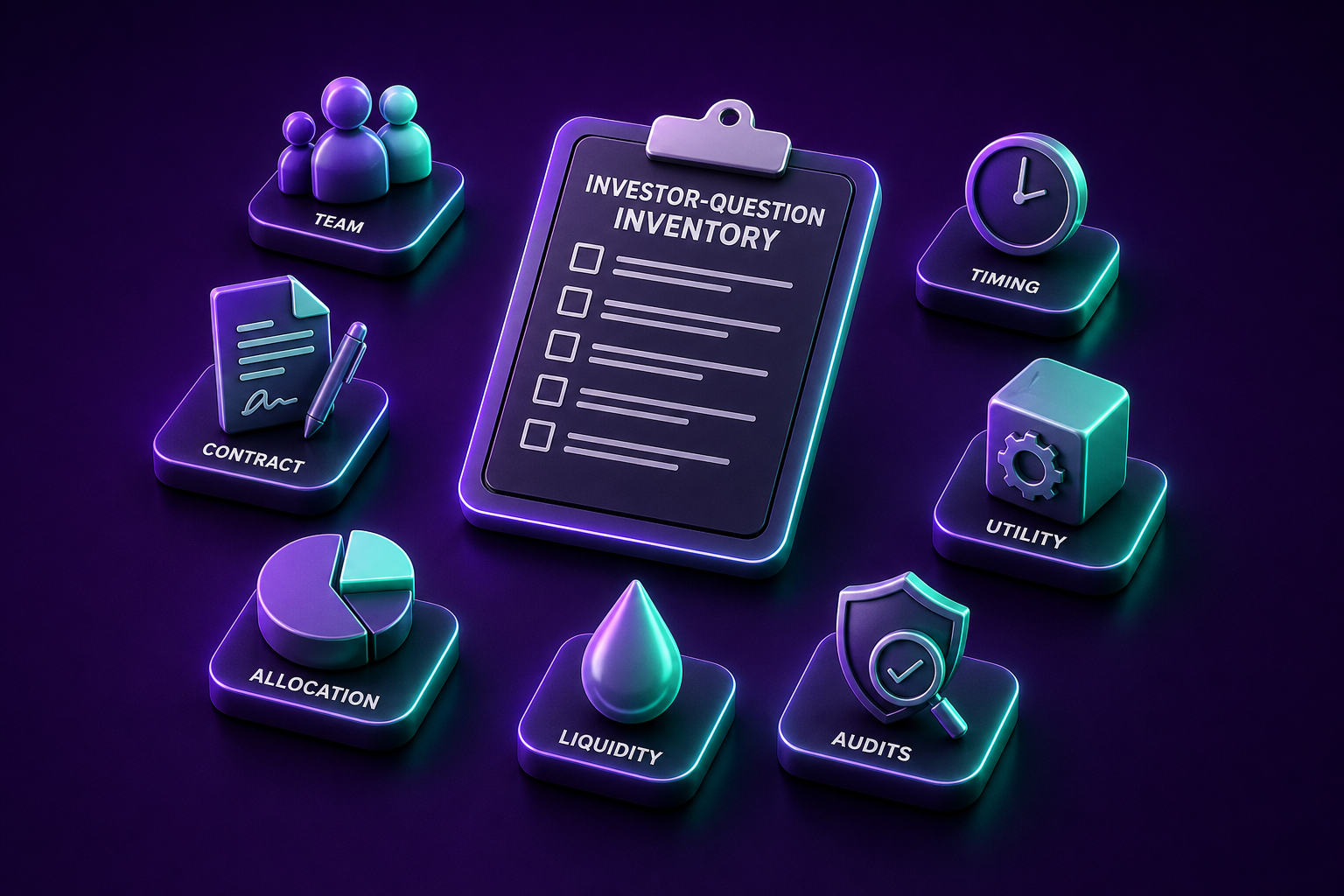
Start by writing down the question, not the answer. Every presale that has faced real public scrutiny gets the same shortlist asked in roughly the same order.
If you cannot answer all seven in one sitting, that's the actual gap in your marketing, not a copywriting problem. Here is the inventory that recurs across team Discords, X threads and investor due-diligence checklists:
- Team — who are they, and is that identity verifiable or deliberately withheld?
- Contract — is it verified on-chain, and what functions does it expose?
- Allocation — who holds what percentage, and on what vesting schedule?
- Liquidity — is it locked, with whom, and for how long?
- Audits — has one happened, by whom, and what did it actually find?
- Utility — what does the token do on day one, not eventually?
- Timing — why now, and what happens to the schedule if conditions change?
Every one of those seven is a legitimate question a careful buyer should ask regardless of how strong your project is. Treating them as attacks to deflect, instead of an inventory to answer, is the single most common mistake in presale marketing, and it is entirely avoidable.
Map Each Concern to Evidence
Each answer needs four things attached: a primary source, a date, a named owner, and a stated scope. Drop any one of those four and the answer reads as marketing copy no matter how honest it actually is.
A primary source means the audit report itself, the block explorer link, the multisig address — not a summary your own team wrote. A date matters because crypto token sale due diligence information decays fast, and an undated claim reads to a skeptical buyer as either stale or evasive.
A named owner means a specific person or firm responsible for the fact being true, so a reader can trace it back to someone accountable. Scope is the piece almost every presale page quietly skips: saying plainly what a claim covers and what it doesn't.
Here's an example of how that mapping should look on an evidence page:
| Concern | Claim | Source | Date | Owner | Scope |
| Liquidity | LP tokens locked 12 months | Lock contract address, block explorer link | 2026-09-01 | Project treasury multisig | Covers LP withdrawal only, not minting or transfer-tax changes |
| Audit | Smart contract audited | Full audit report, firm name | 2026-08-15 | Audit firm | Covers contract logic reviewed at that commit hash only |
| Allocation | Team holds 15%, 24-month vesting | Vesting contract address | 2026-08-20 | Project treasury multisig | Does not cover advisor or marketing wallets |
That last column is where most teams flinch, because stating scope means admitting what a claim does not prove. State it anyway.
A buyer who sees the limitation written down trusts the rest of the page more, not less, and that trade-off is the entire case for this approach over reassurance copy.
Explain Technical Controls in Plain Language
Describe what a control actually does before you claim what it prevents. A multisig means several named keyholders must approve a transaction before it executes, which stops a single compromised key from draining funds. It says nothing about whether those keyholders are trustworthy or independent of one another, and your copy should say that part too.
A pause function lets the team freeze contract activity in an emergency, useful against an active exploit and also a power that could be misused, so disclose who can trigger it and under what conditions. Vesting locks team and investor tokens to a release schedule, preventing an immediate dump at listing — but only for the wallets actually written into the vesting contract.
Undisclosed wallets outside it carry none of the same promise, and a presale's crypto presale marketing Locked Liquidity, Vesting & Audits page should say so directly. Contract verification means the deployed bytecode matches publicly published source code, so anyone can read what the contract actually does rather than trust a description of it. None of these controls is a guarantee of good behavior; each is a mechanism with a specific, limited job.
Liquidity locks are the clearest case of a control oversold as a guarantee. Academic analysis of rug-pull mechanics found that reliable locks typically run a minimum of six months through a third-party platform, while scam projects frequently use self-written locking contracts or skip the lock entirely and drain the pool in one transaction.
Even a genuine, long-duration lock only stops that one withdrawal mechanism. Separate research on rug-pull detection notes that projects which never lock liquidity can simply burn LP tokens and exit whenever they choose, which is the baseline risk a lock is designed to remove, and nothing more.
Publish Limitations Visibly
State what is not yet true in the same place you state what is. This is the section competing presale pages skip almost entirely, and it is also the one that does the most to earn trust, because a page with zero limitations reads as either brand new or dishonest.
If an audit has found issues, say so, with severity attached. CertiK's own published methodology classifies findings into severity tiers from Critical to Informational, and states plainly that critical risks must be resolved before launch and that users should not invest where a critical risk remains open.
An acknowledged Medium or Minor finding with a documented remediation plan isn't a red flag; it's a sign the audit was real. A Critical finding marked "acknowledged" with no resolution date is the actual warning sign, and it's one most retail buyers can't read correctly without you explaining what the scale means.
Say plainly where allocation is still provisional, where a partnership is in negotiation rather than signed, or where a roadmap date is a target rather than a commitment. A limitations section isn't a legal disclaimer bolted to the footer — it's a living part of the same page that makes every other claim on it more believable.
Keep the Hub Current
A change log is the single feature that separates a Trust & Safety hub from a one-time PDF nobody revisits. A hub that looks identical in month three is a tombstone in disguise, and skeptical buyers notice a stale page faster than they notice a missing one.
Every update to an audit status, a vesting schedule or an allocation figure gets a dated entry. Every version of the evidence page carries a version label so a returning buyer can see exactly what changed since they last looked.
Add a correction route too: a visible way for a buyer or auditor to flag an error, and a commitment to how fast you'll respond. This matters more as the backdrop gets worse rather than better.
FBI data shows crypto-related losses reaching $11.3 billion in 2025 against total FTC fraud losses of $15.9 billion that year. The CFTC separately reported crypto ATM scam losses climbing to over $388 million, up 58% year over year.
If your presale sells into the EU, there's a regulatory template worth borrowing even if you aren't required to follow it. Legal analysis of MiCA's white paper rules describes an obligation to disclose issuer identity, the project built with the capital raised, and associated risks, published a minimum lead time before the offer opens.
You don't need to be an EU issuer to copy the structure, and our MiCA and Presale Marketing guidance covers it in more depth: identity, mechanism, use of proceeds, risk, and rights, all dated and versioned.
None of this replaces a proper legal review of your own crypto project risk disclosure, and a hub this detailed takes real coordination between legal, technical and marketing teams inside an eight-week runway. That coordination cost is real, and it's the trade-off for a page that holds up under scrutiny instead of folding the first time someone asks a hard question in your Discord.
Conclusion
A presale evidence map works when every recurring question has a source, a date, an owner and a scope attached, published somewhere the buyer can find without asking. That's the entire method, and none of its seven steps costs more than the reassurance copy it replaces.
Use this as a pre-launch checklist:
- [ ] Team, contract, allocation, liquidity, audit, utility and timing questions all answered somewhere on the site
- [ ] Every claim carries a primary source, a date, a named owner and a stated scope
- [ ] Technical controls described by function, not oversold as guarantees
- [ ] A visible limitations section naming what is not yet final or audited
- [ ] A change log and version label on the evidence page itself
- [ ] A correction route for buyers or auditors to flag errors
Coinpresso hasn't yet published its own before-and-after data on how a hub like this moves bounce rate or time-on-page for a client presale, and we won't claim a lift we haven't measured. What we can say, from building the messaging architecture behind crypto presale marketing launches, is that the structure above is the one that survives a skeptical Discord thread at 2am the night before your presale opens, which is the only test that actually counts.
Ask Coinpresso to turn presale due diligence concerns into a verifiable Trust & Safety content system before launch, not after the first hard question lands in your replies.
FAQs
Which presale red flags should a project address first?
Start with liquidity, audit status and allocation, because those three generate the most unprompted questions in any presale Discord or X thread. Publish a dated, sourced answer for each — lock contract address, full audit report with severity tiers, and vesting contract address — before you spend a pound on crypto PPC to drive traffic toward a page that can't yet answer them.
Can a project market an anonymous team responsibly?
Yes, but anonymity has to be disclosed as a stated limitation rather than quietly omitted, with everything else on the page — contract, audit, allocation, liquidity — made fully verifiable to compensate. Our crypto PR for Anonymous Teams resource covers the specific disclosure language that works for pseudonymous founders; an anonymous team with a weak evidence map reads as a red flag, while an anonymous team with a strong one usually doesn't.
How should audit findings be communicated?
Publish the full report with its severity tiers intact, not a one-line "audited" badge. An acknowledged Medium or Minor finding with a remediation plan signals a genuine audit; a Critical finding left open with no resolution date is the actual warning sign, and most retail buyers can't tell the difference unless your copy explains the scale.
Does locked liquidity remove all risk?
No. A liquidity lock stops one specific exit — LP withdrawal — and says nothing about minting functions, blacklist controls, transfer-tax changes or insider token dumps through other wallets. Treat it as one entry in a wider evidence map, not a standalone safety guarantee, and check our case studies for how that distinction plays out across different token structures.
What belongs on a presale Trust & Safety page?
Seven answered questions — team, contract, allocation, liquidity, audits, utility, timing — each with a primary source, a date, a named owner and a stated scope, plus a visible limitations section and a change log. Contact Coinpresso if you want a second set of eyes on which of those seven your current site actually answers.